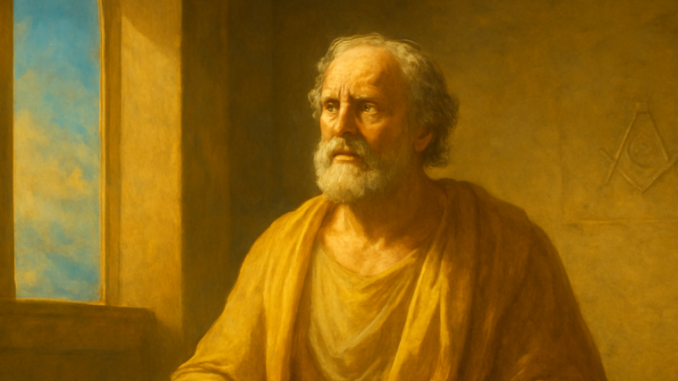
Perhaps you’ve caught a glimpse of those first grey hairs in the mirror, or felt that quiet moment when your body reminded you that time never stands still. Nearly two thousand years ago, the Roman Stoic philosopher Seneca wrote a letter to his friend Lucilius about this very experience. In his twelfth letter from the collection known as Letters to Lucilius, Seneca confronts us with the inevitability of aging — yet does so with a surprising lightness and depth of wisdom that still resonates today.
The Occasion: A Visit to a Crumbling Estate
Seneca opens his letter with a personal anecdote. He visits his country estate outside Rome and finds it in a state of decay. The caretaker, Felicio — a slave Seneca had known since childhood — has become an old man, barely recognizable. This moment of recognition sparks a deeper reflection: if Felicio has aged so visibly, what does that say about Seneca himself?
The crumbling estate and the aged Felicio become mirrors of Seneca’s own mortality. He describes how the plane trees he once planted as saplings have grown into mature trees with bare, weathered branches. Time has done its work — unnoticed, yet relentless. These vivid, concrete images make the abstract notion of impermanence tangible and deeply relatable.
The Central Insight: Acceptance Without Bitterness
What makes this letter so remarkable is Seneca’s attitude toward aging. He does not complain, he does not resist — he accepts. This is the essence of Stoic philosophy: we cannot change the course of nature, but we can determine how we respond to it. Seneca invites Lucilius to welcome old age as a natural part of life, not as an enemy to be fought.
Old age is not an adversary to be defeated, but a teacher reminding us of the value of each day.
He compares life to a fruit ripening on the tree. Just as an apple falls at the right moment, so too does human life reach its natural completion. This process does not signify loss — it signifies fulfillment. The Stoic sees in aging not a cause for despair, but an invitation to gratitude for the years that have been lived.
The Symbolism of the Decaying House and the Inner Temple
The image of the crumbling estate carries a rich symbolic weight — one that resonates particularly well with Freemasonry. In the Masonic tradition, the rough ashlar must be shaped into a perfect cube through patient, dedicated labor. The aging body, slowly wearing down, can be understood as the exterior of a temple under construction. The true value lies not in the outer walls, but in what is being built within: character, wisdom, and inner strength.
Seneca’s observations about his decaying estate reflect this very insight. Physical decline is inevitable, but the inner self can continue to grow. Where the body weakens, the spirit may become stronger. This idea bridges Stoic philosophy and the symbolic journey at the heart of Freemasonry: the continuous work on the inner temple, regardless of the condition of the outer structure.
For Freemasons, this parallel is profound. The work upon the rough stone is never truly finished, and the passage of time does not diminish its importance — it deepens it. As the physical edifice ages, the brother who has labored faithfully on his inner temple finds that his most enduring work is not visible to the eye, but felt in the quality of his character and the depth of his understanding.
Every Day as a Complete Life
One of the most powerful lessons in Letter XII is Seneca’s vision of how we should approach each day. He advises Lucilius to live every day as though it were a complete life in itself. In the morning we are born, in the evening we die, and in between lies the opportunity to live fully.
This perspective liberates us from the fear of death. Those who view each day as a complete whole need not fear what comes next. Seneca cites the Greek philosopher Heraclitus, who said that one day is equal to every day. What you can learn about life in a single day, you need not spend a lifetime repeating.
This daily awareness — the conscious effort to live well within the span of a single day — mirrors the Masonic practice of regular self-examination. At the close of each day, the thoughtful Mason asks: have I lived well? Have I contributed to the building of something greater than myself?
Practical Wisdom for Daily Life
Seneca’s letter is not mere philosophical abstraction. It offers practical guidance that any reader can apply:
Embrace aging as a season of wisdom. Rather than denying or lamenting the passage of years, recognize old age as a phase in which deeper understanding becomes possible.
Close each day with intention. Ask yourself every evening: did I live well today? This simple habit cultivates gratitude and presence.
Replace the fear of death with gratitude for life. The dread of endings dissolves when we truly appreciate what we have been given.
Accept physical decline while investing in inner growth. The body will age, but the mind and spirit can continue to develop — and this inner work is the most meaningful labor of all.
These insights are not only for those who already feel age approaching. Younger readers stand to benefit just as much: by practicing acceptance and gratitude now, you prepare yourself for the later stages of life with greater resilience and peace.
The Timeless Relevance of Seneca’s Message
In a culture that glorifies youth and often marginalizes old age, Seneca’s voice stands as a powerful counterweight. He reminds us that life does not become less valuable as we grow older — on the contrary. The experience of aging brings a clarity that youth simply cannot possess.
For those drawn to the pursuit of self-knowledge and personal development — whether through Freemasonry, philosophy, or both — Letter XII offers a treasury of insight. It invites serious self-reflection: how do you relate to your own mortality? What are you building within, even as the outer form inevitably changes?
Seneca’s twelfth letter to Lucilius is far more than a philosophical essay on growing old. It is an invitation to embrace life in all its phases, to approach each day as a gift, and to direct our most earnest labor toward what is of lasting value: the inner self. In a world often fixated on appearances and the fleeting, Seneca calls us back to what truly matters. The question he places before us is simple yet profound: are you living today the way you would want your whole life to look?
Copyright text & image: devrijmetselaar.nl
Texts are based on the ideas and content of the author of devrijmetselaar.nl, reviewed, corrected, and supplemented with the assistance of OpenAI. Images are created based on the ideas of the author of devrijmetselaar.nl using OpenAI/DALL-E.
Frequently Asked Questions
What is the main theme of Seneca's Letter XII?
Seneca's Letter XII explores aging as an inevitable and natural part of life that should be accepted with wisdom rather than resistance. Through the anecdote of visiting his decaying estate and encountering his aged childhood caretaker Felicio, Seneca reflects on mortality and invites his friend Lucilius to view old age not as an enemy, but as a teacher that reminds us of life's value and leads to inner growth and gratitude.
What Stoic philosophy principle does Seneca emphasize in this letter?
Seneca emphasizes the core Stoic principle that while we cannot change the course of nature and the inevitability of aging, we can control how we respond to it. He advocates for acceptance without bitterness, comparing life to fruit ripening on a tree—a natural process that signifies fulfillment rather than loss. This teaches us to find peace through acceptance rather than resistance.
How does Seneca use symbolism in Letter XII, particularly regarding Freemasonry?
Seneca uses the symbolism of the crumbling estate and aged caretaker to represent the outer decay of the body as one ages. This imagery resonates with Freemasonic tradition, where the rough ashlar must be shaped into a perfect cube through dedicated labor. Similarly, the aging body represents the exterior of a temple under construction, with true value lying in the inner spiritual development and wisdom gained through the aging process, not in external physical form.



Be the first to comment