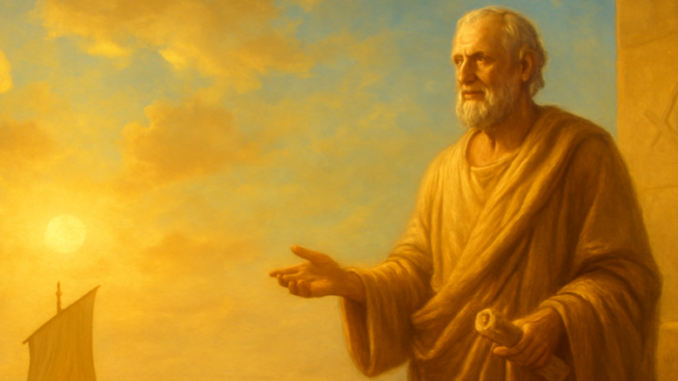
What does it truly mean to practice philosophy? Is it enough to read books and collect wise quotations, or does the love of wisdom demand something far more fundamental? In his sixteenth letter to Lucilius, Lucius Annaeus Seneca explores these questions with the directness and warmth that define his celebrated correspondence. This letter reveals why philosophy cannot remain an intellectual hobby — it must become a compass for daily action.
What Is the Central Question of This Letter?
Seneca opens with an observation that still resonates nearly two thousand years later: many people claim to be philosophers, yet their lives tell a different story. They can quote Plato and recite the doctrines of the Stoics, but the moment fate tests them, they fall prey to the same fears and desires as everyone else. The central question Seneca poses is therefore not “what do you know?” but “how do you live?”
This distinction between knowledge and practice forms the heart of Letter XVI. Seneca argues that philosophy only acquires real value when it shapes character and directs action. A philosopher who fails to embody his own principles is like a physician who cannot heal himself. Philosophy, as Seneca puts it, must be our guide — not our trophy case.
Why Consistency Matters Above All
One of the most powerful passages in this letter addresses the necessity of consistency. Seneca warns Lucilius against people who speak virtuously one day and act out of greed the next. Such inconsistency betrays a philosophy that has only been absorbed at the surface — like paint that washes off in the first rain.
Philosophy is not decoration for the mind; it is a foundation for action.
True wisdom, Seneca argues, manifests in a life that aligns with what one claims to believe. This requires daily practice, honest self-examination, and the courage to face one’s own shortcomings. The philosopher must be willing to start over again and again, to dig deeper each time, and to become ever more honest with himself.
The Analogies Seneca Uses
To illustrate his point, Seneca reaches for comparisons that would have spoken directly to his contemporaries. He describes a sailor who studies the art of navigation but never takes the helm — when the first storm arrives, he is lost. Knowledge without application offers no protection when life puts us to the test.
He also draws on the practice of athletes. No wrestler grows strong merely by reading about strength training. The body must be exercised, the muscles must endure pain before they develop power. The same is true of the soul: it must be tested by real challenges before it can demonstrate virtue.
How This Connects to Freemasonry
Freemasonry has a rich tradition of working tools that serve as symbols of inner development. The compasses and the square are not mere decorative emblems — they point to the ongoing work of refining one’s own character. Just as Seneca sees philosophy as a guide for action, Freemasonry regards its rituals as directions for moral formation.
The rough ashlar that must be shaped into a perfect cube mirrors exactly what Seneca describes in Letter XVI. It is not enough to know that you need to work on yourself — the gavel must actually be wielded. Every blow represents a moment of self-examination, a choice to restrain the lower self in service of a higher ideal.
What Can We Learn From This?
The lesson of Letter XVI is as simple as it is demanding: wisdom calls for embodiment. In an age where information is abundantly available, Seneca reminds us that knowledge without application remains hollow. The question is not how many philosophical works we have read, but how much of that wisdom is visible in our everyday conduct.
For the Freemason, this means that wearing the apron and gloves is only the beginning. The real labor takes place when you leave the lodge and return to ordinary life. It is there — in interactions with colleagues, family, and strangers — that it becomes clear whether philosophy truly serves as a guide or merely as a fine garment.
- Philosophy must direct action, not merely feed the intellect.
- Consistency between word and deed reveals true wisdom.
- Practice and trials are indispensable for building character.
- Symbols and rituals gain meaning only through daily application.
Letter XVI invites an honest conversation with yourself. Am I the person I claim to be? Do my actions match my convictions? These questions are not meant to wound but to heal. Seneca writes not as a stern schoolmaster but as a friend who knows the same struggle and shares the same hope. Nearly two millennia later, his invitation to practice philosophy as an art of living — to embody wisdom rather than merely collect it — speaks to the very heart of what Freemasonry also pursues. Whether you gather in a lodge or quietly study Stoic texts on your own, the challenge remains the same: to shape your life according to a higher ideal, blow by blow, day by day.
Copyright text & image: devrijmetselaar.nl
Texts are based on the ideas and content of the author of devrijmetselaar.nl, reviewed, corrected, and supplemented with the assistance of OpenAI. Images are created based on the ideas of the author of devrijmetselaar.nl using OpenAI/DALL-E.
Frequently Asked Questions
What is the main difference between theoretical philosophy and practical philosophy according to Seneca?
Seneca argues that philosophy must go beyond intellectual knowledge and quotations to become a guide for daily action. He emphasizes that true philosophy is not about what you know, but how you live. Simply reading books and collecting wise sayings is insufficient; philosophy must shape character and direct behavior. A philosopher who fails to embody his own principles is like a physician who cannot heal himself, making the distinction between knowledge and practice the heart of his argument.
Why does Seneca emphasize consistency in philosophical practice?
Seneca warns against inconsistency between words and actions, comparing surface-level philosophy to paint that washes off in the first rain. He argues that true wisdom requires aligning one's life with one's stated beliefs through daily practice, honest self-examination, and willingness to face one's shortcomings. Consistency demonstrates that philosophy has been deeply absorbed rather than merely adopted as mental decoration, and it requires continuous effort and recommitment.
What analogies does Seneca use to explain why knowledge alone is insufficient?
Seneca uses two primary analogies: a sailor who studies navigation but never takes the helm will be lost in the first storm, and a wrestler who only reads about strength training will never grow strong. Both examples illustrate that knowledge without application offers no protection when life tests us. Just as the body must be exercised to develop strength, the soul must practice virtue through action to develop wisdom.



Be the first to comment