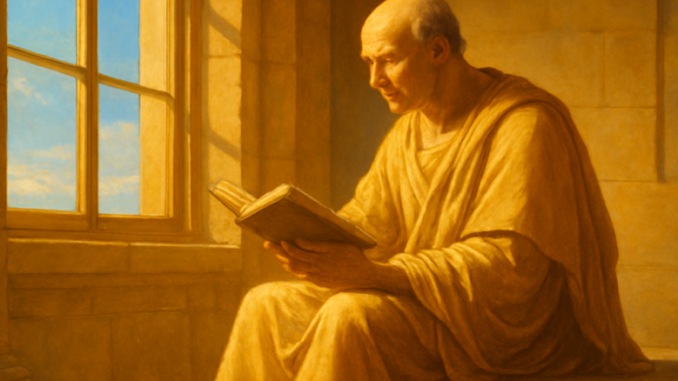
A book lies open on a table. Not just any book, but a source of stillness amid the noise of the world. Lucius Annaeus Seneca wrote his second letter to Lucilius on the art of reading and the pursuit of inner peace. What appears at first glance to be practical advice about choosing books unfolds into a profound meditation on the human mind. The philosophical roots of this letter reach well beyond the Stoic school alone — they touch on traditions that would find resonance centuries later in the symbolic workshops of Freemasons.
The Stoic Ground on Which Seneca Built
Seneca’s thinking is firmly rooted in Stoic philosophy, founded by Zeno of Citium around 300 BCE. This school taught that true freedom arises when the mind detaches itself from external circumstances and focuses on what truly lies within reach: one’s own thoughts, judgments, and reactions. In Letter II, Seneca translates this principle into the practice of reading. He warns against accumulating many books without genuine depth. A mind that leaps from text to text finds no anchor.
The Stoic tradition recognized a threefold division of philosophy: logic, physics, and ethics. Seneca concentrated almost exclusively on ethics — on the practical question of how to live. Chrysippus and Cleanthes, his philosophical forebears, had developed elaborate systems. Seneca took from them what was useful and discarded what struck him as overly theoretical. The book, in his view, was an instrument for self-improvement, not a collector’s item for the vain mind.
Epicurus as an Unexpected Ally
One of the most striking features of Seneca’s letters is his willingness to draw wisdom from rival schools. In this second letter, he quotes Epicurus — a philosopher whose teachings most Stoics rejected outright. Epicurus taught that happiness resides in ataraxia, a state of imperturbability achieved by avoiding unnecessary desire. Seneca recognized in this teaching a kinship with the Stoic ideal of apatheia — freedom from destructive emotions.
True peace of mind comes not from reading widely, but from reading deeply and transforming what is read into personal wisdom.
This readiness to cross philosophical boundaries makes Seneca an eclectic thinker. He judges ideas not by their origin but by their usefulness for the good life. It is an attitude any Freemason will recognize: the lodge is not a place of dogmatic rigidity but a workshop where wisdom from many sources converges. Just as Seneca refused to confine himself to one school, the Masonic tradition draws on a rich tapestry of philosophical, spiritual, and moral teachings to illuminate the path of self-improvement.
The Book as a Symbolic Working Tool
When Seneca writes about books, he is not merely discussing papyrus scrolls. The book becomes a symbol of a deeper truth: the mind requires nourishment, but the nature of that nourishment determines whether it leads to health or sickness. A person who endlessly consumes without digesting poisons himself. Here, Seneca touches on insights that Plato also shared in his dialogues on education and the formation of the soul.
The symbolism extends further. In Freemasonry, the rough ashlar is the starting point of labor — raw material that must be patiently shaped into a more perfect form. Seneca’s book functions in much the same way. What matters is not the volume of knowledge one accumulates, but the degree to which that knowledge is worked, refined, and integrated into daily conduct. Reading without application is like hammering at stone without purpose or plan.
The Influence of Posidonius and Middle Stoicism
Seneca’s philosophy was also shaped by Middle Stoicism, a movement that softened the severity of the early Stoa. Panaetius and Posidonius brought Stoic ideas into dialogue with the Platonic tradition and with insights from rhetoric. Posidonius, in particular, emphasized the unity of body and mind and the influence of emotions on thought. From him, Seneca inherited a psychological sensitivity that resonates throughout Letter II.
Peace of mind, Seneca writes, is not a given but an achievement. It demands practice, discipline, and proper mental hygiene. This insight connects him to later thinkers like Marcus Aurelius, who likewise recorded his meditations in written form. The tradition of philosophical self-examination through the written word has a long history, and Seneca stands at a pivotal point within it.
Inner Peace as Inner Architecture
The mind Seneca describes is no passive receiver but a master builder. Every thought that is admitted, every book that is read, becomes building material for the inner temple. The Freemason who works his rough stone performs the same labor in symbolic form. The square measures the accuracy of the work; for Seneca, that measuring instrument is ratio — the faculty of reason that distinguishes what is valuable from what merely distracts.
Seneca’s core principles in Letter II can be distilled into four essential practices. First, selectivity: choose few but valuable sources. Second, depth: return to the same texts until they become part of you. Third, application: knowledge without practice is dead letter. And fourth, stillness: a well-nourished mind knows quiet.
These principles form the heart of Seneca’s message. They are rooted in the Stoic tradition but transcend it through their universal applicability. Any seeker of wisdom, regardless of school or tradition, can find direction in them. The philosophical background of this brief text reveals, upon closer examination, an entire landscape: Athenian gardens, Roman porticos, and the silent workshops where brethren, centuries later, would continue the same labor.
Seneca’s second letter is far more than reading advice. It is an invitation to regard one’s own mind as a structure in progress — nourished by carefully chosen sources, shaped by repetition and depth. The Stoic, Epicurean, and Platonic influences that converge in this text all point to the same truth: inner peace is not a matter of chance but the result of conscious, deliberate work. For the Freemason who picks up his symbolic tools each time he enters the lodge, Seneca’s ancient wisdom carries an unmistakable resonance. The rough stone awaits, and the book — read with patience, depth, and purpose — remains one of the finest chisels available to shape it.
Copyright text & image: devrijmetselaar.nl
Texts are based on the ideas and content of the author of devrijmetselaar.nl, reviewed, corrected, and supplemented with the assistance of OpenAI. Images are created based on the ideas of the author of devrijmetselaar.nl using OpenAI/DALL-E.
Frequently Asked Questions
What is the main theme of Seneca's Second Letter to Lucilius?
Seneca's Second Letter focuses on the art of reading and the pursuit of inner peace. Rather than accumulating many books, Seneca emphasizes reading deeply and with genuine engagement. He argues that the mind needs an anchor and that books should serve as instruments for self-improvement and personal transformation, not as status symbols for vanity.
How does Seneca use Stoic philosophy to address the practice of reading?
Seneca applies the core Stoic principle that true freedom comes from detaching the mind from external circumstances and focusing on what lies within one's control—thoughts, judgments, and reactions. He translates this into practical advice about reading, warning against jumping from text to text without depth. This approach reflects the Stoic emphasis on ethics and practical living over abstract theory.
Why does Seneca quote Epicurus, a rival philosopher, in his letter?
Seneca demonstrates an eclectic approach to wisdom by recognizing that Epicurus's concept of ataraxia (imperturbability through avoiding unnecessary desire) aligns with the Stoic ideal of apatheia (freedom from destructive emotions). Rather than adhering rigidly to one philosophical school, Seneca judges ideas by their usefulness for achieving the good life—an approach that mirrors Freemasonry's practice of drawing wisdom from many sources.


Be the first to comment