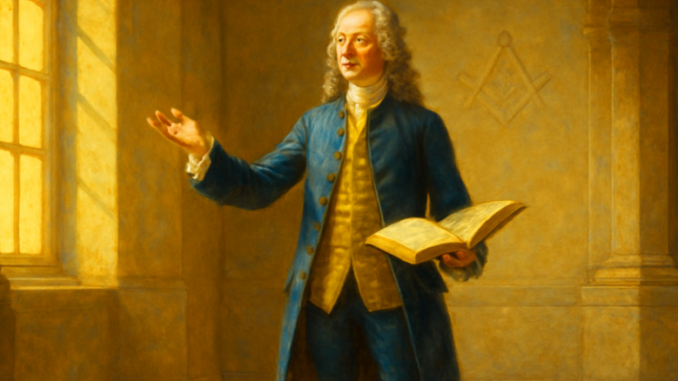
What do we actually mean when we say that all people are equal? Is it a fact, an ideal, or perhaps an illusion? In his celebrated Philosophical Dictionary, Voltaire tackles this question head-on. His entry on equality is a masterwork of nuance, irony, and intellectual precision. For Freemasons — who meet as Brothers on equal footing within the Lodge — this essay remains strikingly relevant. Let us engage in conversation with this great Enlightenment philosopher.
What Exactly Does Voltaire Write About Equality?
The entry on “Equality” in Voltaire’s Philosophical Dictionary is anything but a dry definition. It is a vivid, carefully crafted argument. Voltaire opens with a deceptively simple observation: all human beings are born with the same basic needs. Hunger, thirst, the drive to reproduce, the same organs. So far, equality seems self-evident. But then comes the twist. Voltaire asks aloud: if we are so equal, why do we live so unequally?
He describes how society generates inequality. Some own land, others do not. Some rule, others serve. The philosopher dissects this reality not with moral outrage but with cool analysis. His central thesis is that absolute equality is impossible in any organized society — yet this does not release us from the obligation to pursue reasonableness and justice.
The Core of Voltaire’s Argument
Voltaire draws a crucial distinction that remains relevant today. He separates natural equality from social inequality. In nature, he argues, human beings are indeed equal in their dependence on food, shelter, and companionship. No one is born with a crown on their head or a scepter in their hand. This is biological reality.
“Equality is the most natural and yet the most illusory concept known to humanity — for nature makes us equal, and society makes us unequal.”
But the moment people organize themselves into communities, inequality emerges. Leaders are needed, as are workers, thinkers, and executors. Voltaire argues that this is not inherently wrong, as long as inequality does not degenerate into tyranny or oppression. The problem is not that kings exist, but that kings forget they are nothing without their subjects.
Voltaire’s Masterful Use of Irony and Example
With his trademark irony, Voltaire paints several vivid scenarios. He describes the poor farm laborer who toils his entire life while a prelate lives in luxury off the fruits of other people’s work. Is this just? Voltaire does not pass direct judgment — he lets the contrast speak for itself. The reader draws their own conclusions.
Particularly striking is his comparison with dogs. He observes that even among dogs inequality exists: some are the king’s hunting hounds, others are strays fighting over a bone. Yet we would never say that one dog is more of a “dog” than another. The same applies to people: inequality of circumstance changes nothing about the fundamental humanity we all share.
What Does This Have to Do with Freemasonry?
This is where Voltaire’s essay truly begins to resonate for Freemasons. In the Lodge, Brothers come together who hold very different positions in the outside world. One may be a banker, another a carpenter. One highly educated, another skilled with their hands. But within the Lodge, a different principle prevails: all Brothers meet as equals. The Level — one of the most important symbols in Freemasonry — embodies precisely this ideal.
The Level reminds us that beneath all our social differences lies a shared humanity. Just as Voltaire argues that natural equality is the foundation upon which social inequality rests, the Level symbolizes that brotherhood begins with the recognition of fundamental human worth. This is not naive egalitarianism but a deliberate choice to look beyond titles and possessions.
Why This Essay Still Matters Today
Voltaire’s analysis is not utopian dreaming about a world without differences. He acknowledges the reality of inequality but holds firm to a moral compass. His message is not that we should erase all distinctions, but that we must respect the dignity of every human being regardless of their station. This ethical stance echoes across the centuries.
For Freemasons, this essay provides a philosophical foundation for what they practice in the Lodge. It is not about denying the outside world, but about creating a space where different values take precedence. A space where the question is not “What do you have?” but “Who are you?” — and ultimately: “How can you contribute to the greater whole?”
What Can We Learn from Voltaire’s Reflection?
Voltaire’s entry on equality is an invitation to self-reflection. It challenges us to look critically at the inequalities we take for granted. At the same time, it warns against simplistic solutions. Equality is not a condition you can impose — it is an attitude you can cultivate. It begins with recognizing that the other person, however different they may be, possesses the same fundamental humanity as yourself.
Consider these key takeaways from Voltaire’s essay:
- Natural equality serves as the foundation for human dignity.
- Social inequality is inevitable but must be kept in check.
- The Level in Freemasonry symbolizes equality of worth, not uniformity.
- An ethics of respect transcends differences in rank and position.
Voltaire’s essay on equality is far more than a historical document. It is a mirror that reflects how we deal with difference. For Freemasons, who use the Level as a symbol of equal worth, it offers philosophical depth to an everyday practice. The question Voltaire poses continues to ring out: not whether we are equal, but how — despite our differences — we can treat one another as equals. That is not an illusion. It is a choice. And it may be the most important choice we can make as human beings.
Copyright text & image: devrijmetselaar.nl
Texts are based on the ideas and content of the author of devrijmetselaar.nl, reviewed, corrected, and supplemented with the assistance of OpenAI. Images are created based on the ideas of the author of devrijmetselaar.nl using OpenAI/DALL-E.

Be the first to comment