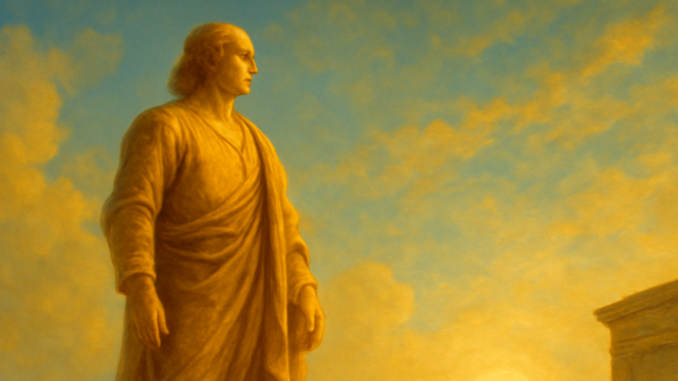
In 1752, Voltaire published a remarkably short story that continues to captivate philosophers and readers to this day. Micromégas tells the tale of an enormous being who descends from the stars to visit Earth and encounters humanity. What Voltaire achieved with this seemingly lighthearted adventure was nothing less than a radical reassessment of our human self-image — a philosophical fairy tale that forced his contemporaries to reconsider their assumed greatness. For Freemasons, the story holds a particular resonance: humility and self-knowledge stand at the very heart of the Masonic tradition.
A Giant from Sirius Visits Earth
The story opens with the introduction of Micromégas, an inhabitant of a planet orbiting the star Sirius. This being stands an astonishing 120,000 feet tall — a height utterly beyond our comprehension. Voltaire describes how Micromégas travels the universe driven by scientific curiosity and philosophical inquiry. Along the way, he meets a resident of Saturn who, at 6,000 feet, is considerably smaller but still gigantic by earthly standards.
Together, these two beings journey to our planet. When they reach Earth, they initially see nothing remarkable. The oceans appear as tiny puddles, the mountains as insignificant hillocks. Only after a lengthy search, using a magnifying glass fashioned from a diamond, do they discover minuscule creatures aboard a ship: human beings. This moment of discovery forms the philosophical heart of Voltaire’s story.
The Core of Voltaire’s Message
Voltaire uses the extreme differences in scale not merely for entertainment but as a philosophical instrument. Micromégas is astonished that these tiny creatures can think, reason, and philosophize. The humans on the ship turn out to be scholars returning from a scientific expedition to the Arctic Circle. They engage the giants in discussions about philosophy, science, and the nature of the soul, referencing the thought of Aristotle, Descartes, Leibniz, and Locke.
True greatness, Voltaire suggests, lies not in physical dimensions or earthly power, but in the capacity for self-reflection and the recognition of one’s own limitations.
The conversation reaches its climax when a follower of scholastic philosophy claims that the entire universe — stars, planets, and all — was created solely for the benefit of mankind. Micromégas and his companion burst into laughter at this staggering arrogance. Through this scene, Voltaire targets the anthropocentrism that still dominated both religious and philosophical circles in his era.
The Historical Context Behind the Story
Voltaire wrote Micromégas during a period when the Enlightenment was transforming Europe. The scientific revolution, set in motion by figures such as Newton and Galileo, had definitively dismantled the geocentric worldview. Earth was no longer the center of the universe — it was merely one of many celestial bodies in an immeasurable cosmos. These scientific insights provided the fertile ground for Voltaire’s satire.
The story was likely written around 1739 but published only later. During these years, Voltaire was in contact with scientists and philosophers across Europe. He was personally familiar with the work of Leibniz and corresponded with countless thinkers. The character of Micromégas may have been inspired by Jonathan Swift’s Gulliver’s Travels, but whereas Swift primarily offered social satire, Voltaire directed his gaze toward metaphysical and cosmological questions.
Striking Parallels with Masonic Principles
Freemasonry, which was a flourishing movement across Europe in Voltaire’s time, shares remarkable themes with this story. The concept of the rough ashlar that must be shaped into a perfect cube presupposes that every person begins in a state of imperfection. Self-knowledge and humility are the first steps on the path of personal development. Micromégas functions as a mirror, compelling us to confront our true position in the universe.
In the Masonic tradition, the starry canopy above the lodge symbolizes the infinity of the universe and the relative insignificance of human concerns. The square and compasses remind us of the need to measure and regulate our own conduct. Voltaire’s extraterrestrial visitors serve a strikingly similar function: they offer an external perspective that puts human pretensions into proportion — without denying the value of human thought itself.
The Blank Book: A Lesson That Still Resonates
At the story’s conclusion, Micromégas promises the human scholars a book containing all the answers to their philosophical questions. When this book is finally opened at the Paris Academy of Sciences, every page turns out to be blank. This climax carries the ultimate wisdom Voltaire wished to convey: some answers must be sought by ourselves, and perhaps definitive answers do not exist at all.
For today’s readers, this message remains strikingly relevant. In an age when technology grants us unprecedented capabilities and scientific knowledge grows exponentially, the temptation toward hubris can be immense. Voltaire’s story reminds us that knowledge and wisdom are not the same thing. The acknowledgment of what we do not know paradoxically forms the foundation of genuine insight. This principle — which traces back to Socrates and his famous declaration about knowing one’s own ignorance — finds a brilliant literary expression in Micromégas.
Key Themes at a Glance
Cosmic perspective: Humanity is a minute presence in an immeasurable universe. Critique of anthropocentrism: The universe does not revolve around mankind. Appreciation for reason: Despite our smallness, we possess the ability to think and reason. Intellectual humility: True wisdom begins with acknowledging our own ignorance. Relativism: Size, significance, and truth are all matters of perspective.
Voltaire’s Micromégas is far more than an 18th-century curiosity. It is a timeless philosophical parable that speaks directly to some of the most cherished principles of Freemasonry — the pursuit of self-knowledge, the cultivation of humility, and the recognition that our journey toward understanding is never complete. The blank pages of Micromégas’s book are not a sign of defeat; they are an invitation. They challenge us, as Masons and as thinking human beings, to keep searching, keep questioning, and never mistake the boundaries of our knowledge for the boundaries of what is real. In that spirit, Voltaire remains a brother in thought — reminding us that the greatest wisdom lies not in the answers we claim to possess, but in the questions we have the courage to ask.
Copyright text & image: devrijmetselaar.nl
Texts are based on the ideas and content of the author of devrijmetselaar.nl, reviewed, corrected, and supplemented with the assistance of OpenAI. Images are created based on the ideas of the author of devrijmetselaar.nl using OpenAI/DALL-E.

Be the first to comment