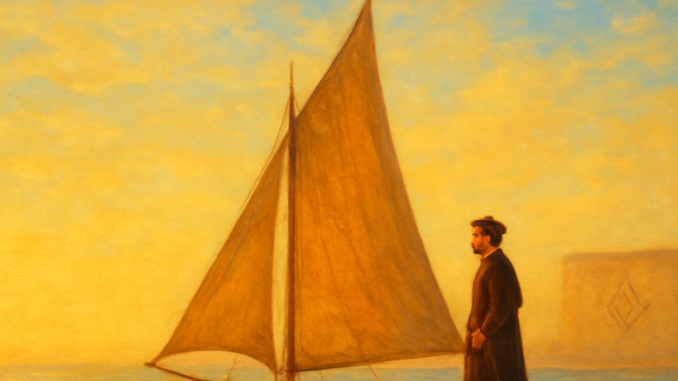
Can we truly prepare ourselves for death? Michel de Montaigne posed this question with striking clarity in his essay ‘Of Practice’ — the sixth essay of the second book of his famous Essays. What begins as a philosophical meditation on rehearsal and repetition takes an unexpected turn when Montaigne recounts a personal near-death experience. He discovers that death may be far less terrifying than we imagine, and that the body can teach us things the mind alone could never grasp. This essay marks a pivotal moment in Montaigne’s thinking: the point where abstract philosophy gives way to lived experience.
The Core Idea: Rehearsing for the Inevitable
‘Of Practice’ revolves around a deceptively simple question: to what extent can a person rehearse something that happens only once — namely, dying? Montaigne begins by engaging with the classical notion that philosophy is essentially a rehearsal for death, a thought that traces back to Plato and his account of Socrates’ final conversations. The Roman Stoics, particularly Seneca, likewise argued that a wise person keeps death constantly in mind in order to overcome the fear of it.
Montaigne embraces this tradition, but he adds a decisive caveat: theoretical preparation has its limits. No one can truly rehearse dying, because anyone who actually goes through it does not return to tell the tale. Philosophy can illuminate the idea of death, but it cannot replicate the experience. This tension between knowing and experiencing becomes the engine that drives the entire essay forward.
The Riding Accident: Where Philosophy and Experience Collide
Then comes the essay’s most remarkable passage. Montaigne describes how, during a horseback ride, he was struck by one of his own servants, who came galloping toward him on a much heavier horse. The impact was so violent that Montaigne was thrown unconscious from his mount and was believed dead for several minutes. His servants carried him home while he vomited, gasped, and showed barely any signs of life.
Slowly, his consciousness returned — but not as a sudden awakening. He describes a state of half-awareness: a curiously pleasant twilight zone in which he felt no pain, knew no fear, and surrendered to a kind of sweet numbness. This is the moment that gives the essay its extraordinary power.
Montaigne discovers that the boundary between life and death is not the sharp fracture we imagine it to be. Instead of an abyss, he experienced a gradual transition, almost comforting in its gentleness. He concludes that nature protects us at the very moment we need her most: consciousness fades precisely when the body suffers the greatest distress. Rather than the terrifying plunge into nothingness that philosophy had warned him about, he found something closer to a soft dissolution — an insight no book could ever have given him.
Two Ways of Knowing: The Philosopher and the Witness
The essay offers a fascinating comparison between two modes of understanding. On one hand, there is the philosophical tradition Montaigne knew intimately. Cicero, Seneca, and Epicurus had all written about death as something that could be conquered through rational insight. Train your mind, master your emotions, and death loses its sting. This perspective places its trust in the intellect as the primary instrument of preparation.
On the other hand, there is the experience Montaigne himself underwent. No book could have taught him what his body taught him during those moments of unconsciousness. The gentle, almost dreamlike state he found himself in was not the product of Stoic discipline. It was something that happened to him, beyond his will, and it was precisely in that involuntary surrender that the lesson lay.
Montaigne does not conclude that philosophy is useless — only that it remains incomplete without the supplement of lived experience. The two perspectives do not exclude each other. They complement one another like two eyes that together lend depth to what each one separately can only perceive as flat. True self-knowledge, Montaigne teaches us, does not arise from thinking alone, but also from living through what happens to us — especially in those moments when thinking falls silent.
The Honesty of the Self-Portrait
Another striking aspect of this essay is Montaigne’s remarkable candor about himself. He describes how, while half-conscious, he repeatedly fumbled with his clothing, mumbled incoherently, and how his body acted on its own while his mind had not yet returned. He offers no apology for these details. On the contrary, he insists that describing one’s own life — including its painful and embarrassing moments — is a legitimate and worthy undertaking.
Montaigne compares himself in this regard to Caesar and Alexander the Great, who also wrote about their own deeds, but he adds that unlike these generals, he is not recording his heroic exploits but his ordinary, fallible humanity. This passage constitutes an early defense of what we would now call autobiographical writing. Montaigne argues that knowing yourself — with all your weaknesses and contradictions — is a worthier goal than conquering cities.
It is a thought that would resonate through later centuries, notably in Jean-Jacques Rousseau’s Confessions, which pursued a similarly radical honesty. But Montaigne got there first, and he did it with a lightness of touch and absence of self-pity that remains refreshing to this day.
What This Essay Still Has to Tell Us
The power of ‘Of Practice’ lies in its rare combination of philosophical depth and personal vulnerability. Montaigne does not offer a definitive answer to the question of whether we can prepare for death. Instead, he shows us that the attempt to answer that question is itself valuable. Practice, the essay reveals, does not consist solely of repetition and discipline. It also consists of daring to acknowledge what has happened to us and seeking meaning in it.
For anyone engaged in personal growth and self-reflection — whether through philosophical study, contemplative practice, or the kind of inner work that traditions like Freemasonry encourage — this essay offers a lasting lesson. It reminds us that the most valuable insights do not always come from books or formal instruction, but sometimes from an unexpected fall from a horse, from a moment of complete surrender to the unknown.
Montaigne’s willingness to explore his own vulnerability, to let experience correct and deepen his intellectual convictions, stands as a model for anyone who takes the examined life seriously. The essay invites us not to abandon thought, but to remain open to the moments when life itself becomes the teacher — moments that arrive uninvited and leave us, if we are honest enough to receive them, profoundly changed.
Montaigne’s ‘Of Practice’ remains one of the most compelling essays ever written on the relationship between knowledge and experience. It challenges us to recognize that preparation for life’s most significant moments cannot be purely intellectual. The body knows things the mind does not; surrender teaches what control never could. For those who value self-knowledge — in philosophy, in Masonic reflection, or simply in the quiet work of becoming more fully human — Montaigne’s account of falling from a horse and drifting toward death offers an enduring and deeply humane reminder: the truest wisdom often arrives precisely when we stop trying to reach it.
Copyright text & image: devrijmetselaar.nl
Texts are based on the ideas and content of the author of devrijmetselaar.nl, reviewed, corrected, and supplemented with the assistance of OpenAI. Images are created based on the ideas of the author of devrijmetselaar.nl using OpenAI/DALL-E.

Be the first to comment