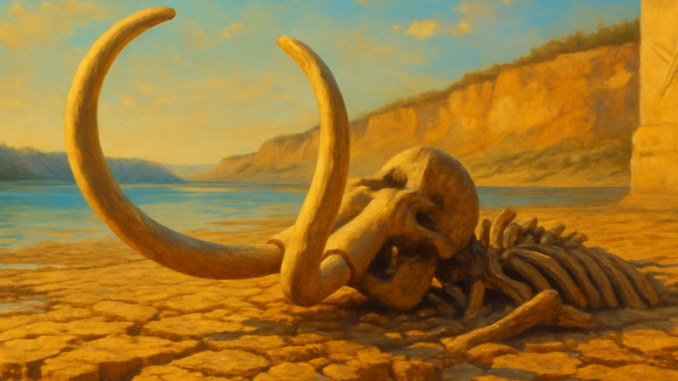
Imagine walking along the banks of the Danube River in Bulgaria and spotting something protruding from the mud — something that last saw the light of day tens of thousands of years ago. Mammoth bones, exposed by historically low water levels this summer. It’s the kind of discovery that stops you in your tracks and makes you wonder: what lies hidden beneath the surface of our world, our society, and ourselves? And what happens when those hidden layers are unexpectedly revealed?
When the River Reveals Its Secrets
The Danube has flowed through the heart of Europe for millennia, carrying far more than water. It carries history, culture, and apparently the remains of creatures that roamed these plains long before the first human ever set foot on its banks. This summer’s extreme drought dropped water levels so dramatically that these ancient relics became visible once more. It’s a striking image: what normally stays hidden beneath the current of daily life suddenly surfaces when conditions change.
You may recognise this feeling from your own experience. There are moments in life when something forces you to look deeper than you’re accustomed to — a crisis, a loss, an unexpected event. Suddenly you see things that were always there but went unnoticed because the steady flow of ordinary life kept them out of sight. These moments are confronting, yet immensely valuable. They invite reflection.
The Hidden Layers of Society
What holds true for a river holds equally true for the society we live in. Beneath the surface of our daily routines lie structures, patterns, and foundations that we rarely consciously perceive. Only when something starts to chafe — when a crisis erupts or a scandal is exposed — do we become aware of what has been quietly at work all along. Climate change, the very force behind this drought, is itself one such theme: an underlying reality we managed to ignore for years but which now undeniably breaks the surface.
The truth about a society is not found in its prosperity, but in what emerges when the water level drops.
This insight is hardly new. Philosophers like Aristotle and later Montaigne wrote extensively about the importance of self-examination and societal reflection. They understood that a society content to look only at the surface ultimately shortchanges itself. True wisdom arises when we dare to dig — when we summon the courage to examine what we would rather keep concealed.
Freemasonry as a Workshop for Depth
In Freemasonry, this principle of going deeper is actively practised. The Lodge is not a place where one flees from the complexity of existence; it is a space where one deliberately engages with that complexity. The work done in a Lodge is designed to look beyond the surface — at yourself, at those around you, at the wider world. Just as the low water in the Danube reveals something that was always there, the work of Freemasonry invites you to discover what lies hidden within yourself.
This is no casual exercise. It takes courage to look at yourself honestly. It takes patience to accept that not everything you uncover will be beautiful or comfortable. But it yields something that seems increasingly rare in our age: depth. In a world that moves ever faster and where surface-level engagement often seems sufficient, the willingness to dig is both an act of resistance and an act of hope.
What the Mammoth Teaches Us About Time
Those mammoth bones in the Danube are more than a curiosity. They remind us how brief our own history truly is within the larger story of this planet. They put our daily concerns into perspective without rendering them unimportant. They invite humility and a broader view. In Freemasonry, the awareness of time is a recurring theme — the fleeting nature of human existence and, simultaneously, the responsibility to leave something of value behind in our brief span.
Johann Wolfgang von Goethe, himself a Freemason and one of the greatest thinkers in European history, wrote extensively about the relationship between humanity and nature, between the temporal and the enduring. He understood that we only truly grow when we dare to place ourselves within a greater whole. The mammoth now rising from the mud is a silent teacher in precisely that lesson.
An Invitation to Reflect
Perhaps this is the moment to ask yourself: what lies hidden beneath your own surface? What truths about yourself or the world around you have you ignored for too long? And what might happen if you found the courage to examine what emerges when the water level in your own life drops?
Which patterns in your behaviour keep repeating without you ever having consciously examined them? Which values do you carry that you once adopted from others without question? Which questions about society do you prefer not to ask because the answers might prove uncomfortable?
These questions are not meant to discourage you. They are meant to invite you into a richer, more conscious life. Freemasonry offers a framework for this: a Brotherhood where you search together with others for answers — or at least for better questions. Not to find certainty, but to draw closer to your own core.
The mammoth bones along the Danube are an unexpected gift from nature to our time. They remind us that beneath every surface lies something worth exploring. Whether it concerns the structures of our society, the foundations of our own character, or the great questions about our place in history — the willingness to dig makes all the difference. In that digging we do not always find answers, but we find the depth that makes us truly human.
Copyright text & image: devrijmetselaar.nl
Texts are based on the ideas and content of the author of devrijmetselaar.nl, reviewed, corrected, and supplemented with the assistance of OpenAI. Images are created based on the ideas of the author of devrijmetselaar.nl using OpenAI/DALL-E.
Frequently Asked Questions
What is the connection between the mammoth bones in the Danube and Freemasonry?
The article uses the discovery of ancient mammoth bones as a metaphor for how Freemasonry encourages members to look deeper beneath the surface of life. Just as the low water levels reveal hidden layers of history, Masonic work helps individuals examine hidden truths within themselves and society. This principle of seeking deeper understanding and reflection is central to Masonic practice and personal growth.
How does Freemasonry encourage self-examination?
Freemasonry provides a dedicated space—the Lodge—where members actively engage with life's complexity and deliberately work to look beyond surfaces. Through structured lessons and ritual work, Masons are invited to discover hidden aspects of themselves and gain greater self-awareness. This practice of deep reflection helps members develop wisdom and understanding that extends to their personal lives and communities.
What makes Freemasonry different from other organizations?
Freemasonry is specifically designed as a workshop for depth and personal development, not as a place to escape complexity but to engage with it meaningfully. The Lodge environment encourages members to examine themselves, their relationships, and the wider world in ways that promote genuine wisdom and growth. This intentional focus on inner development and reflection distinguishes Freemasonry as a unique institution for self-improvement.
Is Freemasonry focused on hidden or secret knowledge?
Freemasonry encourages members to uncover hidden truths—not secret knowledge kept from the world, but rather truths about themselves and society that often lie beneath our everyday awareness. The work is about developing the courage and wisdom to examine what we might otherwise overlook or avoid. This practice of deep examination leads to personal growth and a better understanding of the human experience.




Be the first to comment