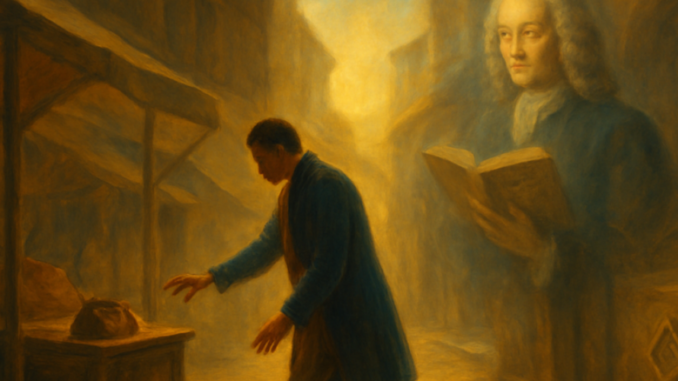
Imagine you are faced with a choice where no one is watching, no one is checking up on you, and you could easily profit at someone else’s expense. What do you do? This is precisely the question Voltaire raises in his famous entry on virtue in the Philosophical Dictionary. His answer is surprisingly practical — and more than 250 years later, it remains directly applicable to everyday life and to the principles at the heart of Freemasonry.
What Is Virtue According to Voltaire?
Voltaire does not define virtue as an abstract ideal or a religious commandment. For him, virtue is something essentially practical: doing good for your fellow human beings. In his dictionary entry, he draws a clear distinction between what he calls “theological virtues” and “civic virtues.” The first category encompasses religious obligations that vary from one faith to another. The second — the category Voltaire is most interested in — consists of concrete actions that promote harmonious coexistence.
He states bluntly that a hermit who fasts and prays is not, strictly speaking, a virtuous person in any social sense. Only when someone actively contributes to the well-being of others — when someone honors their commitments, deals honestly in business, and shows compassion to those in need — can we speak of genuine virtue. This is not armchair philosophy. It is a call to action.
The Four Cardinal Virtues as a Moral Compass
In his argument, Voltaire reaches back to the classical cardinal virtues taught by Plato and Aristotle: justice, temperance, prudence, and fortitude. He presents these not as rigid rules but as an inner compass to guide us through real-world decisions.
Justice, for Voltaire, goes beyond merely obeying the law. It means giving each person what they are due — even when the law falls short or is itself corrupt. Temperance is the ability to govern your passions without suppressing them entirely. Prudence means carefully weighing the consequences of your actions before you act. And fortitude is not simply physical bravery; it is above all the willingness to stand up for your convictions, even when doing so is unpopular or dangerous. Voltaire himself exemplified this courage when he publicly denounced injustices and risked persecution for doing so.
Voltaire’s Famous Example: The Merchant and the Shipwreck
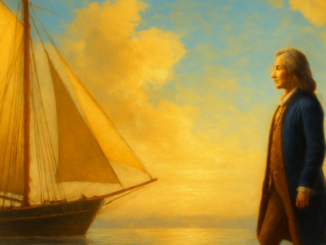
One of the most compelling illustrations in the entry is the story of a merchant whose ship has been lost at sea. He had secretly transported a cargo of gold on board — a cargo that no one else knew about, not even his business partners. Now that the ship has sunk, he could claim that everything was lost and keep the gold for himself. No one would ever find out. So what does the virtuous person do?
Virtue is not what you do when people are watching — it is what you do when no one sees.
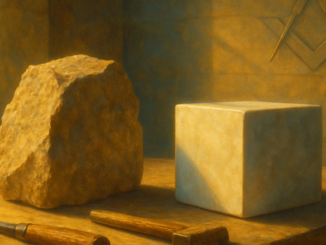
Voltaire argues that the truly virtuous merchant returns the gold to its rightful owners, simply because it is the right thing to do. Not out of fear of punishment. Not out of hope for some reward in an afterlife. But from an inner conviction that honesty forms the foundation of every meaningful human community. This example resonates deeply with the Masonic emphasis on integrity and the symbolic work of refining the rough ashlar of one’s character.
Virtue Without Religious Compulsion
What makes Voltaire’s argument particularly striking is his insistence that virtue stands independent of any specific religious doctrine. He acknowledges that different religions prescribe different virtues, but he maintains that the core principles — honesty, justice, and benevolence — are universal. A Confucian, a Muslim, a Christian, and a freethinker can all be equally virtuous in how they treat their fellow human beings.
This perspective aligns seamlessly with Freemasonry, which welcomes people of all religious backgrounds and places moral action in the world at its center. The lodge is not a church and prescribes no creed, but it does ask its members to strive for personal improvement and service to society. Voltaire’s vision of virtue offers a clear, rational foundation for exactly this aspiration.
Putting Virtue Into Practice: Daily Life Lessons
How do you translate Voltaire’s insights into concrete steps? Start by recognizing those moments when you face a choice between self-interest and the well-being of another person. These can be small situations: Do you return the extra change you were given? Do you speak up when a colleague is being treated unfairly? Do you keep a promise even when it costs you something?
Practice small acts of honesty every day, even when no one is watching. Ask yourself: would I still do this if everyone knew about it? Seek a balance between your own needs and those of others. Have the courage to stand up for what you believe is just, even when it feels uncomfortable.
Voltaire would say that virtue is not a destination — it is a daily practice. It is the sum of countless small decisions that together shape a character. In Freemasonry, this idea is embodied by the working of the rough stone: every strike of the gavel, every choice to do what is right, brings you closer to a better version of yourself.
Why This Entry Remains Relevant Today
In an era of growing polarization and declining trust in institutions, Voltaire’s clear-eyed approach to virtue offers a refreshing alternative. He does not ask for blind faith in rules or authorities. Instead, he calls for personal responsibility for your own actions. His message is timeless: be honest, be just, be helpful — not because someone demands it of you, but because it is the only way to lead a meaningful life and to build a society in which people can truly rely on one another.
Voltaire’s entry on virtue in the Philosophical Dictionary is not a dry philosophical treatise. It is a practical guide to moral conduct. His core message is simple and powerful: real virtue does not reveal itself in words or rituals, but in concrete deeds that serve the common good.
Whether you are a Freemason working on the rough ashlar of your character or simply someone seeking to live with greater integrity, Voltaire’s insights offer a timeless roadmap. Virtue, in his view, is neither a gift bestowed from above nor a set of rules imposed from without. It is a conscious, daily choice — one that defines who we are when no one else is looking. In the lodge and in life, that choice is always ours to make.
Copyright text & image: devrijmetselaar.nl
Texts are based on the ideas and content of the author of devrijmetselaar.nl, reviewed, corrected, and supplemented with the assistance of OpenAI. Images are created based on the ideas of the author of devrijmetselaar.nl using OpenAI/DALL-E.

Be the first to comment