Open book with Montaigne essay beside Masonic square and compass symbol
Michel de Montaigne – Freemasonry & Connection

Montaigne on Custom, Prejudice, and the Power of Connection

What if our deepest convictions are nothing more than habits, worn into us by time and culture? In his essay on custom and convention, Michel de Montaigne poses an uncomfortable question that strikes at the heart of human connection: how can we truly live together when each of us is trapped in the web of our own traditions? Written in the sixteenth century, this question proves remarkably relevant for anyone who reflects on a brotherhood that transcends borders. The Paradox of the Familiar Montaigne opens with an observation that is at once simple and deeply unsettling: we regard whatever is unfamiliar to us as barbarous. The Greek calls the Persian a barbarian; the Persian does the same to the Greek. Both are utterly convinced that their own customs represent the standard of civilization. Here lies a paradox that Montaigne explores with undisguised curiosity — the familiar feels self-evident, but only because we happened to grow up with it. This insight resonates deeply with Freemasonry, which from its very origins has brought together men of different religious and cultural backgrounds. In the lodge, men meet who might never have crossed paths outside its walls. The question Montaigne raises is the same […]
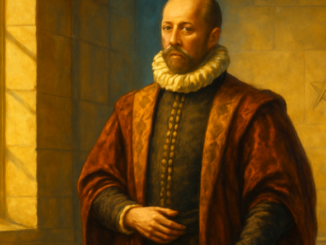
Portrait of Michel de Montaigne with philosophical and Masonic symbols
Michel de Montaigne – Philosophical Background

Montaigne on Customs: Philosophical Roots and Freemasonry

In 1580, Michel de Montaigne published a remarkable essay on the diversity of human customs. His observations on how different peoples perform the same acts in entirely different ways touched upon fundamental questions that had occupied thinkers for centuries. What philosophical traditions shaped his view of human diversity? And what can we — nearly five centuries later — still learn from his intellectual legacy, particularly as Freemasons? The Skeptical Tradition as Foundation Montaigne’s approach to human customs is deeply rooted in Pyrrhonian Skepticism, a philosophical school tracing back to the Greek thinker Pyrrho of Elis. This tradition held that absolute certainty about the world is unattainable and that we must suspend judgment. Montaigne immersed himself in the works of Sextus Empiricus, whose writings were being rediscovered and recirculated during his lifetime, and was profoundly influenced by his arguments against dogmatic thinking. In his essay on customs, Montaigne applies this skeptical stance consistently. He observes how what one culture considers civilized, another may regard as barbaric. Who, then, gets to determine what is truly right? By placing customs side by side without passing judgment, he invites the reader toward intellectual humility. This is not relativism — it is a call to […]

Open book with mirror and rough ashlar stone symbolising Masonic self-reflection
Michel de Montaigne – Content & Summary

Montaigne on Custom: What Our Habits Reveal About Us

A spoon. A simple piece of cutlery we raise to our mouths without a second thought. But what if you grew up in a culture where eating with your hands was the only respectable way to dine? In his twenty-third essay, Michel de Montaigne invites us to pause and reflect on such everyday habits — and to discover what they reveal about the human condition. In ‘Of Custom,’ he unfolds a rich collection of examples that compels us to question everything we consider normal. The Core Idea of the Essay In this essay, Montaigne examines the vast diversity of human customs and habits — from eating practices to funeral rites, from dress codes to forms of greeting. His central thesis is as simple as it is unsettling: what we experience as natural and self-evident is almost always the product of habit and upbringing. The power of custom is so great that we are barely able to look at it critically. Montaigne draws from classical sources such as Herodotus, Pliny, and Seneca, but also from travel accounts of his own time about newly discovered peoples in the Americas and Africa. He places the customs of these distant cultures alongside those of […]

Open book of Montaigne's essays beside Masonic square and compasses symbol
Michel de Montaigne – Freemasonry & Connection

Montaigne on Custom: Freemasonry and the Power of Connection

Custom is a second nature, wrote Michel de Montaigne in the sixteenth century, and it is no less powerful than the first. But what happens when we follow this thought into the realm of brotherhood, shared ritual, and traditions that span generations? Freemasonry, with its centuries-old practices and symbolic language, offers a remarkable framework for exploring Montaigne’s insights about custom and law — not as dogma, but as an invitation to reflect on what binds us, what shapes us, and what we are willing to change. The Paradox of Custom Montaigne confronts us with an unsettling truth: we believe ourselves free in our judgments, yet our customs have shaped us long before we ever began to think critically. In his essay “Of Custom, and Not Easily Changing an Accepted Law,” he examines how deeply cultural practices take root within us. He gathers examples from distant lands and bygone eras to demonstrate that what seems self-evident to one person can be utterly unthinkable to another. Marriage customs, eating habits, attitudes toward death — all of it is sculpted by habit. This is where Montaigne touches on something essential to Freemasonry. The lodge is, after all, a space where men from vastly […]

Portrait of Michel de Montaigne with classical philosophical texts and symbols
Michel de Montaigne – Philosophical Background

Montaigne on Custom: Philosophical Roots of a Timeless Essay

In 1580, Michel de Montaigne published his groundbreaking essays, among them a remarkable treatise on the power of custom and the danger of rashly changing established laws. Written against the backdrop of religious wars and political turmoil, this essay drew on a rich philosophical tradition stretching back to classical antiquity. The intellectual sources Montaigne wove together illuminate his unique position between ancient wisdom and early modern doubt — and offer enduring lessons for anyone who values tradition, reflection, and the careful balance between preservation and reform. Pyrrhonian Skepticism as Foundation Montaigne’s thinking about custom finds its deepest roots in the Greek skepticism of Pyrrho of Elis. This fourth-century BC philosopher taught that human judgments are always uncertain because our senses and reason constantly deceive us. Sextus Empiricus, who systematically recorded Pyrrhonian doctrine, emphasized that different peoples regard entirely different customs as self-evident. What was considered barbaric in Greece was honored in Persia. Montaigne owned and intensively studied a copy of Sextus Empiricus in the years leading up to the composition of his essays. The skeptical method of placing opposing customs side by side — without passing final judgment — permeates his essay on custom. He gathers examples from every corner […]

Open book of Montaigne's Essays with symbolic light representing custom and law
Michel de Montaigne – Content & Summary

Montaigne on Custom: Why Laws Don’t Change Easily

What makes us consider certain customs perfectly natural while other peoples do the exact opposite? And why is it so difficult to change laws, even when they are clearly flawed? Michel de Montaigne posed these questions more than four centuries ago, and his answers remain strikingly relevant today. In this twenty-second essay from his first book, the French philosopher examines the extraordinary power that custom holds over our thoughts and actions — a theme that resonates deeply with anyone who values self-examination and the role of ritual in shaping human life. The Core of the Essay: Custom as Tyrant Montaigne opens with a deceptively simple observation: custom determines nearly everything we consider normal. What we eat, how we sleep, the clothes we wear, the way we bury our dead — all of this varies radically from culture to culture. Yet people everywhere experience their own practices as the natural, even the only correct way to live. Custom, Montaigne argues, is a tyrannical mistress who takes possession of us by stealth. The essay weaves together two interconnected themes. The first explores how custom clouds our judgment and blinds us to the arbitrariness of our own practices. The second applies this insight […]

Antique bronze balance scales symbolizing profit and loss in Masonic philosophy
Michel de Montaigne – Freemasonry & Connection

Montaigne on Profit and Loss: Beyond the Masonic Path

A pair of bronze scales, joined at a central pivot point. When one side descends, the other rises. This everyday object — once found in every market hall and apothecary shop — became for Michel de Montaigne the symbol of a disturbing truth about human exchange. In his short but powerful essay ‘That the Profit of One Man Is the Damage of Another,’ the sixteenth-century philosopher forces us to ask whether human dealings can ever be truly reciprocal. For Freemasons, who place brotherhood and connection at the heart of their craft, this essay opens a profound reflection on the nature of genuine community. The Scales as a Mirror of Existence Montaigne opens his essay by referencing the Athenian lawgiver Solon, who — according to Demades — argued that no profit is possible without a corresponding loss elsewhere. The scales serve here not merely as a measuring device but as a metaphor for the human condition. Every transaction, every exchange, every acquisition seems inevitably tied to a loss on the other side. Montaigne cites the Roman poet Lucretius, who described how nature itself operates on this very principle: what grows does so at the expense of something else that perishes. This […]

Open book with classical philosophy texts symbolizing Montaigne's essays
Michel de Montaigne – Philosophical Background

Montaigne on Profit and Loss: Tracing the Philosophical Roots

When Michel de Montaigne argues in his twenty-first essay that one man’s profit is another man’s loss, he draws upon a rich philosophical tradition stretching back centuries. This short but influential essay reflects not only the economic turmoil of sixteenth-century France but also the voices of Seneca, Plutarch, and Stoic philosophy. How did Montaigne relate to these thinkers, and what can we still learn today from their dialogue about greed, temperance, and human relationships? The World of the Renaissance Humanist To understand Montaigne’s essay, we must immerse ourselves in the intellectual climate of the French Renaissance. Scholars were rediscovering classical texts from Greek and Roman antiquity on a massive scale. Montaigne, born in 1533, grew up with Latin as his first language. His father ensured he could read the classics as naturally as other children read fairy tales. This upbringing made him a true humanist — someone who regarded the wisdom of the Ancients not as dead knowledge but as a living guide for daily life. Renaissance humanism was defined by a return to the source: the original Greek and Latin texts, stripped of medieval interpretations. Erasmus had paved the way with his rediscovery of the New Testament in Greek. […]

Open book with Montaigne's essays beside Masonic building tools and rough ashlar
Michel de Montaigne – Content & Summary

Montaigne on Profit and Loss: Dissecting Zero-Sum Thinking

Have you ever wondered whether your success automatically means someone else loses out? It’s a deeply ingrained assumption in our culture — the idea that the world is a fixed pie, and every slice you take leaves less for everyone else. Michel de Montaigne, the sixteenth-century French philosopher and father of the personal essay, examined precisely this assumption in one of his shortest yet most provocative pieces of writing. Centuries later, his reflections still challenge the way we think about wealth, value, and what it truly means to build something together. The Heart of the Essay In Essay 21 of the first book of his Essais, Montaigne investigates the ancient belief that profit and loss are always perfectly balanced. The title says it all: “That the profit of one man is the damage of another.” He opens with a reference to Demades, an Athenian orator who condemned a trader on the grounds that his profession could only be profitable at the expense of others. This classical conviction serves as Montaigne’s launching point for deeper reflection. The essay is remarkably brief — even by Montaigne’s own standards. Yet within its compact frame, it delivers a fundamental critique of the economic thinking […]

Open book with Masonic square and compasses symbolizing imagination and Freemasonry
Michel de Montaigne – Freemasonry & Connection

Montaigne on Imagination: Practical Lessons for Freemasons

Picture this: you’re about to walk into a difficult conversation. Before you even open the door, your heart rate spikes. Your palms go damp. The conversation hasn’t started, yet your body is already responding as if everything has gone wrong. Michel de Montaigne described this very phenomenon back in the sixteenth century in his essay ‘On the Power of the Imagination.’ For Freemasons, this classic work offers surprisingly practical insights into how our thoughts shape our reality — and how we can consciously harness that power for personal growth and brotherly connection. What Montaigne Teaches Us About the Power of Thought In his essay, Montaigne gathers countless examples of how imagination produces concrete, physical effects. He describes men who become impotent purely from the fear of impotence, patients who recover after taking fake remedies, and people who develop symptoms simply by hearing about a disease. His point is unmistakable: what we think, feel, and fear has a direct impact on our bodies and behavior. This isn’t abstract philosophy — it’s an observation that modern psychology and neuroscience have since confirmed. For daily life, this carries an important implication. If negative imagination can weaken us, then positive imagination can also strengthen […]

Open book with philosophical texts symbolizing Montaigne's intellectual sources
Michel de Montaigne – Philosophical Background

Montaigne on Imagination: Philosophical Roots and Influences

When Michel de Montaigne penned his twentieth essay on the power of imagination, he was drawing from a deep well of philosophical tradition. His observations on how the mind shapes the body were not born in isolation. They stand at a crossroads where ancient wisdom, medieval scholasticism, and Renaissance humanism converge. By exploring the philosophical sources behind this essay, we uncover not only the intellectual landscape of the sixteenth century but also timeless questions about the relationship between mind and matter — questions that continue to resonate today. The Stoic Legacy: The Mind as Shaper of Reality For the Stoics — thinkers like Seneca, Epictetus, and Marcus Aurelius — the human mind was not a passive receiver of impressions but an active shaper of experience. Their central thesis, that it is not events themselves that disturb us but our judgments about them, is a direct precursor to Montaigne’s observations. When he describes how people fall ill merely by thinking about illness, or how the fear of impotence can actually bring it about, the echoes of Stoic insight are unmistakable. Seneca, whom Montaigne read and quoted extensively, wrote at length about how the mind can torment or elevate itself. In his […]

Open book with mirror reflection symbolizing Montaigne and imagination
Michel de Montaigne – Content & Summary

Montaigne on the Power of Imagination: Meaning and Core

There exists an invisible force capable of moving mountains without so much as flexing a muscle. Michel de Montaigne called this force the imagination, and he devoted one of his most fascinating essays to exploring it. In ‘Of the Power of the Imagination,’ the sixteenth-century philosopher examines how our thoughts, expectations, and mental images can transform the body in ways that transcend rational understanding. This essay is far more than a historical curiosity — it touches on a question that remains profoundly relevant today: where does the mind end and the body begin? The Core Idea: Imagination as a Creator of Reality Montaigne opens his essay with a candid confession: he himself is particularly susceptible to the suggestive power of images and stories. When he hears about the symptoms of an illness, he sometimes feels them manifesting in his own body. This personal observation serves as the springboard for a profound exploration of a phenomenon we would now recognize as psychosomatics — though Montaigne approached it from a place of wonder rather than clinical diagnosis. The central theme of the essay revolves around one deceptively simple question: how can mental images produce physical effects? Montaigne argues that the imagination is […]

Open book with Masonic symbols representing Montaigne's philosophy on mortality
Michel de Montaigne – Freemasonry & Connection

Montaigne on Death: Philosophy as a Source of Brotherhood

In 1580, Michel de Montaigne published his nineteenth essay under a provocative title: That to Philosophize Is to Learn to Die. Borrowed from Cicero, these words were not born of morbid fascination but served as an invitation to live more deeply. For this sixteenth-century thinker, contemplating death was never an endpoint — it was a starting point for meaning, human connection, and moral growth. These are precisely the elements that lie at the heart of Freemasonry. The Historical Context of Montaigne’s Meditation Montaigne composed his essays during an era of religious wars, plague epidemics, and political upheaval. France was torn apart by violent conflicts between Catholics and Huguenots. Death was not an abstract concept but a daily reality knocking on everyone’s door. Against this turbulent backdrop, Montaigne retreated to the tower of his château and began writing about what occupied his mind most urgently: how to live when the end is uncertain yet inevitable. He drew inspiration from the Stoic philosophers — Seneca and Epictetus in particular — and from Cicero, who argued that philosophy is essentially a preparation for death. But Montaigne did not adopt this idea wholesale. He transformed it into something far more personal. The fear of […]

Open book with Montaigne's essays surrounded by Masonic symbols and candlelight
Michel de Montaigne – Philosophical Background

Montaigne and Death: Philosophical Sources of a Timeless Essay

Imagine living in the sixteenth century, surrounded by plague epidemics, religious wars, and a life expectancy that barely reached forty. How would you relate to death? Michel de Montaigne chose not to avoid this question but to confront it head-on. In his celebrated essay “That to Philosophize Is to Learn to Die,” he drew upon a rich tradition of ancient wisdom. But which thinkers and philosophical currents whispered in his ear as he wrote? Let us descend together into the philosophical sources that shaped this masterwork — and discover why they still resonate deeply within Freemasonry today. The Stoic Legacy: Seneca as Guiding Light If there is one philosopher whose presence shimmers through every page of Montaigne’s essay, it is Seneca. The Roman statesman and philosopher wrote extensively about the art of dying in his Letters to Lucilius. For Seneca, death was not an enemy to be feared but a natural boundary that gives our lives meaning. He taught that we should live each day as though it could be our last — not out of gloom, but in order to be truly present. Montaigne absorbed this Stoic insight and made it deeply personal. Where Seneca sometimes remained abstract, Montaigne […]

Skull and hourglass symbolizing Montaigne's philosophy on death and Freemasonry
Michel de Montaigne – Content & Summary

Montaigne: To Philosophize Is to Learn to Die

Why did Michel de Montaigne dedicate an entire essay to death in the sixteenth century? And what exactly did he mean when he declared that to philosophize is nothing other than to learn to die? In this nineteenth essay from the first book of his Essays, Montaigne tackles one of the most fundamental questions of human existence — not as a gloomy meditation, but as a practical lesson in wisdom for anyone who truly wishes to live freely. The Core Idea: Freedom Through Acceptance of Death Montaigne’s central thesis is as simple as it is unsettling: anyone who refuses to face death cannot truly live in freedom. As long as we suppress or deny our mortality, the fear of it governs our lives in invisible ways. By thinking through death and accepting it, we strip it of its threatening power. Montaigne draws upon the classical philosophers here, particularly Marcus Tullius Cicero, who argued that philosophy is nothing but preparation for death. But how does one prepare for something one has never experienced? Montaigne offers a surprisingly practical answer: by thinking about it daily. Not to fall into melancholy, but to sharpen our appreciation for every living moment. Death is not […]

Symbolic Masonic tools with light representing Montaigne's philosophy of connection
Michel de Montaigne – Freemasonry & Connection

Montaigne on Laughter and Tears: Connection in Freemasonry

A tear can express joy. A smile can conceal sorrow. Michel de Montaigne understood this paradox of the human soul when he observed that we do not laugh and cry about the same thing. Hidden within this sixteenth-century essay lies a timeless truth that resonates deeply with Masonic thought: genuine connection between people requires us to look beyond the surface of expressions and gestures, into one another’s inner landscape. The Surface Deceives Montaigne opens his essay with a seemingly simple observation: the same event can evoke opposite emotions in different people. More than that, within the same person, laughter and tears can lie remarkably close together — sometimes even occurring simultaneously. What does this mean for how we understand one another? Montaigne suggests that we judge far too quickly based on what we see. The tear on someone’s cheek does not tell the whole story. The smile on someone’s lips may well be a mask. This insight touches on a fundamental Masonic principle: the distinction between the exoteric and the esoteric, between the outer form and the inner truth. In the lodge, we learn that symbols carry multiple layers of meaning. A square is not merely a tool. A level […]

Open book of Montaigne's Essays with Masonic symbols and philosophical imagery
Michel de Montaigne – Philosophical Background

Montaigne on Laughter and Tears: Philosophical Roots Exposed

Why do we sometimes laugh when we really want to cry? And why can tears of grief suddenly give way to a liberating burst of laughter? Michel de Montaigne posed this very question in his eighteenth essay, but he was far from the first thinker to wrestle with the capriciousness of human emotion. Behind his elegant prose lies a rich philosophical tradition reaching back to the ancient Greeks and Romans. Let us explore the thinkers and intellectual currents that inspired Montaigne when he wrote this fascinating essay — and consider what their insights mean for Freemasons committed to the work of self-knowledge. Which Classical Thinkers Whispered in Montaigne’s Ear? Montaigne was a voracious reader of classical antiquity. His library, housed in the tower of his château, contained hundreds of works, and the ceiling beams of his study were inscribed with quotations from his favourite authors. For this particular essay, he drew heavily on the writings of Seneca, the Roman philosopher who wrote so penetratingly about the instability of human feelings. Seneca described how the very same event can provoke completely opposite reactions in different people — or even in the same person at different moments. But there was another voice […]

Open book of Montaigne Essays with symbolic light representing emotional complexity
Michel de Montaigne – Content & Summary

Montaigne on Laughter and Tears: The Capriciousness of Emotion

A man stands at the grave of his beloved. His eyes are dry, his face expressionless. Hours later, when he finds a lock of her hair tucked inside a forgotten drawer at home, he breaks down sobbing. Michel de Montaigne would nod knowingly at this scene. In his eighteenth essay from the first book of the Essays, he examines precisely this mystery: why our emotions so rarely appear when we expect them, and why laughter and tears are often far closer neighbors than we care to admit. The Core Idea of the Essay In this short but powerful essay, Montaigne argues that human emotions are fundamentally unpredictable and contradictory. We do not always weep when sorrow seems called for, and we sometimes laugh at the most unexpected moments. The very title contains a paradox: we do not respond uniformly to the same event. What moves us to tears today may leave us unmoved tomorrow. Montaigne investigates why this happens and what it reveals about the human mind. The French philosopher contends that emotions are rarely pure. When someone weeps at a funeral, is it genuine grief alone, or is there also an element of relief that suffering has ended? When […]

Rough ashlar stone in candlelight symbolizing Masonic self-reflection
Michel de Montaigne – Freemasonry & Connection

Montaigne on Fear: Lessons for Today’s Freemason

You’re about to make a major decision. Your stomach tightens, your thoughts race. Fear is a primal force that every human being knows intimately — whether you lived in sixteenth-century France or in the modern world today. Michel de Montaigne, the French thinker celebrated for his profoundly introspective essays, devoted an entire chapter to this very subject. His insights turn out to be remarkably relevant, especially for those committed to personal growth and brotherhood. So what can Freemasons learn from his reflections on fear? How Fear Works According to Montaigne In his essay “Of Fear,” Montaigne describes how anxiety influences our behavior in unpredictable ways. He recounts stories of soldiers who froze on the battlefield, of people who fled without knowing where they were going. Fear can paralyze us, but it can also drive us to reckless action. Montaigne observes that fear often causes more damage than the danger itself. It is not the threat that breaks us — it is our reaction to it. This insight applies directly to everyday life. How many opportunities do we let slip away out of fear of rejection? How many conversations do we avoid because we dread conflict? Montaigne invites us to face […]

Open book with classical philosophical texts relating to Montaigne and fear
Michel de Montaigne – Philosophical Background

Montaigne on Fear: The Philosophical Roots of Essay 17

Michel de Montaigne did not write his essay ‘On Fear’ in an intellectual vacuum. Behind his seemingly personal observations about anxiety lies a rich philosophical tradition stretching back to Greek and Roman antiquity. By tracing these roots — Stoicism, Skepticism, and the moral psychology of Plutarch — we can better understand how sixteenth-century thinking about fear connects to the contemplative practice that also lies at the heart of Freemasonry. Stoicism as the Foundation Stoic philosophy is arguably the most important undercurrent in Montaigne’s thinking about fear. Seneca, whose letters Montaigne studied closely, regarded fear as a passion born from false judgments about reality. For the Stoics, fear arises when we treat external events as threats to our well-being, when true well-being resides in virtue alone. Epictetus put it sharply: it is not things themselves that disturb us, but our judgments about those things. Montaigne absorbs this Stoic insight but transforms it at the same time. Where Seneca aims for complete mastery over the passions, Montaigne is more modest. He acknowledges that fear is a human reality that cannot simply be reasoned away. This nuance makes his essay far more approachable than the sometimes severe Stoic treatises. He does not ask […]