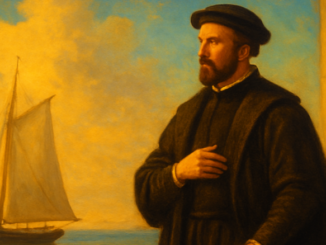
Portrait of Michel de Montaigne symbolizing equality in Freemasonry
Michel de Montaigne – Content & Summary

Montaigne on Equality: What Freemasonry Can Learn From Him

What elevates one person above another? Is it birth, wealth, or something more fundamental? In his thirty-seventh essay from the first book, Michel de Montaigne poses this question with characteristic sharpness and honesty. ‘On the Equality Among Us’ is a brief but powerful argument that examines and challenges the very foundations of human hierarchy. Written in the sixteenth century, its message still resonates today — perhaps nowhere more strongly than in Freemasonry, where brethren meet as equals regardless of their station in life. The Central Thesis: Equality as a Natural State Montaigne opens his essay with a provocative idea: despite all the outward differences between people, we are fundamentally equal. He argues that the distance between a king and a peasant is far smaller than we typically assume. Both are subject to the same human weaknesses, the same bodily needs, the same mortality. He cites classical writers to underscore his point, including Seneca, who likewise emphasized human equality regardless of social standing. What makes Montaigne remarkable is his refusal to moralize. He simply observes that rank and status are human constructions that make no real difference to our fundamental humanity. A prince can fear death just as much as the […]
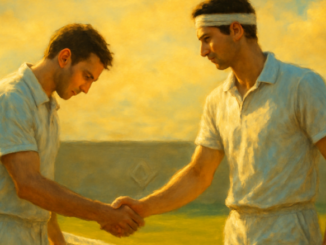
Tennis players shaking hands at the net symbolising Masonic brotherhood
Personal Development & Leadership

Winning and Losing at Wimbledon: Lessons in Brotherhood

Picture the scene: two men stand facing each other on the sacred grass of one of the world’s most famous tennis tournaments. One celebrates; the other bows his head. But what happens in that quiet moment at the net, when they shake hands? Is it mere formality, or does something deeper reside in that gesture? It’s worth asking what these sporting moments can teach us about a concept Freemasons have cherished for centuries: brotherhood. Why Does That Moment at the Net Move Us So Deeply? There is something extraordinary about the instant two opponents look each other in the eye after everything has been said and done. One has won. The other has lost. And yet they reach out and shake hands. Why does this touch so many viewers? Perhaps because we recognise something in it that goes beyond competition. We see two people who, despite their battle, acknowledge each other as equals. That is precisely what brotherhood means: the recognition that you stand before a fellow human being, not merely a rival. In Freemasonry, we often speak of meeting our Brethren “on the level.” Regardless of rank, background, or achievement, we stand as equals before one another. The tennis […]

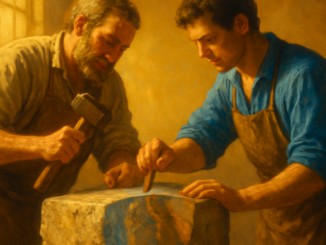
Masonic mosaic pavement symbolizing unity of opposites and friendship
Symbolism & Rituals

Without Judgment: The Symbolism of the Extraordinary Friend

Imagine that the most valuable friendship in your life is one you never sought out — one that fits no category, defies every label, and forces you to reconsider all your definitions of human connection. Wouldn’t that be precisely the kind of bond that reveals the most about who you truly are? The Paradox of the Unnameable Some relationships resist classification. Not because they lack significance, but because they are so essential that every label falls short. Acquaintance? Too shallow. Friend? Too loaded with the expectations and conditions we unconsciously attach to the word. And yet, there is that person — someone with whom every conversation immediately plunges into depth, someone in whose presence the mask slips away and the real face emerges. Someone you met through chance, through loss, through a chain of circumstances no one could have planned. It is precisely this unplanned quality that makes the connection so pure. In Freemasonry, this experience finds expression in an ancient and powerful symbol: the rough ashlar that must be shaped. Not in isolation, but through interaction. The other person acts as chisel and mallet at once — not to wound, but to help us give form to who we […]