You may have seen it in the news: a major technology company is taking former employees to court for allegedly stealing trade secrets and handing them to a competitor. On the surface, it sounds like a corporate dispute with little relevance to everyday life. But look a little closer, and this story touches on something universal — the question of who you are when no one is watching, the weight of your word, and the building blocks of your character.
When Trust Is Broken
Imagine spending years working on complex projects, gaining access to your employer’s most sensitive information, and then one day deciding to move on. What do you take with you? Your experience, your skills, your memories — certainly. But where is the line between what belongs to you and what was entrusted to you? That question now sits at the heart of a lawsuit captivating the technology world.
The case is not merely about the legal definitions of intellectual property. It is about the invisible agreements we make when someone places their trust in us. It is about whether our word still means something after we close a door behind us.
The Rough Ashlar as a Mirror
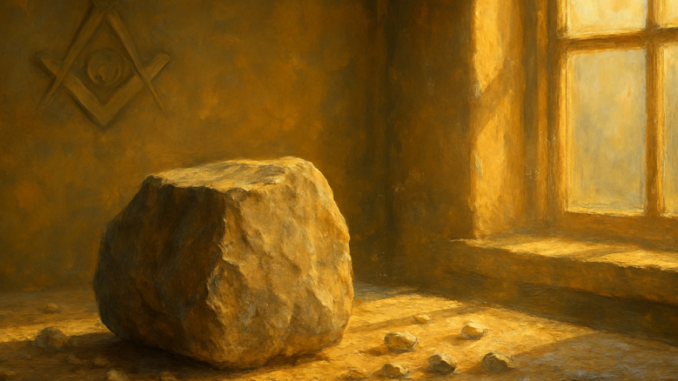
In Freemasonry, we work with the symbol of the rough ashlar — the unworked stone that represents a person at the beginning of their inner journey. The work on that stone is never finished. Every day, we face choices that shape who we become. It is not the grand, dramatic moments that define character, but the small decisions no one ever sees.
Do you take the document? Do you tell the truth when lying would be easier? Do you honour a promise even after circumstances have changed? These are questions every professional, every friend, every partner, every citizen faces daily. Together, the answers form the mosaic of your personality.
Loyalty in a Fast-Moving World
We live in an era where changing jobs is the norm, where talent flows freely between companies, and where knowledge becomes outdated almost as quickly as it is shared. This makes the question of loyalty more complex than ever. To whom — or what — are you loyal? To your former employer? To your new team? To your own ambitions? Or to something greater: to principles that stand firm regardless of where you work?
Freemasonry offers no ready-made answer, but it does provide a compass. It invites you to reflect on the values you uphold, independent of external pressure. Not because a contract requires it, but because you have chosen to live that way. That is the difference between following rules and showing character.
Integrity is doing what is right, even when no one is watching.
The Test of Silence
There is an old Masonic reflection that asks: would you still carry out this action if it appeared on the front page of tomorrow’s newspaper? It is a simple but unforgiving test. It forces you to look past excuses, past rationalisations, past the stories you tell yourself. It asks you to confront the core: are you proud of who you are in this moment?
In lawsuits like these, events are reconstructed after the fact. Emails are combed through, witnesses are heard, motives are examined. But the real judgment falls much earlier — in the silence of the moment itself. When you are alone with your choice and no one is compelling you. That is where character lives.
What You Take and What You Leave Behind
Ultimately, this is not about technology or trade secrets. It is about what you carry through life and what you leave behind. Do you take what was given to you in confidence? Or do you carry something far more valuable — a reputation for trustworthiness, a network built on mutual respect, an inner compass that guides you through difficult decisions?
Freemasonry teaches us that character is not a fixed trait but an ongoing construction. Every choice is a stone you add to the building. Every promise you keep, every truth you speak, every boundary you respect — these are the hammer blows with which you shape yourself.
An Invitation to Self-Reflection
Perhaps you do not work at a tech giant. Perhaps you have no access to valuable trade secrets. But you face similar choices every day, on a smaller scale. In how you handle confidential information shared by friends. In how you speak about former employers or past relationships. In how you act when short-term gain collides with long-term integrity.
Do you honour agreements even when they no longer serve you? Do you respect the boundaries others showed you in confidence? Are you the same person behind closed doors as you are in public?
These questions are not meant to stir guilt, but to deepen awareness. Building your character does not demand perfection — it demands honesty. It demands the willingness to examine yourself and to course-correct when needed.
A lawsuit about trade secrets may seem far removed from your own life. But its essence touches us all: who are you when you face a choice between self-interest and integrity? Freemasonry passes no judgment on others, but it offers a constant invitation to ask yourself that question. Not tomorrow — today. Not through grand gestures, but in the quiet moments that together shape your character. The stone you are working on is yourself.
Copyright text & image: devrijmetselaar.nl
Texts are based on the ideas and content of the author of devrijmetselaar.nl, reviewed, corrected, and supplemented with the assistance of OpenAI. Images are created based on the ideas of the author of devrijmetselaar.nl using OpenAI/DALL-E.
Frequently Asked Questions
What does Freemasonry teach about trust and integrity in the workplace?
Freemasonry emphasizes that character is built through daily choices, especially the small decisions no one sees. Rather than following rules out of obligation, Freemasonry invites individuals to reflect on their values and uphold principles independently, understanding that true integrity means doing what is right regardless of external pressure or reward.
How does the Masonic symbol of the rough ashlar relate to personal character development?
The rough ashlar represents a person at the beginning of their inner journey, with work that is never truly finished. This symbol reminds us that character is continuously shaped by the choices we make each day, and that it is the accumulation of small, unseen decisions rather than grand moments that truly defines who we are.
What guidance does Freemasonry offer about loyalty when changing jobs or careers?
Freemasonry doesn't prescribe a single answer to loyalty questions, but rather provides a compass for reflection on your core values. It encourages individuals to consider principles that stand firm regardless of employment changes, asking whether your loyalty is ultimately to yourself, your ambitions, or to something greater—a set of enduring moral principles.
What is the Masonic 'test of silence' and why does it matter?
The 'test of silence' asks whether you would be proud to see your actions published on the front page of a newspaper. This reflection tool cuts through excuses and self-justification, forcing you to confront whether your choices align with your true values and the person you genuinely want to be.


Be the first to comment