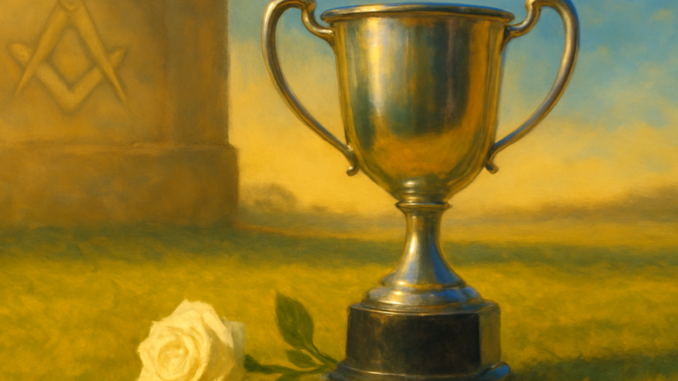
Perhaps you’ve experienced it yourself: a moment of triumph, of completion, where your first thought didn’t go to yourself but to someone who is no longer here. Someone who shaped you, who set you on your path, but who never got to see you cross the finish line. When a young tennis player dedicates her greatest title to her late mother — moving a former champion in the audience to tears — it touches something far deeper than sport. It touches the age-old question: how do we honor those who came before us?
The Power of the Gesture
On the Centre Court of one of the world’s most famous tennis tournaments, a scene recently unfolded that transcended athletic achievement. A young champion, still trembling from the intensity of the match, directed her first words not to sponsors or coaches, but to the mother she had lost years ago. It was a moment of radical vulnerability on the highest stage. And it was contagious: a former champion sitting in the crowd, herself hardened by years of elite competition, could not hold back her tears.
What makes such a gesture so powerful? It breaks through the logic of the present moment. It connects a visible victory to an invisible legacy. It says: I do not stand here alone. I am built on foundations that others have laid.
Legacy in the History of Brotherhoods
This sense of connection to predecessors has a long history, not least within Freemasonry. Since the Middle Ages, when stonemason guilds passed their craft knowledge from generation to generation, honoring those who came before has played a central role. The operative masons who built the great cathedrals literally continued building on foundations that others had laid. Their work would have been impossible without the knowledge, the tools, and the traditions they inherited.
When Freemasonry transformed during the seventeenth and eighteenth centuries from a craft guild into a more philosophical brotherhood, this principle endured. The rituals that took shape during that era — and that are still practiced today — contain countless references to those who went before. Not out of nostalgia, but from the understanding that every builder stands on the shoulders of others.
The Chamber of Reflection: Learning from Loss
In the historical development of Masonic ritual, the encounter with loss occupies a special place. The Third Degree, which took its current form in the early eighteenth century, is fundamentally concerned with mortality and continuity. Without delving into ritual specifics, the central theme is this: what is truly valuable does not perish with death but is passed on to those who follow.
What we build outlives us. What we pass on lives through others.
This insight is not unique to Freemasonry. It recurs across virtually every culture and tradition. But the way lodge history has formalized it — through ritual, through symbolism, through the explicit naming of the chain of generations — offers a particularly rich framework for thinking about legacy and heritage.
From Cathedral to Tennis Court
You might wonder what medieval stonemasons have to do with a modern tennis player. The answer lies in the universality of the experience. Whether you are completing a vault, winning a match, or finishing a project at work, there comes a moment when you realize your achievement does not exist in a vacuum.
The young champion on that famous grass court embodied something that generations of builders, thinkers, and seekers have felt before her. The longing to say: this is not mine alone. This belongs to you, too — you who taught me what perseverance means. You who are no longer here, but whose presence I still feel.
Tears as Recognition
That a former champion in the audience was moved to tears may be the most telling detail of all. She recognized something — not just the grief of loss, but also the courage to give that grief a place within a moment of glory. It was a silent acknowledgment of shared humanity, reaching across generations.
In the history of Freemasonry, there are countless examples of such moments of recognition. When a new Brother hears for the first time the ritual words that have been spoken for centuries, when he realizes he has become part of a chain that reaches back long before his birth, the experience can be overwhelming. Not because the words are magical, but because they connect.
Building on What Was
The lesson here is one you can carry into your own life. What foundations do you carry with you? Whose lessons still echo in how you make choices, how you process setbacks, how you celebrate your victories? And perhaps more importantly: what are you passing on?
The stories you tell about those who shaped you. The values you model for those who come after. The recognition you give to invisible heritage. These are the building blocks of a legacy that endures.
Freemasonry, across its long history, has developed a language for speaking about these things — not as dogma, but as an invitation to reflect. The question of who your predecessors are and what you owe them is not a question with a final answer. It is a question you can ask anew at every milestone, at every farewell, at every fresh beginning.
When someone on the highest stage dedicates her victory to the person she lost, she reminds us of a truth older than any tournament or brotherhood: we are the sum of those who came before us. Recognizing this is not weakness — it is strength. It is the willingness to see yourself as a link in a chain, as a builder on another’s foundation. And perhaps that is the most beautiful victory of all: knowing that what you do matters not only now, but will echo in those who come after you.
Copyright text & image: devrijmetselaar.nl
Texts are based on the ideas and content of the author of devrijmetselaar.nl, reviewed, corrected, and supplemented with the assistance of OpenAI. Images are created based on the ideas of the author of devrijmetselaar.nl using OpenAI/DALL-E.
Frequently Asked Questions
What is the significance of honoring those who came before us in Freemasonry?
Freemasonry teaches that every person stands on the shoulders of those who came before, much like the operative masons who built great cathedrals on foundations laid by their predecessors. This principle is woven throughout Masonic rituals and symbolism, reminding members that their achievements are built upon the knowledge, tools, and traditions inherited from earlier generations. By honoring those who came before, Masons acknowledge that what we build and pass on outlives us and lives through others.
How do Masonic rituals address the themes of loss and legacy?
The Third Degree of Freemasonry, formalized in the early eighteenth century, is fundamentally centered on mortality and continuity—exploring how what is truly valuable does not perish with death but is passed on to future generations. Through carefully crafted symbolism and ritual, Freemasonry provides a meaningful framework for understanding that our legacies transcend our physical presence. This formalization of legacy through ritual offers members a profound way to process loss and find meaning in contribution.
When did Freemasonry begin emphasizing the importance of honoring predecessors?
This principle traces back to the Middle Ages, when stonemason guilds passed their craft knowledge from generation to generation, with operative masons literally building upon foundations laid by their predecessors. When Freemasonry transformed from a craft guild into a philosophical brotherhood during the seventeenth and eighteenth centuries, this core principle of honoring those who came before was preserved and deepened through the development of its rituals and symbolic teachings.
Is the idea of dedicating achievements to those we've lost unique to Freemasonry?
While this insight about legacy and honoring predecessors recurs across virtually every culture and tradition, Freemasonry has formalized it in a particularly rich and structured way through its rituals, symbolism, and explicit naming of the chain of generations. This formal framework allows Masons to connect with this universal human experience in a meaningful, communal context that has been refined over centuries.

Be the first to comment