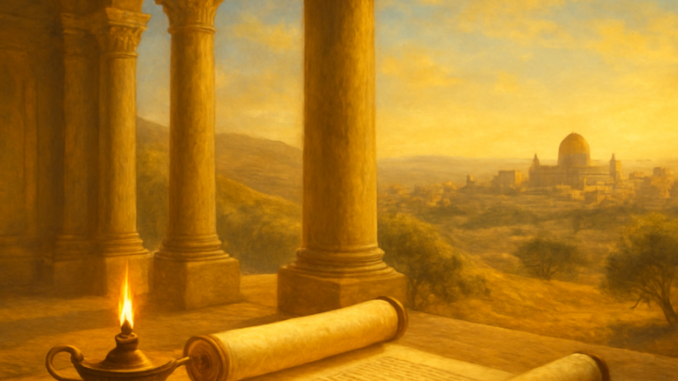
You probably know the feeling: you’re facing a difficult choice, a conflict at work or at home, and you wonder how best to act. Where do you find your moral compass in such moments? The Epistle to the Colossians — a short but powerful text from the New Testament — offers surprisingly concrete guidance for anyone seeking moral direction. For Freemasons, this text resonates with particular force, because it centers on the same pursuit of inner refinement and brotherly conduct that lies at the heart of the Craft.
Two Perspectives on the Same Text
The traditional Christian reads Colossians as a pastoral letter from the Apostle Paul to a young community of believers in Asia Minor. The text warns against false teachings and calls for steadfastness in faith. The Freemason reads the same words through a different lens: he sees a blueprint for moral architecture, a manual for building character in everyday life. Both readings are worthy and valuable. They do not exclude each other — they enrich each other.
The Hidden Treasure: Wisdom and Knowledge
In the second chapter of Colossians, there is a remarkable passage about the hidden treasures of wisdom and knowledge. For the Freemason, this strikes a deeply familiar chord. The search for light, which stands at the center of Masonic ritual, mirrors precisely this movement: from darkness to illumination, from ignorance to insight. Paul encourages his readers not to remain stuck in superficial philosophies, but to penetrate to the core of what truly holds value.
What does this mean in practical terms? With every decision you face, ask yourself whether you are acting from genuine conviction or merely out of habit. The epistle invites self-reflection — the peeling away of learned patterns that no longer serve you. This is not passive reading; it is an active discipline that the Craft encourages at every degree.
Putting Off the Old Self: A Daily Ritual
One of the most compelling images in Colossians is that of putting off the old self and clothing oneself in the new. This is not abstract theology — it is a concrete call to transformation. In Masonic terms, every initiation marks a transition: a symbolic death of who you were and a birth of who you can become.
Moral growth does not require a single dramatic conversion. It demands daily practice in letting go of what no longer serves you. Here is one way to apply this: begin each morning with a brief moment of reflection. Ask yourself which trait or habit you want to consciously release today. Perhaps it is impatience, perhaps a tendency to judge, perhaps a persistent fear. By naming it daily, you transform Paul’s abstract exhortation into a workable ritual — not unlike the daily self-examination that thoughtful Masons have practiced for centuries.
Compassion, Gentleness, and Patience
The third chapter of Colossians lists a series of virtues the believer should cultivate: compassion, kindness, humility, gentleness, and patience. For the Freemason, these are not optional suggestions — they are the building stones of a harmonious existence. The lodge is a training ground for exactly these qualities. In your interactions with brethren, you learn tolerance, especially and precisely when opinions clash.
In your personal life, you can actively practice these virtues. When a colleague irritates you, consciously choose patience over a sharp retort. When someone fails, ask yourself whether compassion might build more than criticism. These are not heroic acts — they are small choices that, taken together, form a character.
A Practical Weekly Exercise
Try this exercise rooted in Colossians 3. At the beginning of the week, choose one virtue: compassion, humility, gentleness, or patience. Each day, look for at least one moment to practice that virtue with full awareness. At the end of the week, reflect: what did you notice? Where did you succeed, and where did you fall short? Then share your experience with a trusted friend or brother, and ask about his. This simple practice bridges the gap between ancient scripture and lived Masonic principle.
The Bond of Perfection: Brotherhood in Action
Paul describes love as the bond that holds everything together in perfect unity. This image of connection is immediately recognizable to Freemasons. The chain of union, in which members hold each other’s hands in an unbroken circle, symbolizes exactly this unity. But brotherhood does not stop at the lodge door. The challenge is to carry that sense of connection outward — into your family, your workplace, and your community.
Ask yourself: who have you lost touch with this week? Who deserves a phone call, a visit, a listening ear? The Epistle to the Colossians reminds us that relationships require maintenance, just as a building needs constant care to keep from falling into disrepair.
What Believer and Freemason Share
Although the Christian believer and the Freemason read from different starting points, they share a fundamental conviction: the human being is not finished, but in the process of becoming. Colossians does not speak to perfect people — it speaks to people who are on the way. The epistle acknowledges weakness, yet it also points toward improvement. This is not a theory you must believe; it is a practice you can live.
The Freemason works on the rough ashlar of his character, chipping away imperfections one stroke at a time. The Christian works at putting off the old self. Both movements require humility, discipline, and the courage to look honestly at yourself. In that shared commitment lies a bridge between traditions that, at first glance, may seem far apart.
The Epistle to the Colossians may be nearly two thousand years old, but its message is timeless. Moral growth demands daily practice and conscious choices in small moments. Whether you read from a place of faith or from Masonic ideals, the text offers concrete guidance for anyone who wants to build a better self. Pick up one virtue today, practice it with intention, and notice how small steps lead to lasting change.
Copyright text & image: devrijmetselaar.nl
Texts are based on the ideas and content of the author of devrijmetselaar.nl, reviewed, corrected, and supplemented with the assistance of OpenAI. Images are created based on the ideas of the author of devrijmetselaar.nl using OpenAI/DALL-E.
Frequently Asked Questions
How does Colossians relate to Freemasonry?
Colossians resonates deeply with Masonic principles because both texts center on inner refinement, moral development, and brotherly conduct. Freemasons find in Paul's epistle a practical blueprint for character building that complements the spiritual journey undertaken through the degrees of the Craft.
What does the Masonic concept of 'light' mean in relation to Colossians?
The search for light in Freemasonry mirrors the hidden treasures of wisdom and knowledge described in Colossians—a movement from darkness to illumination and from ignorance to genuine insight. Both traditions encourage seekers to penetrate beyond superficial understanding to discover what truly holds value.
How can I apply the 'putting off the old self' teaching from Colossians in my daily life?
You can begin each morning with a brief moment of reflection, naming one trait or habit you wish to release that day—whether impatience, judgment, or fear. This transforms Paul's teaching into a practical daily ritual, much like the self-examination that thoughtful Masons have practiced for centuries to support their moral growth.
Are the virtues mentioned in Colossians important to Freemasonry?
Absolutely. Colossians teaches compassion, kindness, humility, gentleness, and patience—virtues that are essential to Masonic practice and brotherhood. For Freemasons, these are not optional suggestions but core principles that guide conduct toward fellow Masons and all of humanity.



Be the first to comment