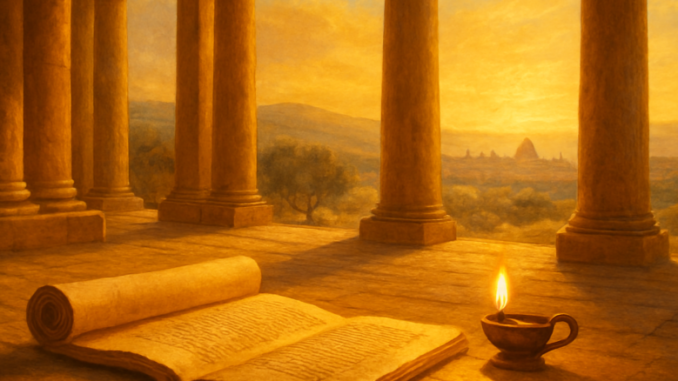
Have you ever wondered how a small group of people, scattered across different cities and cultures, managed to build a global movement — not through force or coercion, but through shared convictions, rituals, and mutual support? The Book of Acts tells exactly that kind of story. And for anyone familiar with the principles of Freemasonry, the parallels are striking.
A Journey from Within
The Book of Acts, written by the evangelist Luke, picks up where his Gospel leaves off. The disciples are still reeling from the crucifixion and resurrection of their teacher. Then the Spirit descends upon them, and everything changes. They speak in new tongues, they find the courage to bear witness, and they set out into the world. What Luke describes here is not merely a historical account — it is an inner transformation expressing itself through action.
Think about that moment when something shifts inside you. When you stop merely contemplating ideals and begin to live them. Acts describes precisely that transition. The apostles go from fearful followers to courageous builders of a new community. Their journey is geographical — from Jerusalem to Rome — but above all, it is spiritual.
The Early Church as a Workshop
In the opening chapters of Acts, Luke describes how the early believers gathered together. They broke bread, shared their possessions, and taught one another. He writes that they were “of one accord.” This image naturally evokes the Masonic lodge, where brethren come together to work on themselves and on the community — not as passive observers, but as active builders.
“And all who believed were together and had all things in common.” This verse from Acts 2 speaks of brotherhood in the most practical sense. Not just a kinship of minds, but actual sharing. The lodge operates on a similar principle: the work on the rough stone is individual, but the temple you build is for everyone. In both traditions, community is not an afterthought — it is the foundation.
Paul and the Journey as Metaphor
The greater part of Acts follows the travels of Paul of Tarsus. This former persecutor of Christians underwent a radical conversion on the road to Damascus. He then devoted his life to establishing communities around the Mediterranean. His journeys are the stuff of legend: shipwrecks, imprisonment, trials before kings. But behind all these outward adventures lies a deeper journey — one of self-knowledge, perseverance, and moral growth.
You may recognize something of the Masonic journey in Paul’s life story. The candidate who enters the lodge also begins as a seeker. The rituals he passes through are symbolic journeys — from darkness to light, from ignorance to understanding. Paul travels literally, but his true transformation takes place within.
Light and Enlightenment
The motif of light recurs throughout Acts. On the road to Damascus, Paul is blinded by a heavenly light, and only after three days of darkness does he receive his sight back — along with a new purpose in life. This story resonates deeply with Masonic tradition, in which the seeker initially enters the lodge blindfolded. The moment the blindfold is removed symbolizes not merely physical sight, but spiritual enlightenment.
The light in Acts is never passive. It calls for action, for witness, for change. The same is true in the lodge: receiving light carries responsibility. You are expected to work, to build, and to pass that light on to others.
Transcending Boundaries
One of the most striking themes in Acts is the breaking down of barriers. The message that began in Jerusalem ultimately reaches Rome. Jews and Gentiles are welcomed into the same community. Old laws are reconsidered, new principles are formulated. Luke describes how the apostles wrestle with the question of who belongs, and time and again they choose inclusion over exclusion.
Freemasonry embraces a similar openness. Men of different religions, backgrounds, and convictions meet in the lodge as equals. What unites them is not a shared dogma, but a shared search. Acts shows us that this universal brotherhood is not a modern invention — it is an ancient longing that continues to take shape across the centuries.
Building an Invisible Temple
What makes Acts so relevant for those interested in Masonic thought? The book describes not a temple of stone, but a living community. The building blocks are people — their relationships, their dedication. The architecture is not visible, but felt in the way people treat one another.
Consider the core themes that link Acts to Freemasonry: inner transformation as the foundation; community as a workshop for growth; journeys as metaphors for personal development; light as a symbol of insight; and universal brotherhood that transcends all borders. Each of these threads weaves through both traditions, binding the ancient to the living present.
Acts invites you to reflect on what you are building — not only in the world around you, but especially within yourself. Which rough stone are you working on? And with whom do you share the burden and the joy of that work?
The Book of Acts is far more than a historical record of the early church. It is a timeless narrative about inner journeying, community building, and the transcendence of boundaries. Whether you are a person of faith or not, its themes resonate with the very foundations of Masonic thought. The light Paul received on the road to Damascus, the bread broken in Jerusalem, the journey from east to west — these are images that invite reflection on your own path. Perhaps that is the true power of ancient texts: they speak not only of the past, but of the present, and of who you are becoming.
Copyright text & image: devrijmetselaar.nl
Texts are based on the ideas and content of the author of devrijmetselaar.nl, reviewed, corrected, and supplemented with the assistance of OpenAI. Images are created based on the ideas of the author of devrijmetselaar.nl using OpenAI/DALL-E.
Frequently Asked Questions
What is the connection between the Book of Acts and Freemasonry?
Both describe communities built on shared convictions, rituals, and mutual support rather than force or coercion. The early church in Acts mirrors the Masonic lodge in how members gather to work on personal transformation while building something greater for their communities. Both traditions emphasize the journey from darkness to light and the transition from contemplating ideals to actively living them.
How does the Masonic lodge compare to the early church described in Acts?
Both function as workshops where individuals work on themselves while contributing to a collective purpose. Acts describes believers breaking bread together, sharing possessions, and teaching one another in unity—principles that echo the Masonic emphasis on brotherhood, mutual support, and community building. In both traditions, the work is individual, but the temple or community being built belongs to everyone.
What can we learn from Paul's journey in Acts about the Masonic path?
Paul's transformation from persecutor to builder of communities parallels the Masonic candidate's journey through ritual degrees—from darkness to light, from ignorance to understanding. Both involve symbolic travels that represent deeper spiritual and moral growth rather than mere outward adventure. Paul's perseverance through trials mirrors the Masonic emphasis on personal development through challenges and self-knowledge.
Is Freemasonry connected to Christianity or the Bible?
Freemasonry welcomes men of all faiths and is not exclusively Christian, though many Masons are Christian and find deep resonance between Masonic principles and biblical teachings. The article demonstrates that Freemasonry's emphasis on brotherhood, light, community building, and personal transformation aligns beautifully with the teachings and practices described in the Book of Acts. Masonry respects all sincere seekers of truth and enlightenment.
What does 'building community across borders' mean in Freemasonry?
Freemasonry creates a global network of communities united by shared values, rituals, and mutual support, transcending geographical, cultural, and social boundaries. Like the early church spreading from Jerusalem to Rome, Masonic lodges exist worldwide, connected by common principles and the brotherhood of all Masons. This network proves that genuine community can flourish through shared convictions rather than coercion or force.



Be the first to comment