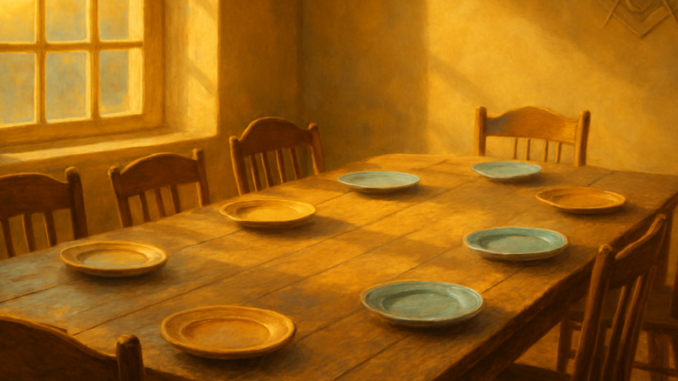
A well-known celebrity recently announced the arrival of his eighth child, declaring himself ‘on cloud nine.’ The news slips past in the endless stream of celebrity updates and family announcements. But pause for a moment. Eight children. Eight unique souls bound together by blood. Doesn’t that raise a deeper question — what does it truly mean to be a brother or sister, and to build a community that extends beyond yourself?
What Turns a Family Into a Brotherhood?
Let’s start with a deceptively simple question: is a family automatically a brotherhood? On the surface, the answer seems obvious. Siblings share parents, a home, a last name. But if we’re honest with ourselves, we all know that blood ties alone don’t guarantee genuine connection. How many families do we know where members barely speak to one another, where old wounds have never healed?
True brotherhood, as Freemasonry teaches us, is not born from the accident of birth. It is built — stone by stone, conversation by conversation, gesture by gesture. A father raising eight children faces the task of not merely educating individuals but forging a community. In a very real sense, he becomes the architect of a small Lodge within his own home.
Fatherhood vs. Brotherhood: Are They Really So Different?
There is, of course, a fundamental difference. A father does not stand beside his children as an equal. He bears responsibility, provides direction, and corrects when necessary. Yet there is a subtlety here worth exploring. The best fathers gradually transform from leaders into companions. As children grow, the relationship shifts. Hierarchy gives way to something that begins to resemble brotherhood.
This mirrors exactly what happens within Freemasonry. A newly initiated Brother is guided by experienced members. There is mentorship and knowledge passed down. But the ultimate goal is never submission or dependence. The goal is equality in the shared pursuit of truth and wisdom. A Master who does not prepare his apprentice to one day meet him as an equal has misunderstood his purpose entirely.
How Do You Keep a Large Community From Falling Apart?
With eight children under one roof, this question becomes urgent. How do you ensure no one feels excluded? How do you prevent rivalry from hardening into permanent estrangement? How do you see each individual while keeping the whole together?
Freemasonry has grappled with these questions for centuries. Its answer lies in ritual, in shared experience, and in the deliberate cultivation of certain values. Brothers come together not to debate who is the best among them, but to remind one another of what binds them. There is a common language, a shared symbolism, and a set of agreements about how to treat one another.
Brotherhood is not a state of being — it is a practice. It must be embodied again and again.
A thriving family operates on similar principles. There are regular moments of togetherness: shared meals, traditions, annual rituals. There is an unwritten code of respect and attention. And above all, there is a willingness to keep working on the relationship, even — especially — when it’s difficult.
What Does It Mean to Be ‘On Cloud Nine’?
It’s a beautiful expression. Being on cloud nine suggests a state of rapture, a momentary lifting away from the earthly. But clouds drift and dissolve. The real question is: what remains when the euphoria of birth gives way to the reality of diapers, sleepless nights, and the daily whirlwind of a large family?
This is where the personal touches the universal. Every new beginning — every initiation, every birth — carries the same promise: the possibility of starting fresh, of doing better, of drawing closer to an ideal. But that promise demands fulfillment through perseverance. The joy of the moment must be transformed into the discipline of the everyday.
What Can We Take Away From This?
You don’t need eight children to apply these lessons. Brotherhood begins wherever you are willing to look beyond your own self-interest. It starts with recognizing that you are part of something larger — whether that’s a family, a circle of friends, a Masonic Lodge, or any community you’ve chosen or found yourself in.
Consider these principles:
- Invest in shared rituals and moments of genuine connection.
- Treat every member as unique, but never lose sight of the whole.
- Transform hierarchy into equality wherever possible.
- Persist, even long after the initial euphoria has faded.
The birth of a child is always a wonder. But the true wonder unfolds in the years that follow — in the patient labor of building relationships that can withstand the test of time. In this, a family is no different from a Lodge, and a father no different from a Brother.
Behind the headline about a celebrity becoming a father once again lies a timeless question: how do we build communities that truly sustain us? The answer is not spectacular. It lives in the everyday — in the choice to show up for one another, again and again. Brotherhood, whether rooted in blood or in spirit, demands constant care. That may be the truest art of human coexistence, whether around the table of a large family or within the walls of a Lodge.
Copyright text & image: devrijmetselaar.nl
Texts are based on the ideas and content of the author of devrijmetselaar.nl, reviewed, corrected, and supplemented with the assistance of OpenAI. Images are created based on the ideas of the author of devrijmetselaar.nl using OpenAI/DALL-E.
Frequently Asked Questions
What is the connection between Freemasonry and family life?
Freemasonry teaches that true brotherhood is built through shared values, rituals, and intentional community rather than circumstance alone. These same principles apply to family life, where a father can serve as an architect of brotherhood by creating shared experiences, traditions, and a common language of respect among his children. Both Freemasonry and strong families recognize that genuine connection requires active cultivation and regular practice.
How does Freemasonry help leaders develop equality with those they guide?
Freemasonry teaches that mentorship should ultimately prepare apprentices to meet their teachers as equals in the pursuit of truth and wisdom. The goal is never dependence or submission, but rather the gradual transformation of hierarchy into companionship. This philosophy mirrors the best approach to fatherhood, where leaders gradually shift from directing others to walking beside them as companions.
What does Freemasonry teach about keeping large communities united?
Freemasonry has developed powerful tools for unity including shared rituals, symbolic language, and deliberate cultivation of core values that bind members together. Rather than focusing on competition or hierarchy, Freemasons gather to remind one another of what connects them. These time-tested practices demonstrate that brotherhood is not a passive state but an active practice that must be embodied repeatedly through shared experience.
Can blood relations automatically create brotherhood?
According to Freemasonry's wisdom, blood ties alone do not guarantee genuine connection or brotherhood. True brotherhood is built through intentional effort, meaningful conversation, and shared commitment to common values. This teaching applies equally to families, where parents must actively forge community within their household through rituals, traditions, and the deliberate cultivation of bonds between siblings.


Be the first to comment