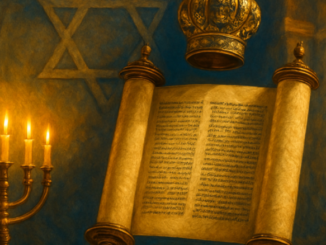
Open Torah scroll symbolising Devarim and the Masonic inner journey
Judaism

Devarim: The Book of Words and the Inner Journey

Imagine standing at the edge of a new beginning. Behind you lie years of growth, hard-won lessons, and sometimes painful detours. Ahead stretches unknown terrain. This is the moment when you must distill everything you have learned — not only for yourself, but for those who will follow. That profoundly human moment lies at the heart of Devarim, the fifth and final book of the Torah. In this concluding article of our series on the Torah, we explore how ancient words and the modern search for meaning continue to speak to one another. Words at the Threshold Devarim means literally “words,” and the book opens with Moses addressing his people at the border of the Promised Land. It is a book of looking back and looking forward at the same time. Moses knows he will not cross over. Yet instead of bitterness, he chooses to teach. He restates the law — not as a dry set of rules, but as living guidance for a people who must learn to stand on their own. Perhaps you recognise this feeling. There come moments in life when you realise that certain knowledge must not die with you. Whether you are an elder passing […]
Desert landscape symbolizing the Masonic journey of inner transformation
Judaism

Numbers: The Desert as an Inner School of Transformation

An empty plain. No trees, no rivers, no marked roads. Only sand, sky, and silence. At first glance, the desert seems like a place of absence — a space where nothing grows. Yet this very emptiness forms the backdrop of one of the most transformative narratives in the Torah. The fourth book, known in Hebrew as Bamidbar — literally meaning “in the desert” — invites us to see emptiness not as loss, but as a precondition for growth. For Freemasons, who regard the inward journey toward self-knowledge as the work of a lifetime, the symbolism of the desert passage resonates deeply. The Census as a Mirror The Book of Numbers opens with a census. Moses is commanded to count every able-bodied man of Israel, tribe by tribe, family by family. On the surface, this seems like a dry administrative exercise — a practical preparation for the journey through the wilderness. But in Jewish tradition, the act of counting carries a deeper meaning. To be counted is to be seen. Each individual is given a place within the greater whole, not as part of an anonymous mass, but as an irreplaceable member of the community. The Midrash teaches that God counts […]

Open Torah scroll with Masonic square and compasses symbolizing holiness
Judaism

Leviticus: The Call to Holiness and Masonic Symbolism

What does it mean to be called? This question opens the third book of the Torah, known in Hebrew as Vayikra — Leviticus. The book begins with the words “And He called,” a divine summons inviting Moses to draw near. But is this call reserved solely for a biblical prophet, or does it also speak to us — modern seekers of meaning and purpose? In this article, we explore the deeper layers of this remarkable book and discover how its themes of purification, sacrifice, and holiness resonate powerfully with the symbolism of Freemasonry. Why Does Leviticus Begin with a Call? The Hebrew word Vayikra literally means “And He called.” In Jewish tradition, great significance is attached to this opening word because it sets the tone for the entire book. The call is personal and intimate. God does not speak in abstract terms but addresses Moses directly with an invitation. According to rabbinical commentators, including the medieval scholar Rashi, this phrasing expresses affection. It is not a command from a distant authority but a loving summons to draw closer to the sacred. For Freemasons, this theme is immediately recognizable. In the Lodge, too, the journey begins with a call — an […]

Masonic square and compass with Hebrew text symbolizing Shemot and liberation
Judaism

Shemot and Freemasonry: The Power of Names and Liberation

In a hushed lodge room, a voice reads out names. Not just any names, but names of generations — of ancestors, of people who built and who fell, who knew bondage and who found freedom. The Mason listening feels how each spoken word carries weight, how a name is far more than a collection of letters. This is the essence of Shemot, the second book of the Torah, which opens in the Jewish tradition with the words “And these are the names.” It is a book about liberation, about building something sacred, and about the transformation of a people learning what it truly means to be free. What Lies Behind a Name? In the Hebrew language, every word carries a deeper resonance. Shemot — literally “names” — does not begin with dramatic events but with a simple enumeration of the sons of Jacob who descended into Egypt. On the surface, this reads like a dry genealogy. But in the rabbinical tradition, it conveys a fundamental lesson: every person counts, and every name carries an entire world within it. Jewish wisdom teaches that a name reveals someone’s essence — their destiny and character. For Freemasons, this resonates deeply. The act of […]

Open Torah scroll with Masonic symbols representing creation and light
Judaism

Genesis Through Jewish Eyes: Creation as a Practical Life Lesson

Imagine waking up every morning with the freedom to begin again. Imagine that your past does not define who you are today — that you carry within you the power to recreate yourself. This is precisely what the first book of the Torah, Bereshit, teaches us. The Hebrew word means literally ‘in the beginning,’ and it opens a narrative that is not merely about the creation of the world, but about your own capacity for renewal. In this first article of our series on sacred texts through a Masonic lens, we explore how this ancient Jewish wisdom translates into the practical art of living. The Power of the First Word In Jewish tradition, Bereshit is far more than a historical account. The medieval commentator Rashi noted that the Torah does not open with laws or commandments, but with a creation story — and this is no accident. It tells us that before we can act, we must first understand where we come from and what our place is within the greater whole. Creation unfolds not randomly but with order, intention, and the deliberate separation of light from darkness. For Freemasons, this resonates deeply. Every lodge meeting begins with the lighting […]