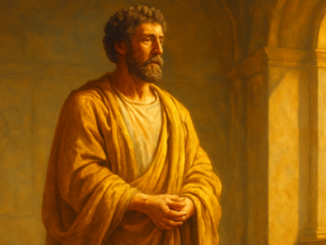
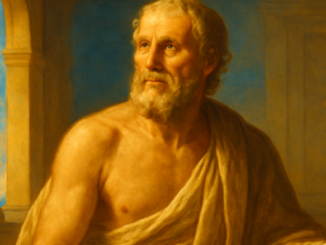
Ancient Roman bust of Marcus Aurelius with Masonic square and compass symbols
Marcus Aurelius – Freemasonry & Connection

Marcus Aurelius Book VII: Fate and Masonic Wisdom

What if everything that happens to us — the good fortune and the misfortune alike — ultimately leads to the same point? In the seventh book of his Meditations, Marcus Aurelius examines the unpredictability of fate with a clear-eyed sobriety that still resonates nearly twenty centuries later. For Freemasons, his philosophy raises a familiar question: how do we relate to the inevitable changes of life, and what does our response reveal about the state of our inner selves? The Paradox of Fate in Marcus Aurelius Marcus Aurelius, the Roman emperor-philosopher who reigned from 161 to 180 AD, wrote his Meditations as private reflections — never intended for publication. In Book VII, he turns his attention to a fundamental paradox: fate appears random, yet the wise person can still adopt a meaningful stance toward it. The unpredictability of life is not an enemy to be conquered, but a teacher that compels self-examination. He writes that the same events which destroy one person make another stronger. It is not the event that determines the outcome, but the way we receive it. This is not passive resignation — it is an active choice for inner sovereignty. The Stoic tradition in which Marcus Aurelius […]

Rescue team symbolizing Masonic brotherhood and the duty to stand by others
Personal Development & Leadership

Rescue After a Crash: What Brotherhood Truly Means

When a fighter pilot goes down over hostile territory, a race against the clock begins — not just for the pilot, but for every person who has sworn never to leave someone behind. The recent account of an American crew member rescued after a crash touches on something far deeper than military protocol. It strikes at the very heart of what Freemasons call brotherhood: the unconditional willingness to act for another, even when circumstances are anything but favorable. What Drives People to Risk Their Lives for Another? This may be the central question that occupies both soldiers and Freemasons alike. When rescue teams venture into dangerous airspace to recover a single person, they are not acting out of self-preservation. They are acting from a deep-rooted conviction that no one should be left alone in their darkest hour. Freemasonry holds this principle as one of its foundations: the duty to stand by a brother, not because it is easy, but precisely because it may be hard. The Roman philosopher Seneca wrote that true friendship means making another person’s fate your own. In his letters to Lucilius, he emphasized that trust forms the bedrock of every meaningful bond. Without trust, brotherhood is […]

Statue of Marcus Aurelius symbolizing Stoic duty and Masonic character
Marcus Aurelius – Meditations

Marcus Aurelius Book V: The Philosophical Roots of Duty

Why would a Roman emperor force himself out of bed before sunrise, even when every fiber of his body resisted? This question confronts us when reading Book V of the Meditations of Marcus Aurelius. The answer lies not in imperial discipline alone, but in ancient philosophical traditions that laid the groundwork for his thinking about duty and strength of character — traditions that continue to resonate deeply within Freemasonry. The Core of Stoic Duty Stoic philosophy, founded by Zeno of Citium around 300 BCE, forms the bedrock upon which Marcus Aurelius built his reflections. The Stoics taught that every human being fulfills a specific role within the cosmic order. Duty, in this view, is not an external constraint imposed from above — it is the natural consequence of understanding your place in the greater whole. When Marcus Aurelius speaks in Book V about rising from bed as a duty, he is invoking this deeper principle: you were born to act in accordance with your nature as a rational, social being. The early Stoics, including Chrysippus and Cleanthes, developed the concept of kathêkon, often translated as “appropriate action” or “duty.” This idea differs from modern notions of obligation because it is […]

Symbolic rough ashlar and polished stone representing Masonic temperance
Philosophy & Ethics

Temperance: A Masonic Lesson That Starts in Childhood

What does a toddler eating less sugar have to do with Freemasonry? At first glance, not much. But dig a little deeper and you touch one of the oldest ethical principles that philosophers and Freemasons alike have cherished for centuries: temperance. Recent research shows that children who consume less sugar in their early years reap the benefits well into old age — raising profound questions about how the choices we make today plant seeds for the future. Why Would a Choice Made in Childhood Still Matter Decades Later? This is exactly the question scientists set out to answer when they studied the long-term effects of sugar consumption in young children. The findings are striking: toddlers who ate little sugar had a significantly lower risk of chronic disease decades later. The body remembers, it turns out, the habits we learn early. But is this merely a biological fact, or does a deeper truth lie beneath? Freemasonry would say yes — there is indeed a deeper truth here. The idea that small, seemingly insignificant actions can have far-reaching consequences sits at the very heart of Masonic thinking. The rough ashlar is not polished in a single blow but through continuous, patient labor. […]

Ancient philosophical manuscript symbolizing Seneca's teachings on shame and virtue
Lucius Annaeus Seneca – Letters to Lucilius

Seneca Letter XI: Philosophical Roots of Shame and Virtue

Have you ever felt a flush rise to your cheeks even though no one was watching? That inner warmth that surfaces when you do something at odds with who you aspire to be? Nearly two thousand years ago, Lucius Annaeus Seneca wrote about this very experience in a letter to his friend Lucilius — and his words still resonate. Letter XI of the Moral Letters to Lucilius explores shame and moral nobility through a rich philosophical tradition that runs far deeper than Stoicism alone. In this article, we trace the intellectual sources that inspired Seneca and discover why his insights remain so relevant for anyone committed to self-improvement and the pursuit of virtue. The Stoic Understanding of Shame When Seneca writes about shame, he draws on a tradition stretching back to the early Stoa in third-century Athens. Zeno of Citium, the founder of Stoicism, made a crucial distinction between emotions born from faulty judgments and those that arise naturally. Shame occupies a special category: it can be both a useful signal and an obstacle to growth. The Stoics viewed the soul as a unified whole with reason at its center. When you act against your rational nature, an inner conflict […]