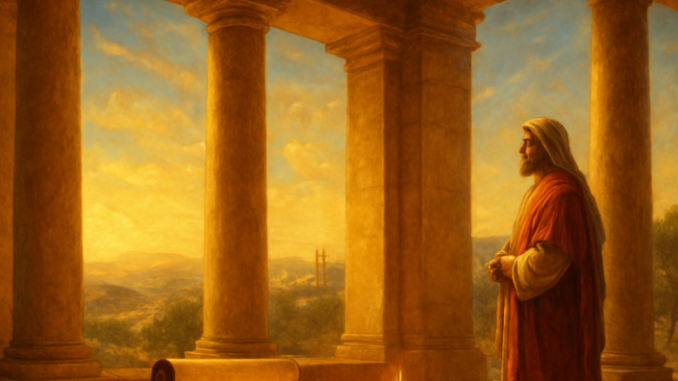
In 538 BCE, something remarkable happened. After decades of exile in Babylon, thousands of people returned to Jerusalem with a single sacred purpose: to rebuild the destroyed temple. The biblical Book of Ezra tells this story of return and reconstruction. But beneath the historical narrative lies a deeper layer — a symbolic journey that still resonates within Freemasonry and in the heart of every person striving for inner renewal.
The Historical Context of Ezra
The Book of Ezra describes a pivotal period in the history of the Jewish people. King Cyrus of Persia issued a remarkable decree in 538 BCE: the exiles were permitted to return to their homeland and rebuild their temple. This was no ordinary political maneuver — the returning exiles experienced it as divine intervention. Ezra, a scribe and priest, played a key role in this return and the spiritual reformation that followed.
The returning exiles found a desolate landscape. The temple, once the spiritual center of their existence, lay in ruins. What followed was a years-long process of reconstruction, plagued by opposition, doubt, and internal conflict. Yet they persevered. Stone by stone, the sanctuary rose once more from the dust. It is this image of patient, steadfast reconstruction that forms the heart of Ezra’s symbolic message.
The Temple as a Symbol of the Inner Self
In Freemasonry, the temple occupies a central place — not as a physical building, but as a powerful symbol. Temple construction refers to the work on the inner self, the shaping of the rough ashlar into a perfect cube. When we read Ezra through this symbolic lens, we discover a story that speaks to every seeker. The destroyed temple represents the broken or neglected inner world. The return from exile symbolizes the moment when a person decides to return to themselves, to their deepest core.
“He who builds the temple builds himself. He who knows himself understands the foundations of the sacred.”
The rebuilding described in Ezra did not proceed without obstacles. Hostile neighboring peoples attempted to sabotage the work, and discouragement spread among the builders. This mirrors the inner struggle that every person experiences during self-improvement: doubt, resistance, the temptation to give up. Yet Ezra teaches us that perseverance and a sense of community can overcome these obstacles.
The Importance of Knowledge and Instruction
Ezra was not merely a builder but above all a teacher. He brought the Torah back to the people and read it aloud to an assembled crowd, explaining the texts so that everyone could understand them. This aspect of Ezra touches on a fundamental principle in Freemasonry: the search for light — for knowledge and insight.
Freemasonry considers itself a Royal Art, in which the practitioner strives for enlightenment through study, reflection, and fraternal exchange. Ezra’s role as an educator reminds us that spiritual growth does not happen in isolation. We need guides — brothers who have walked the path before us, texts that inspire us. The temple is not built with stones alone, but also with words and wisdom.
Brotherhood and Building Together
One of the most striking aspects of the Book of Ezra is its emphasis on collective effort. The returned exiles worked side by side, regardless of their background or social status. Priests, craftsmen, ordinary citizens — all contributed to the great work. This collective character of temple building reflects the Masonic ideal of brotherhood.
Working together toward a higher purpose. Every contribution counts, no matter how small. Mutual support during setbacks. Shared joy upon completion. In the lodge, Freemasons experience this principle at every meeting. The ritual work is always a joint undertaking. No one builds alone. The strength of the chain — the fraternal bond — makes it possible to go further than any individual ever could.
Lessons for Today
What can the story of Ezra still teach us in the twenty-first century? In an age of individualism and fragmentation, this ancient narrative offers a counterbalance. It reminds us that reconstruction is possible, even after the deepest fall. That a return to our core — to what is truly sacred in our lives — always remains an option. And that we do not have to do this work alone.
Ezra’s temple was eventually completed. The joy at its dedication was immense, though it mingled with tears from the elders who still remembered the glory of the first temple. This blend of joy and sorrow is deeply human. Every completion carries the echo of the past within it; every new stone is a reminder of what was lost. Yet the building continues, generation after generation.
The Unfinished Temple Within
Perhaps the most important lesson from Ezra is that the temple is never truly complete. The work on ourselves has no endpoint. Each day offers new opportunities to place a stone, repair a crack, or strengthen a foundation. Freemasonry acknowledges this by guiding its members throughout their lives on their journey. There is no moment at which a brother can say: I am finished; my temple stands complete.
This recognition of imperfection is, paradoxically, liberating. It removes the pressure to be perfect and replaces it with an invitation to continual growth. Ezra shows us that even after destruction, even after exile, rebuilding is possible. That is a message of hope that has resonated through the centuries and continues to speak to us today.
The Book of Ezra is far more than a historical account of temple construction in the distant past. It is a timeless allegory for the human quest for wholeness, connection, and light. The parallels with Masonic symbolism are striking: the temple as a representation of the inner self, the emphasis on knowledge and instruction, and the power of brotherhood in building something greater than oneself. For Freemasons and seekers alike, Ezra’s story is a reminder that every ruin can become a sanctuary — and that the most important temple we will ever build is the one within.
Copyright text & image: devrijmetselaar.nl
Texts are based on the ideas and content of the author of devrijmetselaar.nl, reviewed, corrected, and supplemented with the assistance of OpenAI. Images are created based on the ideas of the author of devrijmetselaar.nl using OpenAI/DALL-E.
Frequently Asked Questions
What is the connection between Ezra's rebuilding of the temple and Freemasonry?
In Freemasonry, the temple is a powerful symbol of inner spiritual development rather than a physical structure. Ezra's story of rebuilding the destroyed temple represents the Masonic journey of self-improvement, where each mason works to refine their character and inner self, much like the ancient builders reconstructed the sacred sanctuary stone by stone. This symbolic connection teaches that true building is the work of developing one's own spiritual and moral foundation.
How does Freemasonry view obstacles and challenges in personal growth?
Freemasonry sees obstacles as natural and necessary parts of the spiritual journey, just as Ezra and his people faced opposition and discouragement while rebuilding the temple. The fraternity teaches that perseverance, community support, and a steadfast commitment to self-improvement enable us to overcome doubt and resistance. Through fraternal exchange and mutual encouragement, Masons support one another in overcoming the inner struggles that arise during personal development.
Why is education and knowledge important in Freemasonry?
Freemasonry, known as the Royal Art, emphasizes that spiritual growth comes through study, reflection, and the sharing of knowledge with fellow seekers. Like Ezra, who taught the Torah to help people understand divine wisdom, Freemasonry recognizes that enlightenment cannot be achieved in isolation. Through instruction from experienced guides and fraternal discussion, Masons gain the insights necessary for genuine inner transformation.
What does 'returning from exile' symbolize in Masonic teaching?
In Masonic symbolism, 'returning from exile' represents the transformative moment when a person decides to reconnect with their deepest spiritual self and begin the work of inner renewal. This return symbolizes awakening to one's potential for growth and embarking on the path of self-discovery and moral development. It reflects the universal human capacity to rebuild what has been neglected and to restore wholeness to one's life.
How does the concept of the 'rough ashlar' relate to Ezra's story?
The rough ashlar is a Masonic symbol representing the unrefined self that must be shaped and perfected through dedicated work, much like the ruins of the temple had to be painstakingly rebuilt into a perfect sanctuary. Just as Ezra's builders transformed chaos into sacred order, Masons work to transform their rough, unpolished nature into a refined and virtuous character. This parallel emphasizes that spiritual development is an ongoing, purposeful process requiring patience and commitment.


Be the first to comment