Open Bible at 2 Thessalonians with Masonic square and compasses in soft light
Christianity

2 Thessalonians and the Masonic Light of Perseverance

What does it mean to stand firm when everything around you seems to shift and tremble? The Second Epistle to the Thessalonians — a brief but powerful text from the New Testament — poses this question with striking urgency. Written to a young Christian community grappling with confusion and doubt, the letter offers a timeless meditation on perseverance, labor, and the strength found in brotherly bonds. For the Freemason, accustomed to symbolic language and moral reflection, this ancient text opens surprisingly resonant perspectives. A Letter Born from Uncertainty The paradox at the heart of 2 Thessalonians lies in its origin: a community so fervently convinced of imminent salvation that it was in danger of neglecting the present. Some had abandoned their work, certain that the end of days was upon them. Others had been thrown into confusion by false messages and counterfeit letters. The epistle, traditionally attributed to the Apostle Paul, calls for reflection — not by denying the vision of hope, but by reminding its readers of their duty to the here and now. This tension between future expectation and daily responsibility touches on a universal human theme. How often do we lose ourselves in dreams of what is […]
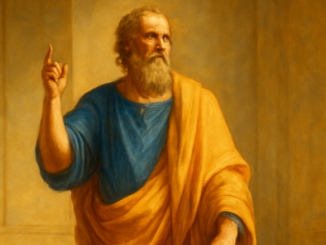
Ancient Greek temple columns symbolizing Plato's philosophy and Masonic self-knowledge
Plato – Philosophical Background

Plato’s Apology: The Philosophical Roots of Self-Knowledge

There is a paradox at the very heart of Western philosophy: the wisest man in Athens claimed to know nothing. When Socrates stood before the court, he was not so much defending his life as defending a way of life. The Apology that Plato recorded is far more than a legal document — it is a philosophical manifesto whose influence has echoed through the centuries, from the Stoics to Freemasonry. The question it raises still lingers: what does it truly mean to know yourself? The Legacy of Delphi Above the entrance to the Temple of Apollo at Delphi stood the famous inscription: “Know Thyself.” This oracle would become the starting point for Socrates’ entire philosophical quest. When his friend Chaerephon asked the oracle whether anyone was wiser than Socrates, the priestess answered that no one was. This response presented Socrates with a riddle that would define the rest of his life. How could he be the wisest man when he was so acutely aware of his own ignorance? The Apology shows how Socrates resolved this apparent contradiction. By questioning politicians, poets, and craftsmen, he discovered that they believed they knew things they did not actually know. His own wisdom, he […]

Open book with Montaigne essays beside Masonic rough ashlar and square symbol
Michel de Montaigne – Philosophical Background

Montaigne on Good and Evil: Philosophical Roots of Essay 14

Imagine waking up tomorrow under exactly the same circumstances as yesterday, yet suddenly feeling happier. Nothing in the outside world has changed — only the way you look at it. This simple thought experiment strikes at the heart of what Michel de Montaigne explores in his fourteenth essay. But where did this sixteenth-century thinker draw his ideas from? The philosophical sources he tapped into turn out to be remarkably relevant today, shedding light on how Freemasons, too, think about moral truth and personal perception. The Stoic Legacy in Montaigne’s Thought When you read Montaigne’s essay, you immediately taste the influence of Stoic philosophy. Thinkers like Seneca, Epictetus, and Marcus Aurelius shared a central conviction: it is not events themselves that determine our well-being, but our judgments about those events. Montaigne, who frequently quoted and admired Seneca, adopted this starting point and gave it his own distinctive twist. He observed how people experienced the same adversity in completely different ways, depending on their inner disposition. The Stoics drew a clear line between what lies within our control and what does not. You cannot command the weather, but you can choose how you respond to it. Montaigne applied this principle to the […]

Ancient Roman bust of Marcus Aurelius symbolizing Stoic wisdom and gratitude
Marcus Aurelius – Content & Summary

Marcus Aurelius Book I: Gratitude to Teachers and Mentors

Why would a Roman emperor — the most powerful man in the known world — begin his private journal with a long list of everything he owes to other people? Book I of the Meditations of Marcus Aurelius reads as an extended letter of gratitude to family, teachers, and friends. This is not false modesty or diplomatic courtesy. It is a deliberate philosophical choice. And in that choice, an ancient vision of personal growth unfolds that remains remarkably relevant today: we are shaped by those who came before us. What Makes Book I So Remarkable? Unlike the remaining eleven books of the Meditations, which are filled with self-reflection and philosophical reasoning, Book I consists almost entirely of acknowledgments. Marcus Aurelius names seventeen individuals — from his grandfather to his philosophy tutors — and describes precisely which virtue or life lesson he learned from each one. This is no superficial politeness. It is a systematic accounting of moral debts. Why would a powerful ruler do this? The answer lies in the Stoic philosophy Marcus practiced. For the Stoics, wisdom is never a solo achievement. It is the result of a chain of transmission. Every master stands on the shoulders of those […]

Masonic lodge illuminated by candlelight symbolizing watchfulness and light
Christianity

1 Thessalonians: Watching in the Light as a Fraternal Duty

There is a remarkable tension at the heart of Paul’s First Letter to the Thessalonians: he calls for vigilance as though the end is near, yet simultaneously urges the patient building of a loving community. How can urgency and patience coexist? This paradox lies at the core of a text that proves surprisingly relevant for anyone reflecting on moral growth and brotherhood — including those who walk the Masonic path. The Paradox of the Watchful Builder Paul wrote this letter around 50 AD to a young community in Thessalonica, a port city in northern Greece. It is the oldest known text in the New Testament — older even than the Gospels. What stands out immediately is the dual message: on the one hand, Paul expects the end of days to arrive soon; on the other, he offers detailed instructions for daily life. Work with your hands. Encourage the fainthearted. Be patient with everyone. At first glance, this seems contradictory. Why invest in relationships and craftsmanship if everything is about to end? And yet, there is a deeper truth hidden in this tension. The attitude of watchfulness does not replace the work of community building — it intensifies it. Those who […]

Open book showing Voltaire's Candide with garden and Enlightenment imagery
Symbolism & Rituals

Voltaire’s Candide: The Best of All Worlds as a Mirror

Can a world filled with earthquakes, wars, and relentless human suffering truly be the best that God could have created? Voltaire posed this question with biting wit in his masterwork Candide, a satirical novella that has confronted readers since 1759 with the dangerous limits of naive optimism. This analysis explores the core ideas behind the story and why this eighteenth-century work continues to resonate with anyone searching for genuine meaning without self-deception. The Paradox of Optimism Voltaire wrote Candide as a direct attack on the philosophical optimism of Gottfried Wilhelm Leibniz, who argued that our world — despite all its misery — is the best of all possible worlds. On the surface, this sounds comforting. But Voltaire saw something dangerous lurking beneath: a complacency that kills initiative. If everything is already perfectly arranged by divine providence, why would anyone bother striving for improvement? The paradox Voltaire exposes is deeply unsettling: a philosophy designed to offer hope can easily become an excuse for passivity and moral blindness. In the story, the character Pangloss embodies this optimism in its most absurd form. As tutor to the naive young hero Candide, Pangloss insists that every misfortune ultimately serves the greater good — even […]

Ancient scroll symbolizing Seneca's letters on the value of time
Lucius Annaeus Seneca – Content & Summary

Seneca’s First Letter: On the Use of Time – A Summary

What does it truly mean to possess time? Lucius Annaeus Seneca opens his famous correspondence with Lucilius with a paradox that still strikes an uncomfortable chord today: we are exceedingly careful with our money and possessions, yet we squander our time as though it were infinite. This first letter, written in the first century AD, confronts the reader with a sobering truth about how we live — and how we might choose to live instead. Time as Our Only True Possession In this opening letter, Seneca poses a simple but deeply unsettling question: if time is the only thing we truly possess, why do we treat it as though it were the least valuable? The philosopher observes how people carefully guard their money, protect their property, and defend their reputations — yet freely give away their hours and days to distraction, procrastination, and meaningless activity. The central theme revolves around what Seneca calls “reclaiming” ourselves. He urges Lucilius to treat each day as a complete life in itself. Not in the sense of rushing to accomplish everything, but with the awareness that every moment that passes unused is gone forever. This is not a call to obsess over productivity — […]

Ancient Greek philosopher Socrates delivering his defense at his trial in Athens
Plato – Content & Summary

Plato’s Apology of Socrates: Key Ideas and Summary

What if the greatest wisdom lies in the realization that you know nothing? This paradox beats at the very heart of Plato’s Apology of Socrates — a text that has challenged readers for over two thousand years to examine their own convictions. It is not a legal defense in the conventional sense, but a philosophical manifesto on the value of the examined life. For those who walk the Masonic path, where self-knowledge and the pursuit of truth are foundational principles, this ancient text carries a remarkably familiar resonance. In this article, we explore the key ideas, the central theme, and the enduring lessons that Plato preserved from the teachings of his master. The Historical Context of the Trial In 399 BCE, Socrates stood trial in Athens. The charges against him were twofold: corrupting the youth and introducing new gods while failing to acknowledge the traditional ones. Plato, who was present at the trial as a young man, later wrote this account as one of his earliest dialogues. The text is not a verbatim transcript of what Socrates actually said, but rather a literary reconstruction that captures the essence of his philosophical defense. What makes the Apology so remarkable is that […]

Open Bible at Colossians with Masonic square and compasses symbolizing wisdom
Christianity

Colossians and Freemasonry: Practical Wisdom for Every Day

You probably know the feeling: you’re facing a difficult choice, a conflict at work or at home, and you wonder how best to act. Where do you find your moral compass in such moments? The Epistle to the Colossians — a short but powerful text from the New Testament — offers surprisingly concrete guidance for anyone seeking moral direction. For Freemasons, this text resonates with particular force, because it centers on the same pursuit of inner refinement and brotherly conduct that lies at the heart of the Craft. Two Perspectives on the Same Text The traditional Christian reads Colossians as a pastoral letter from the Apostle Paul to a young community of believers in Asia Minor. The text warns against false teachings and calls for steadfastness in faith. The Freemason reads the same words through a different lens: he sees a blueprint for moral architecture, a manual for building character in everyday life. Both readings are worthy and valuable. They do not exclude each other — they enrich each other. The Hidden Treasure: Wisdom and Knowledge In the second chapter of Colossians, there is a remarkable passage about the hidden treasures of wisdom and knowledge. For the Freemason, this strikes […]

Open book of Montaigne's Essays with Masonic rough ashlar and square symbolism
Michel de Montaigne – Content & Summary

Montaigne on Good and Evil: The Power of Our Judgment

What if pain is not an objective evil, but merely what we make of it? In his fourteenth essay from the first book of the Essays, Michel de Montaigne examines a bold proposition: our perception of good and evil does not depend on things themselves, but on the judgments we form about them. Rooted in the Stoic philosophy of thinkers like Epictetus and Marcus Aurelius, this insight strikes at the very heart of human freedom. If we can truly become masters of our own judgments, a path opens toward inner peace — even in the midst of turmoil. The Core Idea of the Essay Montaigne opens this essay with a reference to a classical dictum he attributes to Epictetus: it is not things that disturb us, but our judgments about those things. This thought forms the backbone of the entire argument. Montaigne explores how the very same event can be experienced in completely different ways by different people. What is unbearable suffering for one person turns out to be a challenge — or even a source of pride — for another. The question then arises: where does evil truly reside? In the event itself, or in the lens through which […]

Rough ashlar and working tools symbolizing Masonic self-improvement and compassion
Michel de Montaigne – Freemasonry & Connection

Montaigne on Cruelty: How Compassion Makes You a Better Man

You’re stuck in traffic when someone cuts you off, and irritation flares instantly. At work, a colleague dismisses your idea, and your thoughts drift toward resentment. These are small moments, but they reveal something larger: how quickly we harden ourselves against others. Michel de Montaigne addressed this very mechanism in the sixteenth century in his essay “Of Cruelty.” His conclusion? Cruelty is not a sign of strength — it is a sign of weakness. And compassion is not softness — it is the highest form of human civilization. For Freemasons, who dedicate themselves to moral refinement and brotherhood, Montaigne holds up a practical mirror: how gentle are we, really, in our daily conduct? What Montaigne Teaches Us About Cruelty In his essay, Michel de Montaigne examines why human beings are cruel — not only to one another, but also to animals. He observes that cruelty often grows from habit and indifference. Once a person becomes accustomed to inflicting pain, he argues, the capacity for empathy gradually erodes. This is not some abstract philosophical puzzle. It speaks directly to how we treat colleagues, family members, strangers on the street, and even ourselves. Montaigne notes that hunters who kill animals without hesitation […]

Ancient letter symbolizing Paul's Epistle to the Philippians and Masonic wisdom
Christianity

Philippians: Joy in Captivity and the Masonic Path

Somewhere around the year 62 AD, a man sat in a Roman prison cell, chained to a soldier, uncertain of his fate. Yet from that confinement he produced one of the most joyful texts in Western history. Paul of Tarsus wrote to the faith community in Philippi — a Roman colony in northern Greece — and the letter he composed would be read for centuries as a masterwork on inner freedom amid outer constraint. For Freemasons, devoted to building the inner temple, this ancient text contains remarkably timely insights. A Letter From a Roman Dungeon The city of Philippi owed its name to Philip II of Macedon, father of Alexander the Great. By the first century, it had become a thriving Roman veterans’ colony on the Via Egnatia — the great trade route connecting East and West. It was here, around 50 AD during his second missionary journey, that Paul established a small community. The Philippians remained loyal supporters, even after he was imprisoned in Rome. They sent him gifts and dispatched a trusted companion named Epaphroditus to care for him. The letter Paul wrote in return is remarkably personal in tone. Unlike his other epistles, Philippians contains almost no […]

Portrait of Michel de Montaigne with philosophical texts on cruelty
Michel de Montaigne – Philosophical Background

Montaigne and the Law of Cruelty: Philosophical Roots

You have almost certainly experienced it: someone treats another person with unnecessary harshness, and somewhere deep inside you sense that something is fundamentally wrong. Michel de Montaigne, the sixteenth-century French thinker, wrestled with exactly this question. In his essay on cruelty, he digs into the philosophical roots of human violence and compassion. Which thinkers shaped his views? And more importantly — what can those insights still offer us today, particularly as Freemasons committed to the moral improvement of ourselves and society? The Stoic Legacy: Seneca as Teacher When Montaigne writes about cruelty, the voice of Seneca resonates throughout. The Roman philosopher, who lived from 4 BC to 65 AD, regarded cruelty as the very opposite of humanity. For Seneca, brutality was not merely a moral misstep — it was a fundamental assault on human dignity. He championed clementia, a form of mercy that springs from inner strength rather than weakness. Montaigne adopted this idea and applied it to his own turbulent era. Where Seneca wrote amidst the spectacle of Roman gladiatorial games, Montaigne observed the Wars of Religion tearing France apart. Both men witnessed how violence became entertainment, how crowds took pleasure in the suffering of others. The Stoic lesson […]

Masonic temple symbolism representing unity and the building of community
Christianity

Ephesians and Freemasonry: Building Unity in Practice

You’ve been there before: sitting in a meeting, a team, or a community where everyone has the best of intentions, yet genuine connection never materializes. Everyone talks, but nobody builds. The Epistle to the Ephesians, written in the first century, speaks directly to this challenge. And remarkably, this ancient text resonates deeply with what Freemasons have been striving to do for centuries — building a community that goes far beyond words alone. The Heart of the Epistle to the Ephesians The Epistle to the Ephesians, traditionally attributed to the Apostle Paul, was addressed to the faith community in Ephesus, a thriving port city in what is now modern-day Turkey. Unlike some other letters in the New Testament, this epistle doesn’t revolve around specific conflicts or misconduct. Its central theme is the unity of all believers, regardless of background. The author employs a powerful metaphor that any Freemason will immediately recognize: the community as a building, a temple under construction, with Christ as the cornerstone. What makes this letter truly remarkable is its emphasis on the concrete and practical. Rather than offering abstract theological musings, it provides actionable guidance for daily life. How do you handle anger? How do you speak […]

Rough ashlar stone symbolizing self-improvement through compassion in Freemasonry
Michel de Montaigne – Content & Summary

Montaigne on Cruelty: Why Compassion Makes Us Truly Human

Imagine witnessing needless suffering inflicted by someone who takes pleasure in it. You feel an instinctive revulsion — perhaps even physical disgust. Michel de Montaigne knew that feeling intimately. In his essay “Of Cruelty,” he explores why cruelty repels him so deeply and what this reveals about our shared human nature. More than four centuries later, his reflections still cut to the heart of fundamental questions about compassion, character, and how we treat other living beings — questions that resonate powerfully within the traditions of Freemasonry. Cruelty as the Deepest Vice For Montaigne, cruelty is not simply one vice among many — it is the worst of them all. While other failings spring from weakness, ignorance, or uncontrolled passion, cruelty stems from a deliberate choice to inflict suffering with no purpose beyond the suffering itself. It represents a perversion of human nature that filled Montaigne with genuine horror. Montaigne writes with striking candor about his own sensitivity. He cannot bear to watch a chicken having its neck wrung, and the death cry of a hare caught by his hounds causes him genuine distress. But this is not weakness, he argues. It is the sign of a sensitive soul that recognizes […]

Broken chains and Masonic symbols representing spiritual freedom and growth
Christianity

Galatians and Freedom: When Chains Symbolically Fall

You may know the feeling: you follow every rule, meet every expectation, and yet something inside you feels imprisoned. As though you’re doing exactly what you’re supposed to, but somewhere along the way you’ve stopped hearing your own voice. The Letter to the Galatians, written by the Apostle Paul around the year 50 CE, speaks directly to that tension. It is a text about freedom — not the freedom to do whatever you please, but the freedom to become who you truly are. A Letter Against Regression The Galatians were communities in Asia Minor that Paul had previously visited. After his departure, other teachers arrived insisting that, in addition to their new convictions, followers must also observe the old Mosaic laws in order to be truly redeemed. Paul responds with fire. For him, this is no theological footnote — it is a fundamental issue. If you have found freedom, why would you voluntarily return to a system of obligations that never transformed your inner self? This tension between outward form and inward transformation is something every sincere seeker recognizes. You can follow every ritual, recite every word, know every symbol, and still remain hollow inside. The question Paul puts to […]

Open book of Montaigne's essays beside Masonic square and compasses symbolizing reflection
Michel de Montaigne – Freemasonry & Connection

Montaigne and Connection: Steadfastness as a Bridge to Others

Picture yourself standing in a room full of strangers. Everyone is wearing a mask — not a literal one, but the invisible masks of social expectation. How often do you find yourself trying to impress rather than genuinely connect? In the sixteenth century, Michel de Montaigne wrote a penetrating essay on constancy that cuts straight to the heart of this question. His insights remain strikingly relevant for anyone reflecting on authentic human connection, and they resonate deeply with what Freemasons have pursued within their brotherhood for centuries. The Paradox of Unyielding Resolve In the twelfth essay of his first book, Montaigne examines what it truly means to be steadfast. He reveals how easily we confuse genuine inner stability with the outward appearance of immovability. That exterior can be deeply deceptive. Montaigne describes how people sometimes seem resolute out of pride or fear, while internally they are crumbling. True constancy, he argues, springs from self-knowledge and the acceptance of our human limitations. This distinction matters enormously for anyone thinking about connection with others. When you know and accept your own weaknesses, there is no need to perform. You can allow yourself to be vulnerable without losing your foundation. Montaigne saw this […]

Symbolic veil falling away revealing light in a Masonic temple setting
Christianity

2 Corinthians: The Veil That Falls From the Heart

A veil is more than a piece of fabric. It is a boundary between seeing and not seeing, between the known and the hidden. In Paul’s Second Letter to the Corinthians, this veil plays a central role as a symbol for the transformation of human consciousness. For those familiar with the symbolic language of Freemasonry, the text opens up a rich dialogue between two traditions that both speak of breaking through darkness and discovering inner light. The Earthen Vessel and the Hidden Treasure Picture a simple clay pot — rough, unglazed, the kind you might find in any archaeological museum. In 2 Corinthians, Paul uses precisely this everyday object as a metaphor for the human condition. “We have this treasure in earthen vessels,” he writes, referring to the divine light that dwells within the fragile human body. It is an image that resonates directly with Freemasonry, where the rough ashlar represents the unworked human being who is transformed through labor and reflection. The pot itself is not worthless because of its simplicity. On the contrary, it is precisely the vulnerability of the material that makes the presence of the treasure within all the more remarkable. Paul invites his readers to […]

Rough stone being shaped into a perfect ashlar symbolizing constancy
Michel de Montaigne – Philosophical Background

Montaigne on Constancy: The Philosophical Roots Revealed

A stone that stands unmoved while the storm rages around it. This image, as familiar in the builder’s craft as in philosophy, strikes at the heart of what Michel de Montaigne explores in the twelfth essay of his first book: human constancy. But which thinkers whispered those ideas into his ear? Which philosophical traditions formed the foundation upon which he built his reflections on steadfastness? The answers lie hidden in a rich intellectual heritage reaching back to antiquity. The Stoic Foundation When Montaigne writes about constancy, he is unmistakably walking through the colonnades of the Stoa. Stoic philosophy, founded by Zeno of Citium in the third century BC, placed the imperturbability of the human mind at its center. For the Stoics, true virtue lay in accepting what lies beyond our control while mastering our own reactions. This idea forms the backbone of Montaigne’s approach to the subject. Particularly influential was the work of Seneca, the Roman philosopher and statesman whose letters and essays Montaigne studied with great enthusiasm. Seneca’s De Constantia Sapientis (On the Constancy of the Wise Man) addresses precisely the theme Montaigne would later rework. The wise man, Seneca argued, cannot truly be insulted or harmed, for his […]

Ancient temple columns symbolizing Freemasonry building metaphors from Corinthians
Christianity

First Corinthians: Building Metaphors and Brotherhood

Around the year 55 CE, Paul of Tarsus sat down in Ephesus to write a letter to the fledgling Christian community in Corinth. This bustling port city, perched on a strategic isthmus between two seas, thrived on commerce, philosophy, and religious diversity. The letter we know as First Corinthians contains some of the most compelling imagery in early Christian literature: the community as a temple, believers as building stones, and the imperative to build upon a solid foundation. For those familiar with the symbolic language of Freemasonry, these metaphors sound remarkably familiar. A Letter to a Divided Community Understanding the historical context of this letter is essential to grasping its symbolism. First-century Corinth was a cosmopolitan city where Greeks, Romans, Jews, and freedmen lived side by side. The young congregation Paul had founded there was struggling with internal division. Different factions rallied behind different leaders, threatening to fracture the community’s unity. It is against this backdrop that Paul develops his powerful building metaphor. In the third chapter, he compares the community to a building whose foundation he himself has laid. Others build upon it, but the quality of their work will be tested by fire. This image of the skilled […]