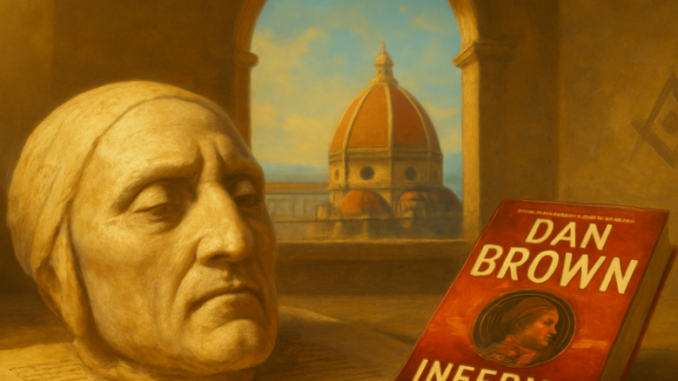
A man wakes up in a Florentine hospital, his memory erased, his pockets filled with riddles that trace back to a seven-hundred-year-old masterpiece. In Dan Brown’s thriller Inferno, Dante Alighieri’s Divine Comedy serves as the compass guiding the protagonist through a deadly maze. But how much of the Dante symbolism Brown employs is genuinely rooted in historical fact? And where does fiction take over from reality?
The Historical Dante: Poet and Exile
Let’s start at the source. Dante Alighieri lived from 1265 to 1321 and wrote his Divine Comedy during his exile from Florence. This is thoroughly documented history. The poet was banished in 1302 for political reasons and never returned to his birthplace. In Brown’s Inferno, Florence plays a central role, and the tension between Dante’s love for the city and his exile is accurately portrayed as historical background.
Brown also correctly presents the three-part structure of Dante’s work: Hell, Purgatory, and Paradise. This division corresponds to medieval cosmology and theological views on the afterlife. The nine circles of Hell, which serve as puzzle pieces in the thriller, are authentic elements drawn directly from the original poem.
The Death Mask: Between Legend and Reality
A crucial object in Inferno is Dante’s death mask, and this is where things get complicated. There is indeed a well-known death mask attributed to Dante, preserved in the Palazzo Vecchio in Florence. However, its provenance is disputed. Art historians doubt whether it is truly a cast of Dante’s face, since death masks did not become common practice until later centuries. The mask likely dates from the fifteenth or sixteenth century — well after Dante’s death in 1321.
Dan Brown presents the mask as an authentic relic containing hidden messages. This is pure fiction. There is no historical evidence that the mask ever contained secret codes or clues. The dramatic role the object plays in the thriller is entirely the author’s invention.
Symbolism and Secret Societies
In Inferno, Brown suggests that Dante’s work is saturated with hidden symbolism that only initiates can decipher. This touches on an interesting truth. Dante did indeed employ multiple layers of meaning, which he himself described as the literal, allegorical, moral, and anagogical levels of interpretation. This technique was standard practice in medieval literature and theology.
However, Dante’s symbolism is not a secret code — it is an open invitation to deeper reading that any attentive reader can follow. The suggestion that this symbolism was connected to secret societies is unfounded. Dante lived centuries before the establishment of modern Freemasonry in 1717. While later generations, including Freemasons, have drawn inspiration from his work because of its rich symbolic language, Dante himself was not a member of any such organisation. His symbolism sprang from the Christian tradition, classical antiquity, and the Florentine politics of his day.
That said, the connection between Dante and Freemasonry is not entirely arbitrary. Many Freemasons have recognised in Dante’s journey from darkness through purification toward light a powerful parallel to their own spiritual path. The Divine Comedy charts a course from ignorance to enlightenment — a theme that resonates deeply within Masonic philosophy. But recognising a kindred symbolism is quite different from claiming Dante was part of a secret brotherhood.
Florentine Locations: Fact and Fabrication
The Florentine locations Brown describes are largely accurate. The Baptistery of San Giovanni, where Dante said he was baptised, truly exists and does contain striking mosaics depicting scenes of Hell. The Boboli Gardens, the Palazzo Vecchio, and the concealed passageway known as the Corridoio Vasariano are all real historical sites.
What Brown creatively adapts, however, is the accessibility and the hidden spaces within these locations. The dramatic underground passages and secret chambers featured in the thriller are largely fictitious or heavily exaggerated. The Corridoio Vasariano, for example, is a real covered corridor built in 1565 by Giorgio Vasari, but it does not function as the mysterious labyrinth the novel suggests.
Population Theories: Science or Alarmism?
A central theme in Inferno is the threat of overpopulation. Brown connects this to Dante’s visions of Hell as a metaphor for an overcrowded world. The scientific consensus on population growth is more nuanced than the thriller implies. Demographers point out that the global population is expected to stabilise toward the end of this century. The apocalyptic scenarios sketched by the antagonist in Inferno are not supported by most experts.
The link between Dante’s Hell and modern population concerns is a literary construction by Brown, not a historical or scientific claim. Dante wrote about moral and theological questions, not demographics.
What Can We Conclude?
Dan Brown’s Inferno is skillfully woven around a historical core. The figure of Dante, his exile, the structure of his masterpiece, and the Florentine settings are all authentic. The symbolic richness of the Divine Comedy is likewise a fact that has inspired generations of readers and thinkers — from philosophers like Montaigne to contemporary Freemasons who see in Dante’s quest for light a parallel to their own spiritual journey.
What remains fiction are the secret codes in the death mask, the suggestion of a hidden society surrounding Dante’s work, and the dramatic underground chambers. Brown does what he does best: he takes authentic elements and weaves a gripping story around them. The reader who can distinguish between fact and fabrication ultimately gets the most out of both worlds.
Dan Brown’s Inferno invites readers to rediscover Dante’s masterpiece, but it does so through a lens of fiction. The historical Dante was a poet who explored universal themes with a symbolic depth that requires no secret key to unlock. His work still speaks to anyone willing to read with attention and an open mind — whether you approach it as a literary scholar, a student of history, or a Freemason seeking resonance with your own path from darkness toward light.
Copyright text & image: devrijmetselaar.nl
Texts are based on the ideas and content of the author of devrijmetselaar.nl, reviewed, corrected, and supplemented with the assistance of OpenAI. Images are created based on the ideas of the author of devrijmetselaar.nl using OpenAI/DALL-E.
Frequently Asked Questions
Is Dante's death mask in Dan Brown's Inferno a real historical artifact?
While a death mask attributed to Dante does exist and is preserved in the Palazzo Vecchio in Florence, its authenticity is disputed by art historians. The mask likely dates from the fifteenth or sixteenth century, well after Dante's death in 1321, since death masks were not common practice during his lifetime. Dan Brown's depiction of the mask containing hidden messages and secret codes is entirely fictional with no historical evidence to support it.
How much of the Dante symbolism in Inferno is historically accurate?
Brown accurately portrays several historical elements, including Dante's exile from Florence in 1302, the three-part structure of the Divine Comedy (Hell, Purgatory, and Paradise), and the nine circles of Hell. However, while Dante did employ multiple layers of meaning (literal, allegorical, moral, and anagogical), this was standard medieval literary practice, not a secret code. Brown's suggestion that only initiates can decipher Dante's symbolism misrepresents how these symbols function in the original work.
Was Dante's Divine Comedy actually written during his exile?
Yes, this is thoroughly documented history. Dante Alighieri lived from 1265 to 1321 and wrote his Divine Comedy during his exile from Florence, which began in 1302 for political reasons. Dante never returned to his birthplace. Brown accurately portrays this historical fact and the tension between Dante's love for Florence and his banishment as a genuine historical backdrop for the novel.

Be the first to comment