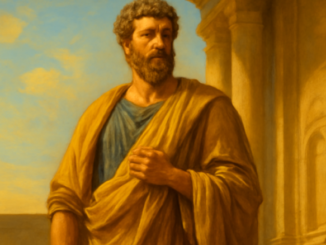
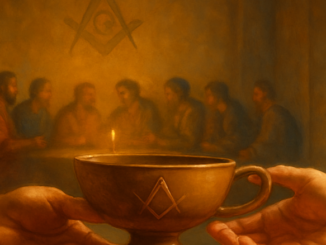
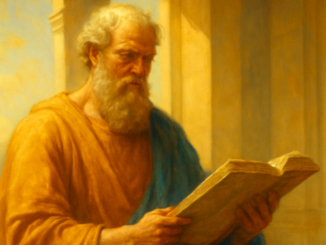
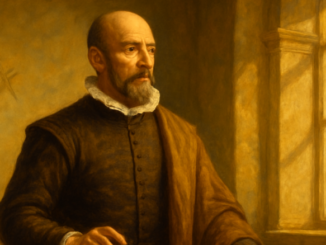
Open book of Montaigne's essays beside Masonic square and compasses symbolizing reflection
Michel de Montaigne – Freemasonry & Connection

Montaigne and Connection: Steadfastness as a Bridge to Others

Picture yourself standing in a room full of strangers. Everyone is wearing a mask — not a literal one, but the invisible masks of social expectation. How often do you find yourself trying to impress rather than genuinely connect? In the sixteenth century, Michel de Montaigne wrote a penetrating essay on constancy that cuts straight to the heart of this question. His insights remain strikingly relevant for anyone reflecting on authentic human connection, and they resonate deeply with what Freemasons have pursued within their brotherhood for centuries. The Paradox of Unyielding Resolve In the twelfth essay of his first book, Montaigne examines what it truly means to be steadfast. He reveals how easily we confuse genuine inner stability with the outward appearance of immovability. That exterior can be deeply deceptive. Montaigne describes how people sometimes seem resolute out of pride or fear, while internally they are crumbling. True constancy, he argues, springs from self-knowledge and the acceptance of our human limitations. This distinction matters enormously for anyone thinking about connection with others. When you know and accept your own weaknesses, there is no need to perform. You can allow yourself to be vulnerable without losing your foundation. Montaigne saw this […]

No Picture
Philosophy & Ethics

Freemasonry and Philosophy: The Ethical Foundation

Freemasonry is far more than a fraternal organization with elaborate rituals and symbolic regalia. At its heart, it is a philosophical and ethical system — a structured approach to self-improvement, moral reasoning, and the pursuit of truth. The intersection of freemasonry philosophy ethics has shaped some of the most thoughtful minds in Western history, offering its members a framework through which to examine their place in the world, their duties to their fellow human beings, and the nature of virtue itself. This pillar page explores the deep philosophical roots of Freemasonry, its core ethical principles, the thinkers and traditions that have influenced it, and why its moral teachings remain profoundly relevant in the modern world. Historical Background: Philosophy and the Origins of Freemasonry To understand the ethical foundations of Freemasonry, one must first appreciate the historical context in which the fraternity emerged and evolved. Although the precise origins of Freemasonry are debated by historians, the formation of the first Grand Lodge in London in 1717 marks the beginning of what is known as “speculative” Freemasonry — a practice that drew on the symbolic tools and language of medieval stonemasons to construct a philosophical and moral edifice rather than a physical […]

Masonic symbols of compasses and square representing interpretation and meaning
Philosophy & Ethics

The Art of Interpretation: Finding Meaning in Life and Lodge

In 1784, Immanuel Kant penned his famous essay on the meaning of Enlightenment. His answer was simple yet profound: it is the capacity to think for oneself, to refuse to accept the world at face value and instead seek to understand it actively. What Kant described touches on something essential — the art of interpretation, or the process of giving meaning to what we experience and observe. Both in our everyday lives and within the walls of a Masonic lodge, this act of interpretation plays a central role, though it takes on distinctly different forms in each setting. What Interpretation Really Means Interpretation is the process through which we transform raw experiences, facts, and observations into something comprehensible and meaningful. It goes far beyond mere explanation. When we interpret, we connect what we perceive with our own values, our life history, and our worldview. The Greek philosopher Aristotle spoke about the necessity of knowing not only what something is, but also why it matters. Interpretation, then, is an active endeavor — it demands reflection and a willingness to pause at what often seems self-evident. In daily life, we interpret constantly, often without realizing it. A glance from a colleague, an […]

Open book with candle light symbolizing Montaigne and Masonic search for truth
Michel de Montaigne – Freemasonry & Connection

Montaigne on Prophecy and the Masonic Search for Truth

Imagine standing at a crossroads. To your left, someone whispers that the stars determine your fate. To your right, another promises that dreams reveal your future. And straight ahead lies a path with no signposts, illuminated only by your own inner light. Michel de Montaigne stood at precisely this crossroads centuries ago. His essay on prophecy is far more than a historical document — it is an invitation to reflect on how we relate to uncertainty, to truth, and to our own capacity to discern what truly matters. The Skepticism of a Searching Mind In his eleventh essay of the first book, Montaigne examines the phenomenon of prophecy with the curiosity that defines his entire body of work. He discusses divination, dream interpretation, and omens — not to condemn or embrace them, but to investigate. He quotes Cicero, who observed that out of a thousand predictions, perhaps two come true, and that people conveniently forget the failures. Montaigne wonders why humans are so eager to believe in a predetermined fate when daily experience teaches them, again and again, that the future refuses to be captured. This attitude of critical inquiry without prejudgment feels remarkably modern. Montaigne does not reject the […]

Open books and classical philosophy texts in a Renaissance tower library
Michel de Montaigne – Philosophical Background

Montaigne’s Philosophical Sources on Divination and Prophecy

Have you ever wondered why some people swear by horoscopes while others dismiss them without a second thought? That tension between belief in predictions and healthy skepticism is nothing new. In the sixteenth century, the French thinker Michel de Montaigne grappled with exactly the same questions — and he did so by drawing on a rich tradition of classical philosophy, from the Roman Stoics to the Greek skeptics. In this article, we explore the philosophical sources that fed Montaigne’s thinking when he wrote his famous essay on divination and prophecy. The Renaissance Humanist in His Tower Library Picture Montaigne in his celebrated tower study, surrounded by thousands of books lining the walls from floor to ceiling. Each volume bore his handwritten inscriptions and annotations. This was no mere decoration — it was a living dialogue with the past. As a true Renaissance humanist, Montaigne believed that the wisdom of the ancients remained profoundly relevant to his own age. He was no passive reader: he questioned, compared, and drew conclusions that often feel strikingly modern. The humanism of the Renaissance was characterized by a return to classical sources. Where medieval scholars had often worked through commentaries and summaries, the humanists read […]

Mosaic Pavement of black and white tiles symbolizing uncertainty and wisdom
Michel de Montaigne – Content & Summary

Montaigne on Predictions: The Wisdom of Uncertainty

In a dimly lit study, a man bends over a manuscript. Outside the wind howls, and somewhere in the distance an astrologer makes his calculations. The man at the desk smiles, sets his quill to paper, and writes: what can we truly know about tomorrow? Michel de Montaigne — the sixteenth-century philosopher who made himself the subject of his own study — turned his attention in his eleventh essay to a question that has haunted humanity for centuries: the value of predictions. The Heart of the Essay In this brief but provocative essay, Montaigne examines the deeply human desire to know the future. He poses a fundamental question: why are we so inclined to place our faith in predictions when the evidence for their reliability is so scarce? At its core, the essay explores the tension between our profound longing for certainty and the inescapable uncertainty of human existence. Montaigne opens with a characteristically sober observation: throughout the ages, people have devised all manner of methods to peer into the future. From studying the flight of birds to interpreting dreams, from reading entrails to casting astrological charts — every era has had its preferred forms of divination. But what, he […]

Open book of Montaigne's essays with Masonic symbols representing silence and wisdom
Michel de Montaigne – Freemasonry & Connection

Montaigne on Eloquence: The Masonic Art of the Right Word

In the sixteenth century, a French thinker penned a brief but striking essay on the art of speaking. His observations about eloquence and the speed with which people choose their words touch on something timeless. Centuries later, we can hear in his thoughts an echo of values that also stand at the heart of Freemasonry: the search for truth, the importance of self-reflection, and the understanding that true wisdom often resides in what we choose not to say. A Renaissance Thinker Speaks Michel de Montaigne lived from 1533 to 1592. After an active career in public life, he withdrew to his estate to write and to think. His collection of essays — written in an intensely personal, searching style — ranks among the most influential works in Western literature. In the tenth essay of his first book, he turned his attention to something seemingly simple: the way people speak. Some, he observed, speak quickly and rashly. Others weigh every word with care. Montaigne himself confessed to being one of the slower speakers, someone whose thoughts only reached full maturity after time had passed. This honest self-observation is characteristic of his method. He did not write to lecture others, but to […]

Masonic square and compass with symbolic scales representing value and measure
Freemasonry & Society

Falling Inflation, Rising Worries: A Philosophical Exploration

Here is a paradox that demands deeper reflection: economists tell us inflation is falling, that the numbers are moving in the right direction, that the curve is finally bending downward. Yet we look at the receipt at the checkout and feel something quite different. Groceries still cost more than we expect, the energy bill still stings, and fixed costs still gnaw at our peace of mind. How can something simultaneously improve and remain painful? This tension between measurement and experience — between abstract truth and felt reality — touches on fundamental questions about how we, as human beings, assign value to the world around us. The Gap Between Numbers and Feeling Let us first examine the paradox more closely. When economists speak of falling inflation, they mean the rate at which prices are rising is slowing down. Prices are not falling — they are simply rising less quickly. It is the difference between a car still moving forward, but decelerating. For anyone already struggling to keep up, this offers little comfort. The distance between where you are and where you need to be is still growing, just not as fast. This is not a matter of ignorance or misunderstanding on […]

A contemplative man standing at a crossroads symbolizing agnostic doubt and growth
Philosophy & Ethics

Agnosticism in Practice: How Doubt Can Enrich Your Life

You’re standing at a crossroads and you simply don’t know. Maybe it’s a major life question, maybe something small. That uncertainty feels uncomfortable — as though you’re falling short somehow. But what if that very uncertainty is actually a strength? Agnosticism, the honest acknowledgment that some things remain unknowable, is often mistaken for indecisiveness. Yet this philosophical stance offers surprisingly practical tools for anyone who wants to live more consciously. In this article, you’ll discover how to put doubt to work — not as a weakness, but as an instrument for personal growth. What Agnosticism Really Means for Everyday Life Agnosticism derives from the Greek word meaning “not knowing.” It isn’t a rejection of faith or science — it’s the honest recognition that certain questions have no definitive answer. You encounter this more often than you might realize. What’s the right career move? How do you know for certain that you’re on the right path? An agnostic attitude means accepting this uncertainty without being paralyzed by it. This is precisely where philosophy and Freemasonry intersect. Within Freemasonry, no definitive truth is imposed. There is no catechism to recite, no creed to sign. Instead, you’re invited to seek, to question, and […]

Open book with Masonic symbols representing Montaigne's philosophy and Freemasonry
Freemasonry & Connection

Montaigne on Idleness: The Restless Mind and the Search for Light

When the mind has no direction, Michel de Montaigne wrote in the sixteenth century, it thrashes about like a horse without a rider. This brief but powerful essay from his famous collection touches on a paradox that both the philosopher and the Freemason will recognize: rest without purpose brings not peace, but turmoil. What can two traditions — separated by centuries and vastly different in form — teach each other about the value of directed silence? The Philosopher Speaks: A Mind Without Reins In his essay “Of Idleness,” Montaigne describes how he withdrew to his country estate after a busy life, fully expecting his mind to settle into peaceful contemplation. The opposite happened. Without the discipline of daily occupation, his thoughts began to race like a runaway horse. Strange images, half-formed ideas, and unfinished reflections piled up like weeds in an untended garden. The philosopher concluded that the mind, much like the body, requires exercise to remain healthy. Crucially, this was not an indictment of rest itself, but of aimless idleness. Montaigne drew a sharp distinction between doing nothing and being without purpose. The former can be restorative; the latter undermines the clarity of the soul. To tame his wild […]

Open book of Montaigne's Essays with philosophical symbols and candlelight
Michel de Montaigne – The Essays

Montaigne on Idleness: Philosophical Roots of an Essay

In the eighth essay of the first book of his Essays, Michel de Montaigne takes on the subject of idleness. But where a modern reader might expect a case for relaxation, what emerges instead is a profound reflection on the dangers of an unoccupied mind. This short but powerful piece reveals how deeply Montaigne was rooted in the classical philosophical traditions of his era — and how his thinking built a bridge between ancient wisdom and Renaissance humanism, with insights that still resonate within traditions devoted to inner work and self-knowledge. The Stoic Legacy: Idleness as Moral Danger For the Stoics, whose writings Montaigne studied thoroughly, idleness was no innocent pastime. Seneca, one of the authors Montaigne returned to most often, repeatedly warned against the dangers of a mind without direction. In his Letters to Lucilius, he stressed that an empty mind becomes susceptible to anxiety, restlessness, and destructive thoughts. Montaigne takes this warning to heart when he writes that an unoccupied mind, much like fallow land, produces all manner of weeds. The Stoic tradition drew a sharp distinction between two kinds of rest. On one hand, there was valuable contemplation, directed toward self-knowledge and moral progress. On the other, […]

An open antique book with Masonic square and compasses in candlelight
Freemasonry & Connection

Montaigne on Intentions: The True Measure of Our Inner Work

It is late in the evening. A Freemason sits alone in his study, a yellowed book open before him. He reads a passage by a sixteenth-century French thinker and feels the words reaching across the centuries, as though they were written for him personally. The question that surfaces is at once simple and unsettling: not what he has done, but why he did it. In that moment, two traditions touch — separated by four hundred years, yet united in the same search for sincerity. The Heart of Montaigne‘s Essay In one of his brief but penetrating essays, Montaigne argues that our actions cannot be separated from the intentions behind them. The results of what we do may shine in the eyes of the world, but the true value lies in what moved us when we began. A good deed performed out of vanity carries a very different weight than the same act born of genuine compassion. Montaigne invites us to look beyond the surface — past the praise and criticism of others — into the quiet chamber of our own conscience. This is no idle thought experiment. Montaigne warns that we are remarkably skilled at deceiving ourselves. We construct noble […]

Open book of Montaigne's essays with Masonic square and compass symbol
Michel de Montaigne – The Essays

Montaigne on Intention: How Purpose Judges the Work

In 1580, a remarkable book appeared in Bordeaux. Michel de Montaigne — a nobleman who had withdrawn from public life — published his first collection of essays. Among them was a short but profoundly rich piece: “That Our Actions Should Be Judged by Our Intentions.” With that single title, Montaigne touched on a question that had occupied philosophers for centuries. It is not what we do, but why we do it, that determines the true value of our actions. Rooted in Stoic and Aristotelian traditions, this idea would become a cornerstone of Western ethical thought — and it carries a special resonance for anyone engaged in the inner work of Freemasonry. The Legacy of Seneca and Stoicism Montaigne was a voracious reader of the Roman Stoics, and no thinker influenced him more deeply than Seneca. In his famous letters to Lucilius, Seneca had already argued that the intention behind an action matters more than its outcome. A deed may appear good on the surface, yet remain morally hollow if driven by self-interest or vanity. Montaigne eagerly adopted this view and applied it to even the smallest aspects of human conduct. The Stoics drew a crucial distinction between what lies within […]

Open book with Masonic symbols representing Montaigne and Freemasonry wisdom
Freemasonry & Connection

Montaigne on Negotiation: Wisdom for Uncertain Hours

Imagine you are about to have a difficult conversation. Perhaps it involves a conflict, a business deal, or a personal matter that has been simmering for too long. You feel the tension, the uncertainty about the outcome, and somewhere beneath it all, the vulnerability of the moment. Michel de Montaigne, the sixteenth-century philosopher celebrated for his deeply personal essays, wrote about precisely these kinds of moments. In his essay ‘That the Hour of Negotiation Is Dangerous,’ he examines why the period of deliberation can be so perilous — and what it demands of our integrity. His insights connect in surprising ways to values that lie at the very heart of Freemasonry. The Vulnerable In-Between In this essay, Montaigne describes how the period of negotiation represents a uniquely dangerous phase. Not because conversations themselves are harmful, but because during this interim the usual rules seem temporarily suspended. Opposing parties come together under a flag of provisional peace. There is no agreement yet, but open hostility has ceased. Within that apparent calm lies the real danger: trust can be exploited, words can be twisted, and anyone who lets down their guard may pay a heavy price. Montaigne draws on historical examples of […]

Open book with Masonic symbols representing philosophy and Freemasonry
Michel de Montaigne – The Essays

Montaigne on Dangerous Negotiation: Two Philosophical Worlds

In his sixth essay from the first book, Michel de Montaigne examines what appears to be a practical theme: the dangers of negotiation in times of conflict. Yet beneath the surface lies a profound philosophical question about trust, vulnerability, and human integrity. When we read this essay through two distinct lenses — classical philosophy and Masonic symbolism — a surprising conversation emerges between two worlds that both seek truth in moments of uncertainty. The World of the Renaissance Humanist Montaigne wrote his essays during the second half of the sixteenth century, a period when France was torn apart by religious civil wars. The humanistic tradition of the Renaissance formed his intellectual foundation. This movement, inspired by rediscovered classical texts, placed human experience at the center of the search for wisdom. For Montaigne, this meant a return to the sources: the Greek and Roman thinkers who had grappled with the very same human dilemmas centuries before. His essay on the perilous hours of negotiation reveals just how deeply rooted Montaigne was in this tradition. He draws on historical examples, references generals and statesmen from antiquity, and uses their experiences as a mirror for his own troubled times. This method was a […]

Open book with Montaigne Essays symbolizing vigilance and Masonic reflection
Content & Summary

Montaigne on the Dangerous Hours of Negotiation

In the sixth essay of the first book of his Essays, Michel de Montaigne issues a warning that remains strikingly relevant today: it is precisely when parties appear to be reaching agreement that danger can be at its greatest. This short but powerful essay examines the human tendency to let our guard down the moment peace seems within reach. Centuries later, the question remains — what can we still learn from this penetrating observation, and how does it speak to those who pursue not only worldly wisdom but also inner development? The Core Idea of the Essay Montaigne opens with a clear thesis: the moments when enemies enter into negotiation are often the most dangerous of the entire conflict. His reasoning is as simple as it is unsettling. As soon as people believe that peace is near, their attention slackens. Weapons are set aside, guards are reduced, and trust increases. It is in precisely this vulnerable state that an adversary may strike. It is not open warfare that poses the greatest threat, but rather the twilight zone where hope and danger converge. This insight extends far beyond the battlefield. Montaigne describes a universal human pattern: we tend to abandon our […]

Open book with Montaigne essays and Masonic square and compasses symbol
Michel de Montaigne – The Essays

Montaigne on Negotiation: Philosophical Sources Explored

When you face a difficult choice, where do you turn for guidance? In the sixteenth century, a French nobleman asked himself the very same question. Michel de Montaigne wrote his fifth essay about military commanders who had to decide whether to negotiate during a siege. Behind this seemingly practical question lies a rich philosophical tradition that remains surprisingly useful today — not least for those who walk the path of self-improvement and moral reflection. The Question Beneath the Question At first glance, Montaigne is dealing with a military problem: is it honorable for a commander to launch a sortie while negotiations are underway? But read a little deeper, and you discover a timeless ethical puzzle. How do you act with integrity when circumstances are uncertain? When does caution become wisdom, and when does it slide into cowardice? These questions connect directly to everyday life. Imagine you are in conversation with someone about a conflict, and you suddenly discover new information that changes the game entirely. Do you use that knowledge? Do you hold back? The dilemma of the besieged commander is recognizable to anyone who has ever had to choose between tactical advantage and personal integrity. Stoic Roots of the […]

Rough and smooth ashlar stones symbolizing Masonic sustainability philosophy
Philosophy & Ethics

Sustainability as a Philosophical Foundation in Freemasonry

Picture this: two Freemasons sit together after a lodge meeting. One is an engineer specializing in circular economy. The other is a classicist, steeped in ancient philosophy. The conversation turns to sustainability. What follows is not a debate but a shared exploration — a dialogue that touches on what it truly means to bear responsibility for what comes after us. This conversation, reconstructed in essence, forms the foundation of this article. The Question That Opens Everything “What is sustainability, really?” the classicist asks, stirring his coffee with a pensive look. “We use the word as if everyone knows what it means. But is it a goal? A method? A moral duty?” The engineer smiles. “In my field, we talk about systems that can sustain themselves without exhausting their resources. But you’re right — that’s merely the technical definition. The philosophical question runs deeper: why should we care about what happens a hundred years from now?” This is precisely the question Freemasons have grappled with for centuries, albeit in different terms. The construction of the symbolic temple is not a project for a single lifetime. It is a work that transcends generations. The Stone You Leave Behind “Are you familiar with […]

Ancient fortress commander contemplating a difficult decision at the walls
Content & Summary

Montaigne on the Besieged Commander: Courage and Trust

Imagine standing at the head of a fortress, surrounded by enemy troops. The walls are crumbling, supplies are dwindling, and your men look to you for guidance. What do you do? Negotiate? Fight to the bitter end? Seek an honorable way out? In his fifth essay from the first book, Michel de Montaigne examines exactly this dilemma — and in doing so, he offers surprisingly practical wisdom for anyone who has ever faced a difficult choice. The Central Question of the Essay Montaigne opens with a deceptively simple question: is it permissible for the commander of a besieged fortress to negotiate with the besieging enemy? In his era, this was a burning issue. The code of military honor demanded that a commander hold out to the last. But Montaigne, ever the clear-headed thinker, questions whether that rule is truly as absolute as it was claimed to be. At the heart of the essay lies the tension between rigid rules and practical judgment. Montaigne argues that circumstances determine what is fair and wise. A commander who negotiates from a position of weakness acts very differently from one who negotiates from strength and secures favorable terms. It is not the act itself […]

Montaigne philosophy and Freemasonry symbolism representing self-knowledge
Freemasonry & Connection

Montaigne and Freemasonry: Passions and True Connection

Why do we sometimes direct our deepest emotions at things that don’t actually matter? And more importantly, how do we recognize the moment our passions deceive us? These are questions the sixteenth-century philosopher Michel de Montaigne posed in his essay on how the soul projects its emotions onto false objects. They are also questions that resonate powerfully within the ritual space of the Masonic lodge, where brethren gather to examine themselves and seek authentic human connection. What Did Montaigne Mean by “False Objects”? Montaigne identified a peculiar yet universal human tendency. When we are overwhelmed by powerful emotions — anger, grief, frustration — we instinctively seek an outlet that has nothing to do with the real source of our distress. A man who receives bad news kicks a chair. A person in mourning lashes out at the messenger. The soul, Montaigne argued, simply cannot bear the full intensity of its passions, and so it desperately searches for something — anything — to direct them toward, even if that target is entirely innocent. This insight is not a judgment but an observation about human vulnerability. Montaigne draws our attention to the fact that we often deceive ourselves by pouring emotional energy […]