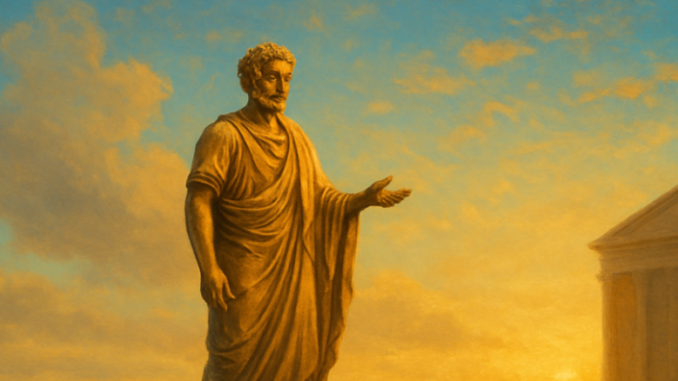
What drives a Roman emperor to write about the interconnectedness of all people while camped in a war zone? And why do those thoughts still resonate nineteen centuries later in the rituals of Masonic lodges around the world? The answers lie buried deep in the philosophical traditions that shaped Marcus Aurelius — traditions that continue to provide the foundations for fraternal bonds to this day.
Where Did Marcus Aurelius Draw His Ideas From?
This is perhaps the first question that arises when reading Book VI of the Meditations. Marcus Aurelius did not write in a vacuum. He stood on the shoulders of giants — generations of Stoic thinkers who had laid the groundwork before him. The Stoa, founded by Zeno of Citium around 300 BC, taught that all human beings are part of one cosmic community. This concept, the cosmopolis, forms the backbone of everything Marcus wrote about our obligations to one another.
But the emperor did not limit himself to a single source. He drank from multiple philosophical rivers: the practical ethics of Epictetus, the letters of Seneca, and the moral biographies of Plutarch. Each of these thinkers contributed a unique stone to the edifice of his thought on brotherhood.
What Did Epictetus Teach Him About Human Connection?
Epictetus, the freed slave who became one of the most influential Stoics, was the teacher Marcus never met in person — yet whose words he reread daily. Through his tutor Quintus Junius Rusticus, Marcus received the Discourses of Epictetus, a gift that would permanently transform his thinking. Epictetus taught that our true freedom lies in our attitude toward others, not in our power over them.
The true philosopher sees a brother in every fellow human being, because the spark of universal reason burns in each of us.
This idea echoes throughout Book VI, where Marcus repeatedly emphasizes that we are born to work together — like the rows of teeth in a mouth, like hands that support one another. This is not sentimental idealism but a logical conclusion drawn from Stoic physics: if everything in the universe is connected through the logos, the divine reason, then separation between people is an illusion.
How Did Seneca Shape His View of Brotherhood?
Seneca, who lived a generation before Marcus, had written extensively in his Epistulae Morales about the duties people owe one another. His letters on friendship and his treatises on benefits served as a practical handbook for ethical coexistence. Where Epictetus laid the theoretical foundation, Seneca offered concrete application.
In Book VI, Marcus echoes this practical approach. He does not merely ask why we should be compassionate — he asks how. What do you do when someone irritates you? How do you respond to ingratitude? The answers he formulates clearly bear the stamp of Seneca’s sober wisdom: return to your own inner self, remember that the other person is also struggling, and act from understanding rather than resentment.
What Role Did Plutarch Play?
Plutarch, the Greek biographer and philosopher, offered Marcus something the strict Stoics sometimes lacked: human stories. His Parallel Lives showed how virtue and brotherhood manifested in concrete historical figures. Alexander the Great sharing his cloak with a fellow soldier. Cato refusing privileges that were denied to his comrades. These examples were not abstract principles but living illustrations of moral conduct.
Marcus employed a similar method in his Meditations. He invoked the names of his own teachers and role models — not to glorify them, but to remind himself of the possibility of lived virtue. For him, brotherhood was not an ideal deferred to some future moment. It was a daily practice.
What Connects All of This to Freemasonry?
Here, philosophical tradition and Masonic practice meet at a deeper level. Freemasonry, which took its modern form in the eighteenth century, deliberately drew from the same sources as Marcus Aurelius. The Stoic emphasis on universal brotherhood, on the spark of the divine within every person, on the duty of self-improvement in service to the community — all of this is woven into the rituals and symbols of the lodge.
The building symbolism of Freemasonry reinforces this philosophical foundation. Just as Marcus wrote that people are made to work together like the stones of a building, Freemasons see themselves as rough stones shaped through fraternal labor into fitting building blocks of a greater human temple. It is no coincidence that the Meditations have been read in Masonic circles for centuries.
Consider the parallels: the Stoic cosmopolis mirrors Freemasonry’s ideal of universal brotherhood. Epictetus’ emphasis on inner freedom aligns with the Masonic pursuit of self-knowledge. Seneca’s practical ethics offer a blueprint for brotherly conduct within the lodge and beyond. And Plutarch’s exemplary figures function as moral compasses — much like the symbolic tools and allegories that guide a Mason’s journey.
Why Does This Philosophical Background Still Matter?
Because the questions Marcus asked remain our questions. How do we live together in a world full of difference? How do we preserve our humanity when others disappoint us? The Stoic answers are not ready-made solutions but tools for reflection. They invite an ongoing conversation with ourselves and with others — precisely the kind of dialogue that takes place in the silence of a lodge or in the solitude of personal contemplation.
The philosophical background of Book VI reveals that Marcus Aurelius’ thoughts on our shared humanity were not isolated flashes of inspiration. They were the result of centuries of philosophical inquiry into what it means to be human among humans. From Zeno to Epictetus, from Seneca to Plutarch — each of these thinkers contributed to a vision of brotherhood that continues to inspire today.
For Freemasons, this tradition offers a rich and living heritage. The philosophical roots that nourished Marcus Aurelius’ reflections on brotherhood are the same roots that sustain the fraternal ideals of the Craft. Understanding where these ideas came from does more than deepen our appreciation of a Roman emperor’s private journal — it illuminates the timeless foundations upon which every lodge, every ritual, and every act of brotherly love continues to be built.
Copyright text & image: devrijmetselaar.nl
Texts are based on the ideas and content of the author of devrijmetselaar.nl, reviewed, corrected, and supplemented with the assistance of OpenAI. Images are created based on the ideas of the author of devrijmetselaar.nl using OpenAI/DALL-E.
Frequently Asked Questions
What philosophical traditions influenced Marcus Aurelius' views on brotherhood?
Marcus Aurelius drew from multiple philosophical sources, primarily Stoicism founded by Zeno of Citium around 300 BC. The concept of cosmopolis—that all human beings are part of one cosmic community—forms the backbone of his thinking. He also studied the practical ethics of Epictetus, the letters of Seneca, and the moral biographies of Plutarch, each contributing unique perspectives to his understanding of human connection and brotherhood.
How did Epictetus influence Marcus Aurelius' understanding of human connection?
Though Marcus Aurelius never met Epictetus in person, he studied the Discourses of Epictetus through his tutor Quintus Junius Rusticus daily. Epictetus taught that true freedom lies in our attitude toward others, not in power over them, and that every human being shares the spark of universal reason. This idea permeates Book VI, where Marcus emphasizes that people are born to work together like interconnected parts of a unified whole.
Why do Marcus Aurelius' ideas about brotherhood still resonate in Masonic lodges today?
Marcus Aurelius' philosophical insights about interconnectedness, universal reason (logos), and our obligations to one another established enduring principles that transcend centuries. These core concepts about human unity and fraternal bonds have been integrated into Masonic rituals and traditions, demonstrating that his logical conclusion—that separation between people is an illusion—continues to provide the foundational values for fraternal organizations worldwide.


Be the first to comment