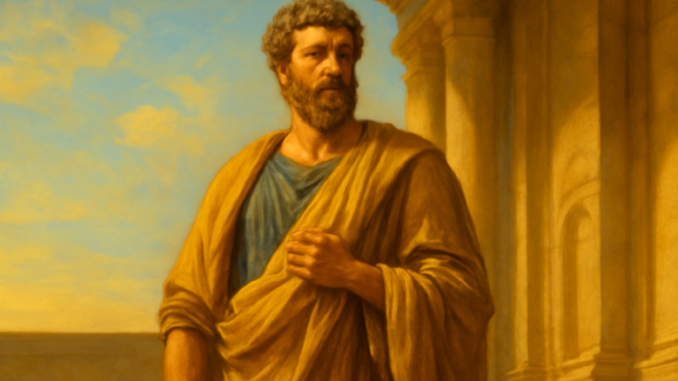
When Marcus Aurelius writes in the sixth book of his Meditations that only virtue possesses real value, he is not speaking as a solitary thinker philosophizing in his tent. He is articulating a tradition that began more than four centuries before him in the colonnades of Athens, was shaped by exiles and slaves, and ultimately reached the throne of the Roman Empire. The claim that virtue is the sole good forms the beating heart of Stoicism — but what does it actually mean? And which thinkers forged this conviction before an emperor committed it to his private journal?
The Paradox of the Stoic Good
Here lies a philosophical paradox that deserves careful examination. Stoicism asserts that virtue — and only virtue — is good. Wealth is not good. Health is not good. Even life itself is not good. How can such an extreme position be reasonable? The answer lies in the Stoic definition of the good: something is truly valuable only if it always, under all circumstances, leads to well-being. Wealth can breed greed, health can foster arrogance, and a long life can descend into idleness. But a virtuous character, the Stoics argued, can never be misused. You can have too much money, but you can never have too much justice.
This idea did not originate with Marcus Aurelius. It traces back to Zeno of Citium, who around 300 BCE began teaching in the Stoa Poikile — the painted colonnade from which the philosophical school takes its name. Zeno was a merchant who lost everything in a shipwreck. In that loss, he discovered a fundamental question: if external things can be taken away, what remains that is truly mine?
Chrysippus and the Systematization of Virtue Ethics
After Zeno came Chrysippus, the man who gave Stoicism its logical backbone. He reportedly wrote more than seven hundred works, nearly all of which have been lost. Yet we know his central argument: the virtues form an indivisible unity. A person who is truly courageous must also be just, because courage without justice is mere recklessness. A person who is wise must also be temperate, because wisdom without moderation leads to intellectual arrogance. This idea of the unity of the virtues permeates the sixth book of Marcus Aurelius’s Meditations.
Virtue, in this view, is not a collection of separate qualities but a single, indivisible stance toward existence. For anyone who has reflected on how moral qualities depend on and reinforce one another, this insight carries profound weight. No virtue stands alone; each draws its meaning from the whole.
Epictetus: The Teacher Behind the Emperor
Between the Greek founders and the Roman emperor stands a crucial figure: Epictetus. Born into slavery and later freed, he became the most influential Stoic of his era. His Enchiridion and Discourses served as the direct intellectual nourishment for Marcus Aurelius. Epictetus introduced a practical distinction that echoes throughout the sixth book of the Meditations: the difference between what is within our power and what is not. Only our judgments, our impulses, our desires, and our aversions truly lie within our control. Everything else — from bodily health to imperial authority — is ultimately on loan.
This distinction is neither passive nor fatalistic, as critics sometimes claim. It is an invitation to radical responsibility. If only my character is truly mine, then my character is also the only thing for which I can be held fully accountable. The external world can inflict harm upon me, but only I can damage myself morally. This is a bracing thought — one that places the entire burden of moral development squarely on the individual.
The Roman Context and Seneca’s Influence
The Stoicism Marcus Aurelius inherited was no longer the purely Greek system of Zeno. It was a Roman Stoicism, infused with practical wisdom and political experience. Seneca, the wealthy senator who served under Nero, had made Stoic philosophy accessible to the Roman elite. His letters to Lucilius address precisely the tension Marcus Aurelius knew intimately: how does one live virtuously while entangled in the compromises of power?
Seneca acknowledged that the wise person is not immune to suffering. The sage feels pain, grieves, and experiences fear. But the sage does not allow these emotions to govern his judgment. Seneca drew a distinction between the initial emotional impulse — which is involuntary — and the assent we give to that impulse, which does lie within our control. This psychological insight deeply informed the personal notes of Marcus Aurelius and gave Roman Stoicism a human warmth that the earlier, more austere Greek formulations sometimes lacked.
A Counterpoint: The Peripatetic Critique
It would be intellectually dishonest to present the Stoic position as though it went unchallenged. The Peripatetics — followers of Aristotle — offered a powerful counterargument. They acknowledged that virtue is necessary for happiness but insisted it is not sufficient. A virtuous person being tortured, they argued, cannot truly be called happy. This difference is far from trivial. It touches on the question of whether philosophy can offer genuine consolation in extreme circumstances, or only in the comfortable quiet of the study.
Marcus Aurelius was well aware of this critique, and his sixth book bears witness to an inner struggle. He repeats his Stoic principles like mantras, as though he must convince himself. The imperial throne gave him wealth and power, but it also brought war, betrayal, and plague. In that context, the claim that only virtue is good is not an abstract principle — it becomes an existential necessity, a lifeline amid chaos.
The Synthesis: Virtue as an Inner Compass
What remains when we weave these philosophical threads together? From Zeno, Marcus Aurelius inherited the conviction that external goods are unreliable. From Chrysippus, he learned that the virtues are inseparably connected. From Epictetus, he received the practical distinction between what lies within our power and what does not. From Seneca, he adopted the psychological nuance that wisdom does not demand the suppression of feeling.
The result is a philosophical position that is at once humble and ambitious. Humble, because it acknowledges that we cannot control the external world. Ambitious, because it holds us fully responsible for who we become. In this synthesis lies a profound lesson for anyone walking a path of self-improvement: the outer world will always be uncertain, but the inner work of cultivating virtue remains entirely within our reach. It is a compass that never stops pointing toward our highest potential — no matter the storms that rage around us.
The Stoic tradition that Marcus Aurelius inherited and enriched reminds us that virtue is not merely one good among many — it is the foundation upon which all other goods derive their meaning. From a shipwrecked merchant in ancient Athens to a beleaguered emperor on the Danube frontier, the same conviction endured: what matters most is not what happens to us, but who we choose to be in response. For those who seek to build their character with intention and integrity, this ancient wisdom remains as vital and as challenging as it ever was.
Copyright text & image: devrijmetselaar.nl
Texts are based on the ideas and content of the author of devrijmetselaar.nl, reviewed, corrected, and supplemented with the assistance of OpenAI. Images are created based on the ideas of the author of devrijmetselaar.nl using OpenAI/DALL-E.
Frequently Asked Questions
What does Stoicism mean when it claims that only virtue is truly good?
Stoicism defines the good as something that always leads to well-being under all circumstances and can never be misused. While wealth, health, and even life itself can be taken away or lead to negative outcomes, virtue is the only thing that remains valuable in all situations because a virtuous character can never be corrupted or used for harm.
Who founded Stoicism and what inspired this philosophy?
Stoicism was founded by Zeno of Citium around 300 BCE, who began teaching in the Stoa Poikile (the painted colonnade in Athens). Zeno was a merchant who lost everything in a shipwreck, which led him to question what truly belongs to us if external possessions can be taken away, ultimately shaping the core Stoic belief that only virtue is truly ours.
What was Chrysippus's major contribution to Stoic philosophy?
Chrysippus systematized Stoicism by arguing that the virtues form an indivisible unity—a person cannot possess one virtue without possessing all others. For example, true courage requires justice, and genuine wisdom requires temperance. This idea means virtue is not a collection of separate qualities but a single, unified stance toward existence that influenced later thinkers like Marcus Aurelius.



Be the first to comment