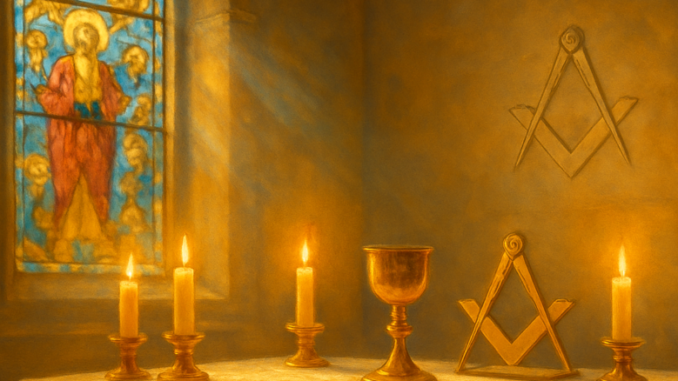
In an age of growing secularism, Roman Catholicism remains one of the most enduring pillars of Western culture. But how does this ancient tradition relate to Freemasonry — an organization that defines itself not as a religion, but as a brotherhood with deep spiritual roots? The answer reveals surprising parallels, historical tensions, and a shared quest for meaning that continues to resonate today.
Roman Catholicism: A Tradition Built on Ritual
Roman Catholicism has deep historical roots across Europe and the wider world. Despite declining church attendance in many countries, the faith continues to shape the cultural and spiritual landscape. At its heart lie the sacraments, the celebration of the Eucharist, and a strong emphasis on tradition. The interior of a Catholic church reflects this beautifully — richly decorated altars, candles burning as prayers made visible, and stained-glass windows that tell the stories of Scripture.
What makes Catholicism particularly distinctive is its ritual nature. From baptism to marriage and the funeral rite, every significant moment in life is framed by ceremony. These rituals provide structure, a sense of belonging, and something many regard as a spiritual compass — guiding the faithful through life’s most profound transitions.
Freemasonry: Ritual in a Different Form
Like Roman Catholicism, Freemasonry is steeped in ritual — but its purpose and context differ considerably. Within the Masonic lodge, symbols and ceremonies play a central role in personal development. They encourage the pursuit of self-knowledge and a deeper understanding of universal truths about human existence.
Freemasonry is not dogmatic and does not require its members to adhere to any specific creed. This makes it a compelling complement to traditional religions such as Catholicism. Despite their differences, both share a common foundation: the search for meaning and a connection to something greater than oneself.
Striking Parallels Between Catholicism and Freemasonry
When you look more closely, the similarities between these two traditions are remarkable. They share several key elements that speak to the enduring power of ritual and community in human life.
Symbolism: In both the Catholic liturgy and Masonic ritual, symbolism plays a crucial role. A crucifix or the square and compasses are far more than objects — they embody deeper spiritual values and serve as focal points for contemplation and moral reflection.
Community: Both Catholic parishes and Masonic lodges provide a community where members feel connected and grow together spiritually. This sense of belonging — of being part of something meaningful — is a powerful draw in both traditions.
Rites of Passage: Both traditions use ceremonies to mark important transitions. In Catholicism, these include baptism, First Communion, and Confirmation. In Freemasonry, they take the form of initiations into successive degrees, each representing a new stage of moral and philosophical development.
Historical Tensions and the Path Toward Dialogue
Historically, the Catholic Church has viewed Freemasonry with suspicion. The perceived secrecy of the Craft and its emphasis on individual interpretation of spiritual truths have at times been at odds with Church doctrine. Papal encyclicals, most notably Pope Leo XIII’s Humanum Genus of 1884, explicitly condemned Freemasonry, and the Church’s official position has remained cautious.
Yet the reality on the ground tells a more nuanced story. Today, there are Freemasons who are also active and devout members of the Catholic Church. This suggests a growing — if informal — mutual understanding. Many of these individuals see no contradiction between their faith and their Masonic membership, viewing the lodge as a space for philosophical exploration that enriches rather than undermines their religious life.
Cooperation in Diversity
Although Roman Catholicism and Freemasonry may appear quite different on the surface, they share a fundamental driving force: the desire to provide a moral and spiritual framework for living a meaningful life. For Catholics seeking depth and reflection beyond doctrinal boundaries, Freemasonry can offer a valuable complement. For Freemasons, the Catholic tradition can add an extra layer of meaning to their spiritual journey.
Both traditions remind us that the human need for ritual, symbolism, and community is as strong as ever. In a world where spirituality is becoming increasingly individualized, the structured approaches of Catholicism and Freemasonry demonstrate that tradition still has the power to inspire, challenge, and transform.
In an era when many are searching for personal meaning outside conventional structures, both Roman Catholicism and Freemasonry show that ritual and tradition remain profoundly relevant. Rather than viewing them as competitors, we might recognize them as two paths that, each in their own way, guide seekers toward greater understanding, deeper community, and a richer inner life.
Copyright text & image: devrijmetselaar.nl
Texts are based on the ideas and content of the author of devrijmetselaar.nl, reviewed, corrected, and supplemented with the assistance of OpenAI. Images are created based on the ideas of the author of devrijmetselaar.nl using OpenAI/DALL-E.
Frequently Asked Questions
Is Freemasonry a religion?
No, Freemasonry is not a religion but rather a brotherhood with deep spiritual roots that welcomes members of all faiths, including Roman Catholics. It focuses on personal development and the pursuit of self-knowledge rather than requiring adherence to any specific creed or dogma.
What is the relationship between Freemasonry and Roman Catholicism?
While historically there have been tensions between the two traditions, Freemasonry and Roman Catholicism share remarkable parallels in their use of ritual, symbolism, and community to guide members toward spiritual meaning. Both traditions emphasize the search for connection to something greater than oneself and use ceremonies to mark important life transitions.
How does Masonic ritual compare to Catholic ritual?
Both traditions place great importance on ritual and symbolism as tools for spiritual growth and reflection. However, while Catholic rituals are tied to specific sacraments and scriptural traditions, Masonic rituals encourage personal development and the pursuit of universal truths without dogmatic requirements, making them complementary rather than contradictory.
What role does community play in Freemasonry?
Like Catholic parishes, Masonic lodges provide a sense of belonging and community where members connect spiritually and grow together. This powerful sense of being part of something meaningful is a central aspect of the Masonic experience and helps guide members through life's transitions.
Can Catholics be Freemasons?
Freemasonry welcomes members of all faiths, including Catholics, as it does not conflict with religious belief but rather complements it through its focus on personal moral development and universal spiritual truths. Members are free to maintain their religious traditions while enjoying the benefits of Masonic fellowship and philosophical exploration.

Be the first to comment