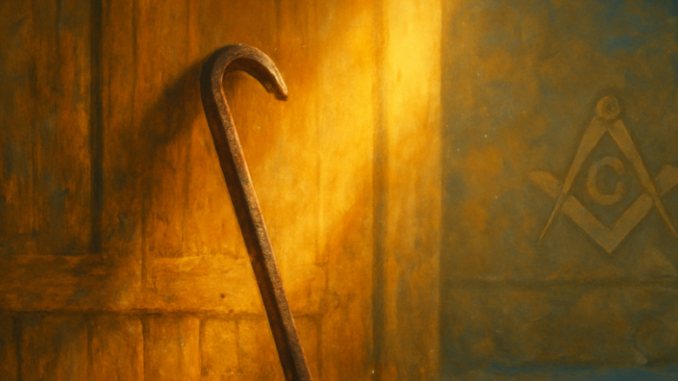
Sometimes you need a crowbar to pry something open — not just in the physical world, but in your inner life as well. The crowbar symbol and its meaning reach far beyond the practical tool we know from construction sites. This simple instrument carries a powerful spiritual message: some doors in our lives only open when we are willing to apply real force. In Freemasonry, where working tools serve as central symbols, the crowbar offers a surprisingly compelling perspective on personal transformation.
What the Crowbar Symbol Tells Us About Resistance
You probably know the feeling. Something in your life has rusted shut. A habit you cannot let go of. A belief that limits you but that you cannot seem to break through. A relationship that no longer works but that you cling to anyway. In moments like these, the image of the crowbar acts as a mirror. The pry bar does not ask for subtlety — it asks for honesty about what is truly needed.
The meaning of this tool lies in its directness. Where other instruments perform fine, delicate work, the crowbar is designed for one purpose: overcoming resistance. In a spiritual sense, it represents those moments when a gentle approach no longer suffices. When you have been circling around a problem for years, only forceful action can bring about real change.
The Crowbar as a Spiritual Tool
Within the Masonic tradition, working tools are central to the Craft. The gavel, the chisel, the compasses, the square — each tool carries a lesson about self-improvement. The crowbar is mentioned less frequently, but it deserves attention precisely because it symbolizes the uncomfortable work. It stands for those moments when you must tear something down before you can rebuild.
This tearing down is not destruction for its own sake. It is the conscious dismantling of what no longer serves you. Think of an old barn that you are converting into a workshop. The rotting beams must come out before you can install new ones. Inner growth works the same way. Sometimes you have to wrench a rusted belief loose with force before space opens up for something new.
Three Ways to Apply the Crowbar Principle
How do you translate the meaning of the crowbar symbol into your daily life? Here are three concrete applications you can put into practice right away.
1. Identify your rusted-shut doors. Take pen and paper and write down three situations in which you have been experiencing the same frustration for months or even years. These are your potential crowbar moments.
2. Consciously choose force over comfort. Select one of those situations and take a concrete action within 48 hours — one you would normally avoid. Have a difficult conversation. Radically break a habit. Make a decision you have been putting off.
3. Accept the noise. Crowbar work is not elegant. Expect resistance, discomfort, and perhaps temporary chaos. This is part of the process. The stillness comes later, when the newly created space begins to fill with something better.
The Wisdom of Knowing the Right Moment
The crowbar symbol also carries a warning. Not every door deserves a pry bar. Sometimes patience is the better path. The art lies in discerning when gentle pressure is enough and when forceful action is necessary. In Freemasonry, there is a principle about knowing your tools — and this means understanding when to use each one.
A wise person knows the difference between a wall that protects and a wall that imprisons.
Ask yourself honestly: does this resistance protect me, or does it keep me small? If the answer is the latter, then you know what needs to be done. The crowbar awaits your decision.
From Demolition to Construction: Completing the Cycle
The crowbar is not an endpoint. It is a beginning. After you have pried open what was stuck, the real work follows. The Freemason sets down his crowbar and picks up his building tools. The leverage was necessary, but it is only the first step in a larger process of inner architecture.
This understanding is what separates destructive behavior from constructive transformation. You do not tear down to destroy. You tear down so that you can rebuild. The pain of breaking open gains meaning through what you put in its place. That is why reflection after the crowbar moment is essential. What do you want to build in the space you have created?
A Daily Practice
Start each morning with this question: what small resistance can I break through today? It does not have to be dramatic. A phone call you have been postponing. An excuse you keep making. A boundary you have been afraid to set. By practicing with small crowbar moments every day, you build the strength for the larger transformations when they inevitably arrive.
The crowbar symbol and its meaning invite you to look honestly at what has become stuck in your life. This simple tool reminds us that growth sometimes demands force, not just patience. In the spiritual tradition of Freemasonry, we find the wisdom to know when gentleness works and when the pry bar is called for. The question that remains is a personal one: which door in your life is waiting for forceful action? The tool is ready. The decision is yours.
Copyright text & image: devrijmetselaar.nl
Texts are based on the ideas and content of the author of devrijmetselaar.nl, reviewed, corrected, and supplemented with the assistance of OpenAI. Images are created based on the ideas of the author of devrijmetselaar.nl using OpenAI/DALL-E.
Frequently Asked Questions
What does the crowbar symbol mean in Freemasonry?
In Freemasonry, the crowbar is a working tool that symbolizes overcoming spiritual and personal resistance through direct, forceful action when gentler approaches have failed. It represents the conscious dismantling of limiting beliefs and outdated patterns to make room for genuine inner growth and transformation. The crowbar teaches us that sometimes meaningful change requires us to confront difficult truths and take bold action rather than remain comfortable in stagnation.
How is the crowbar different from other Masonic working tools?
While other Masonic tools like the gavel, chisel, compasses, and square represent fine, delicate work and precision, the crowbar stands apart as a symbol of necessary force and directness. It specifically addresses those uncomfortable moments when subtle approaches no longer suffice, making it a powerful reminder that spiritual progress sometimes demands we tear down what no longer serves us before rebuilding something better.
Can I apply the crowbar principle to my everyday life?
Absolutely—Freemasonry teaches that these symbolic working tools have practical applications for personal development. You can identify areas where you've been stuck for years, consciously choose to take difficult action within 48 hours, and accept that meaningful change may feel uncomfortable or chaotic at first. By embracing the crowbar principle, you honor the Masonic commitment to continuous self-improvement and transformation.
Why does Freemasonry use working tools as spiritual symbols?
Freemasonry uses working tools as central symbols because they provide concrete metaphors for the internal work of self-improvement and spiritual development. Each tool—including the crowbar—carries a specific lesson about character building and personal transformation. This practical, hands-on approach makes abstract spiritual concepts tangible and actionable, helping Masons understand that their inner work parallels the careful, intentional work of a skilled craftsman.
Is the crowbar symbol about being destructive or forceful in a negative way?
No—the crowbar symbol in Freemasonry represents conscious, purposeful action, not destruction for its own sake. It teaches that sometimes we must forcefully remove what is rusted shut, damaged, or no longer serving us, just as a builder must remove rotted beams before constructing something sound and new. This principle honors the dignity of the process and recognizes that temporary discomfort leads to lasting positive transformation.


Be the first to comment