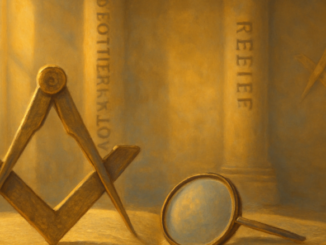
Masonic symbols including square and compasses in soft contemplative light
Symbolism & Rituals

Allusive Meaning: Symbols That Whisper in the Silence

The allusive meaning of a symbol does not unfold through explanation — it unfolds through experience. In a world that demands directness and clarity, the allusion offers a refined alternative: it invites reflection without imposing conclusions. For the Freemason, this is not a rhetorical device but a way of life. Today, we explore how the allusive dimension of symbolism bridges the visible and the hidden — the space between what can be spoken and what can only be felt. What Is the Allusive Meaning of a Symbol? When we speak of allusive meaning, we enter the realm of indirect reference. An allusion is never a straightforward statement. It is a nod, a wink toward something greater than the words or images being used. In literature, we recognize this as a reference to a well-known story or figure without naming it explicitly. In symbolism, the concept goes further: the entire medium of communication becomes a whisper. The square and compasses, the rough ashlar, the trowel, the plumb line — all of these objects from the stonemason’s craft carry meanings that extend far beyond their physical form. They point toward something else, something the initiated recognize without it ever needing to be […]
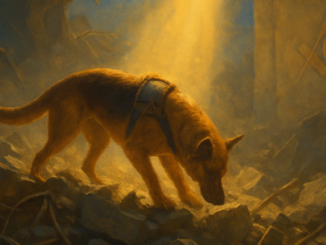
Search dog working through building rubble symbolizing Masonic brotherhood
Personal Development & Leadership

The Search Dog as Teacher: Finding Brotherhood in the Rubble

A search dog picks its way through the rubble of an exploded building in Amsterdam. The footage circulated across the Netherlands this past week, drawing millions of eyes. But for those willing to look beyond the headlines, the images reveal something far more profound than breaking news: a creature moving without hesitation toward what has been lost. In that unconditional devotion lies a lesson Freemasons have been trying to understand for centuries — what does it truly mean to show up for another person? Searching Without Knowing What You Will Find The search dog knows no doubt. It follows its nose, trusts its training, and surrenders completely to the task at hand. Whether the search will lead to a living person, a body, or nothing but emptiness — the animal does not know. And yet it searches. This posture of unconditional action without any guarantee of results strikes at one of the core paradoxes of human connection. We humans hesitate because we cannot see the outcome. The dog reminds us that true devotion needs no certainty. In Freemasonry, we speak of the search for light — a symbolic journey toward insight and truth. But just like the search dog, the […]

Freemason contemplating philosophical questions in a symbolic lodge setting
Philosophy & Ethics

Agnosticism as a Way of Life: The Questioning Freemason

Agnosticism is often mistaken for indifference or an inability to make up one’s mind, but nothing could be further from the truth. It is a deliberate philosophical stance — one that acknowledges certain questions may never be definitively answered. For the Freemason, who is constantly rearranging the building blocks of his inner life, this attitude offers remarkably fertile ground. The answer is not what matters most; what matters is the courage to keep asking the question. The Origins of Agnosticism The term “agnostic” was coined in the nineteenth century by British scientist Thomas Henry Huxley, who sought to express the idea that certain metaphysical truths lie beyond the reach of human knowledge. The Greek prefix “a” means “without,” and “gnosis” means “knowledge” — literally, without knowledge. But this bare translation fails to capture the richness of the concept. Agnosticism is not intellectual laziness; it is a sincere recognition of the limits of human understanding. Throughout the centuries, countless thinkers have wrestled with the question of what we can truly know about the transcendent, about the origins of existence, about what lies behind the veil of observable reality. The agnostic position refuses to answer these questions with certainties that cannot be […]

Compasses and square on a stone surface symbolizing Masonic trust and balance
Freemasonry & Society

Interest Rates as a Measure of Trust: A Masonic Perspective

When a central bank announces an interest rate hike, financial markets react, economists debate, and homeowners recalculate their budgets. But behind the numbers lies a deeper question that has fascinated Freemasons for centuries: what is the true nature of trust in a society, and how do we build foundations strong enough to endure when the winds change direction? The Invisible Architect of Value Money is, in essence, crystallized trust. A banknote has no intrinsic value — it is a promise, a symbol of collective belief in a system. When central banks adjust interest rates, they are turning dials designed to regulate that trust. Too much money in circulation undermines value; too little stifles growth. It is a delicate dance between abstract concepts that carries very real consequences for millions of people. For Freemasons, this terrain is not unfamiliar. The Craft has a rich symbolic language built around construction, measurement, and balance. The compasses and the square are not merely tools of the stonemason — they are metaphors for finding equilibrium and measuring proportions. In a broader societal context, they invite us to reflect: what invisible structures support our civilization, and who safeguards their integrity? Trust as the Foundation A rate […]

Masonic level and gavel symbolizing equality and fair judgment
Freemasonry & Society

Social Condemnation: Judgment Without a Gavel

When news breaks that a public figure has been accused of a serious crime, society often delivers its verdict long before any judge has spoken. We have seen this pattern play out time and again: allegations become public, and within hours a collective judgment has already formed. This phenomenon touches on fundamental questions about justice, human dignity, and how we as a society deal with guilt and innocence. And it is precisely on these matters that Freemasonry — with its centuries-old tradition of moral reflection — has a surprising amount to offer. The Court of Public Opinion In our age of instant news and social media, the court of public opinion is permanently in session. The moment an accusation becomes public, millions of people begin forming their judgment. This happens without access to the evidence, without hearing both sides, and without the nuance that a proper trial demands. Social condemnation moves at lightning speed and is often irreversible — even when an acquittal follows later. This raises an uncomfortable question: what does this rush to judgment say about us? Freemasonry teaches its members that forming a judgment about a fellow human being is one of the gravest responsibilities a person […]

Masonic square and compasses symbolizing allusive meaning in Freemasonry
Symbolism & Rituals

Allusive Meaning: The Art of Veiled Speech in Freemasonry

When we speak of the allusive meaning of words and images, we enter a fascinating realm where nothing is said directly, yet everything is suggested. Allusion is the art of the hint — a reference to something greater without ever naming it outright. In Freemasonry, this way of communicating forms the beating heart of symbolic language. Where others seek direct answers, the Freemason embraces the power of what remains unspoken. What Does “Allusive” Actually Mean? The word “allusive” derives from the Latin alludere, which literally means to play toward something or to refer to it indirectly. An allusive expression never states its meaning outright — instead, it plays with references that the listener or reader must decipher. This demands active engagement, a willingness to look beneath the surface. In everyday language, we use allusions far more often than we realize. When someone speaks of an “Achilles’ heel” or a “stumbling block,” they are referencing stories that resonate far deeper than the words themselves. Allusive meaning distinguishes itself from literal meaning by drawing on shared knowledge, experience, or culture. It creates a bond between speaker and listener — an invisible thread of understanding that exists only for those who recognize the […]

Masonic symbols representing the agnostic search for truth and meaning
Philosophy & Ethics

Agnosticism and Freemasonry: The Art of Not Knowing

What if the answer to life’s greatest questions isn’t a definitive yes or no, but an honest “I don’t know”? Agnosticism makes room for exactly that kind of intellectual humility. Far from being a position of weakness, it takes genuine courage to acknowledge that some truths may lie beyond our reach. In Freemasonry, we find a remarkable kinship with this philosophical stance — not as doctrine, but as a living practice of seeking without the pretense of final answers. What Does Agnosticism Actually Mean? The word “agnostic” has its roots in Greek: “a” means without, and “gnosis” means knowledge. An agnostic is, quite literally, someone who acknowledges that certain knowledge — particularly about the existence of a higher power or the ultimate purpose of the universe — may be fundamentally unattainable. This is not intellectual laziness. It is a deeply considered epistemological position. The agnostic doesn’t claim that truth doesn’t exist, but rather that we as human beings may lack the tools to fully grasp it. The term was first coined in the nineteenth century by the British biologist Thomas Henry Huxley, who grappled with the question of how we can truly know what we think we know. Since then, […]

Famous Freemasons and their hidden Masonic symbols throughout history
Symbolism & Rituals

Famous Freemasons and Their Hidden Symbols Explored

When people hear about famous Freemasons, the mind often drifts to conspiracy theories and shadowy meetings in smoke-filled back rooms. The reality is far richer and more fascinating. Countless historical figures who shaped the course of civilization were members of the Craft, and they wove Masonic symbolism into their art, music, and writings — not to conceal secrets, but to express universal truths that words alone cannot capture. In this article, we unravel that hidden language and explore why symbols meant so much to these illustrious Brethren. Why Famous Freemasons Chose the Language of Symbols The eighteenth and nineteenth centuries were a golden age for Freemasonry. Among its members were composers, writers, scientists, and statesmen. What united them was not merely a desire for brotherhood, but a shared symbolic language. That language allowed them to convey complex philosophical ideas without being pinned down by dogma or political allegiance. For these Brethren, symbols were not decorations or secret codes. They were thinking tools. Just as the compasses and the square serve the builder in achieving precision, symbols in Freemasonry serve to bring order to one’s inner life. A triangle points to the harmony of body, mind, and soul. A staircase represents […]

February symbolism and purification represented through Freemasonry traditions
Freemasonry & Society

February Symbolism: Purification and Its Role in Society

February carries a depth of meaning that stretches back thousands of years, rooted in ancient traditions of purification, reflection, and societal renewal. The very name comes from the Latin word februare, meaning to cleanse. For the Romans, this was the month of purification — a time to settle old debts and prepare the community for a fresh start. This timeless symbolism resonates powerfully with Freemasonry, where the work of building a better society always begins with inner purification. The Origins of February: Symbolism of Cleansing The Roman festival of Februalia was devoted entirely to ritual purification. During this period, homes were scrubbed clean, offerings were made to the gods, and the city of Rome was swept clean — both literally and figuratively. This was no casual tradition. The Romans firmly believed that a society could only flourish when its members freed themselves of what no longer served them. In Freemasonry, we recognize this same principle in the concept of the rough ashlar. Every Freemason begins as an unworked stone and spends a lifetime chipping away at imperfections. This is not a selfish pursuit of perfection — it is a deeply social commitment. After all, how can we contribute to a […]

Rough and smooth ashlar stones symbolizing Masonic sustainability philosophy
Philosophy & Ethics

Sustainability as a Philosophical Foundation in Freemasonry

Picture this: two Freemasons sit together after a lodge meeting. One is an engineer specializing in circular economy. The other is a classicist, steeped in ancient philosophy. The conversation turns to sustainability. What follows is not a debate but a shared exploration — a dialogue that touches on what it truly means to bear responsibility for what comes after us. This conversation, reconstructed in essence, forms the foundation of this article. The Question That Opens Everything “What is sustainability, really?” the classicist asks, stirring his coffee with a pensive look. “We use the word as if everyone knows what it means. But is it a goal? A method? A moral duty?” The engineer smiles. “In my field, we talk about systems that can sustain themselves without exhausting their resources. But you’re right — that’s merely the technical definition. The philosophical question runs deeper: why should we care about what happens a hundred years from now?” This is precisely the question Freemasons have grappled with for centuries, albeit in different terms. The construction of the symbolic temple is not a project for a single lifetime. It is a work that transcends generations. The Stone You Leave Behind “Are you familiar with […]

Vrijmetselarij - Vrijmetselaarsliteratuur en inspiratie: boeken en bronnen die je laten groeien
Philosophy & Ethics

Masonic Literature & Inspiration: Books and Sources for Growth

Freemasonry is not a one-time experience — it is a lifelong journey of self-awareness, personal development, and meaningful connection. Beyond what happens inside the lodge, Masonic books, essays, and online resources form an invaluable treasury of knowledge and inspiration. Masonic literature opens doors to deeper understanding and offers practical tools to better grasp the symbolism, rituals, and philosophy of the Craft — and to apply them in your everyday life. Whether you are a curious seeker, a newly initiated Entered Apprentice, or a seasoned Master Mason, Masonic literature enriches your thinking, sharpens your intuition, and encourages meaningful reflection. Why Masonic Literature Is So Powerful Freemasonry is not about dogmas or fixed truths. It is about asking questions, seeking meaning, and shaping your own path. Books and written works support that process. They provide not only historical context but also philosophical frameworks, interpretations of symbolism, and personal testimonies from fellow travelers on the same road. Think of Masonic literature not as a textbook, but as a toolbox: you choose the tool that fits your journey at any given moment. Recommended Books to Get Started If you are new to Freemasonry or looking to build a solid foundation, several accessible books serve […]

Vrijmetselarij - Vrijmetselarij en filosofie: ontdek hoe denken en handelen samenkomen
Philosophy & Ethics

Freemasonry and Philosophy: Where Thought Meets Action

Philosophy might conjure images of dusty lecture halls, dense textbooks, or endless debates about the nature of existence. But within Freemasonry, philosophy takes on an entirely different character. It’s not abstract theorizing — it’s a living, practical way of engaging with the world. Freemasonry and philosophy walk hand in hand, forming a powerful path toward personal growth and deeper meaning. What Role Does Philosophy Play in Freemasonry? Philosophy in Freemasonry isn’t a standalone academic exercise. It’s woven into the very fabric of the craft’s ritual and symbolic system. Every degree, every ceremony, and every symbol is steeped in philosophical insight. The goal isn’t to promote a single school of thought, but to cultivate a way of life rooted in reflection, openness, and ethical awareness. Freemasonry invites you to live philosophically — to search for meaning, to embrace doubt, and to ask questions that go beyond the surface. Most importantly, it challenges you not only to think about your answers but to embody them in the way you act and treat others. Inspired by Great Thinkers Throughout the centuries, Freemasonry has drawn inspiration from some of history’s most influential philosophical traditions. Here are a few that have left a lasting mark […]

Vrijmetselarij - Vrijmetselarij en Zelfontwikkeling – Groeien naar de Beste Versie van Jezelf
Personal Development & Leadership

Freemasonry and Self-Development: Becoming Your Best Self

Freemasonry carries an air of mystery for many people. Some imagine secret rituals behind closed doors; others picture an exclusive, impenetrable society. But anyone who looks beneath the surface discovers something quite different: a practical, time-tested path for personal growth. Freemasonry and self-development are, in fact, inseparable — not as theory or dogma, but as a living practice of self-knowledge, reflection, and purposeful action. So what makes Freemasonry such a unique wellspring of self-development? In this in-depth guide, you’ll discover how this centuries-old tradition helps you bring out the best in yourself — and why that may matter more today than ever before. Self-Development: The Backbone of Freemasonry Self-development isn’t a luxury — it’s a necessity. In a world saturated with distraction, superficiality, and relentless pace, Freemasonry offers a powerful alternative. It’s a space where you’re encouraged to pause, reflect on your life, examine your behavior honestly, and take deliberate steps toward inner growth. In Freemasonry, everything revolves around who you truly are — not what you own or what title you hold. Whether you’re a CEO or a carpenter, an academic or an artist, only one question really matters: are you willing to work on yourself? Working the Rough […]

Skull and hourglass as Masonic memento mori symbols on a dark background
Content & Summary

Montaigne on Feelings That Reach Beyond Ourselves

In the sixteenth century, a French nobleman wrote an essay that still challenges the way we think about death, fame, and the memory we leave behind. Michel de Montaigne explored, in the third essay of his first book, how human emotions stretch toward times and places we will never experience. Centuries later, his questions still resonate — perhaps nowhere more deeply than in the symbolic world of Freemasonry, where mortality and eternity stand as central themes of reflection and ritual. The Core Idea of the Essay Montaigne opens with a deceptively simple observation: we concern ourselves with matters that lie far beyond our own existence. We worry about our reputation after death, about what will happen to our bodies, about the memory we leave behind. But can we truly feel anything about events that take place when we no longer exist? This is the central paradox Montaigne investigates. He argues that our emotions extend into domains our consciousness can never reach — and he wonders whether this makes any sense at all. Historical Examples as Mirrors As is typical of his essays, Montaigne draws liberally from classical antiquity. He cites Roman generals and Greek philosophers who were intensely preoccupied with […]

A single tear drop symbolizing grief, vulnerability, and Masonic brotherhood
Freemasonry & Connection

The Tear as Symbol: Montaigne, Grief, and Brotherhood

A tear falls. A single droplet of moisture sliding down a cheek. In everyday life, we might look past it quickly, or avert our gaze out of respect for someone else’s sorrow. But what if we truly considered this tear? What if we paused, as sixteenth-century philosopher Michel de Montaigne did in his essay “Of Sadness,” to reflect on what this small gesture reveals about our humanity and our connection to others? The Tear as a Language Beyond Words In his essay, Montaigne describes how the most intense emotions are sometimes too vast for words. The deepest grief, he observes, exceeds our ability to express it. When sorrow overwhelms us, the body takes over: we weep, we fall silent, we tremble. The tear then becomes more than a physical reaction — it becomes a symbol of everything that language cannot contain. Freemasonry holds a deep understanding of this language beyond words. Rituals, symbols, and gestures carry meanings that the intellect alone cannot fully grasp. Just as the tear speaks where the voice fails, so too do the working tools of the Freemason speak of truths that resist neat definitions. The square does not merely measure angles; it also measures the […]

Ancient temple illuminated by light symbolizing Isaiah and Freemasonry
Christianity

Isaiah and Freemasonry: Prophetic Images of Light and Building

Somewhere around 740 BCE, in the kingdom of Judah, a voice rose — not from a man who had chosen the role of prophet, but from one who had been called to it. In a vision filled with smoke and seraphim, he glimpsed something his contemporaries could not yet grasp: a future in which light would drive out darkness and a broken people would rise again as builders of a new age. The images woven through the Book of Isaiah continue to resonate millennia later, and their echoes are remarkably vivid in the symbolic language of Freemasonry. A Calling in the Temple The sixth chapter of Isaiah contains one of the most striking calling visions in all of biblical literature. The prophet finds himself in the temple when he sees a throne surrounded by six-winged beings. One of the seraphim touches a burning coal to his lips, purifying him of unrighteousness. This moment of transformation — from the impure to the pure — lies at the heart of everything Isaiah will go on to proclaim. For Freemasons, this theme feels deeply familiar. The candidate who enters the lodge undergoes a symbolic purification of his own. He leaves the profane world […]

Open book with Montaigne's Essays beside Masonic square and compasses in soft light
Michel de Montaigne – The Essays

Montaigne on Grief: Philosophical Roots and Masonic Symbolism

There comes a moment when words fail. A moment when the soul is so overwhelmed by sorrow that it freezes, falls silent, or erupts in a flood no one anticipated. Michel de Montaigne wrote about precisely this in his second essay — a brief but deeply penetrating exploration of the limits of human emotion. Beneath its seemingly simple subject lies a rich philosophical inheritance stretching from the Greek Stoics to Renaissance humanism. And for those accustomed to thinking in symbols, it opens a world of meaning that reaches far beyond the surface of everyday experience. The Silent Voice of the Stoics Montaigne‘s reflections on grief are unthinkable without Stoic philosophy. This school of thought, born in third-century Athens, taught that emotions are the result of the judgments we make about reality. Sorrow does not arise from what happens to us, but from how we interpret it. Seneca, the Roman philosopher whom Montaigne so frequently quotes, wrote extensively about the art of dealing with loss and adversity. He insisted that the wise person does not suppress emotions but learns to understand them. In his essay on sadness, however, Montaigne takes a more nuanced position. He observes that extreme emotions sometimes paralyze […]

Vrijmetselarij - Freemasonry and Ethics – Building Your Best Self
Philosophy & Ethics

Freemasonry and Ethics – Building Your Best Self

In a world increasingly driven by superficiality and snap judgments, many of us long for something deeper. For integrity. For authenticity. For a way to grow — not just in knowledge, but in character. This is where Freemasonry enters the picture: an ancient system that doesn’t just offer philosophical insights, but actively invites you to put them into practice. And nowhere is that invitation more powerful than in the realm of ethics. What Does Ethics Mean in Freemasonry? Ethics in Freemasonry is not a rigid set of rules or dogmas. It functions as a living compass — an inner guide that is continually sharpened through self-reflection, ritual, and fraternal interaction. You don’t learn a standard answer to what is “good.” Instead, you learn to ask yourself the right questions: What are my true intentions? What is my responsibility? How can I contribute to the greater good — in my community, my work, my relationships? Freemasonry invites you to see ethics not as abstract theory, but as something you experience, apply, and develop in your daily life. Ethics Begins with Yourself Freemasons work with a powerful symbol: the rough ashlar. This unworked stone represents your unrefined self — full of potential, […]

A veiled figure in silent grief, symbolizing Montaigne's essay on sadness
Content & Summary

Montaigne on Grief: When Words Fall Short

There comes a moment when grief cuts so deep that it turns to silence. Tears refuse to fall, words catch in the throat, and what remains is a stillness that weighs more than any gesture. Michel de Montaigne explored this phenomenon in his brief but penetrating essay ‘On Sadness,’ the second chapter of his monumental Essays. He poses a question that resonates as powerfully today as it did in the sixteenth century: what happens when emotion exceeds the limits of expression? The Core Idea: Emotion Beyond Expression Montaigne opens his essay with a striking claim: he professes to be hardly susceptible to sadness himself. This is not an attempt at Stoic indifference but rather a runway toward his real subject. What fascinates him are those moments when grief becomes so overwhelming that the body simply cannot express it. Instead of releasing us, the sheer intensity of the emotion paralyzes us. This central insight illuminates a paradox most of us recognize: the most intense feelings sometimes manifest as total silence. A mother who loses her child may appear calm while others weep around her. Only later, when the initial shock begins to subside, do the tears come. Montaigne sees in this […]

Vrijmetselarij - What Is Freemasonry? Core Principles, Symbolism and Purpose
Personal Development & Leadership

What Is Freemasonry? Core Principles, Symbolism and Purpose

Freemasonry is one of the oldest fraternal organizations in the world, yet it remains widely misunderstood. It is not a religion, not a political movement, and certainly not a secret society — but rather a society with secrets. At its heart, Freemasonry brings people together around a shared purpose: personal and moral development. Through symbols, rituals, and allegory, members are given the tools to better understand themselves and find deeper meaning in life. Why Do People Join Freemasonry? In a world saturated with distractions, superficiality, and relentless pressure to perform, more and more people are searching for something deeper — genuine connection and purposeful reflection. Freemasonry offers a space where you can pause, reflect, and learn alongside others who walk the same path. It is not about receiving ready-made answers. Instead, it is about learning to ask better questions — about yourself, your values, and your place in the world. The Three Pillars of Freemasonry Freemasonry rests on three fundamental pillars that guide every member’s journey. These principles shape the experience within the lodge and extend far beyond its walls into everyday life. Brotherly Love Within a lodge, members form a close-knit community built on mutual support, encouragement, and inspiration. […]