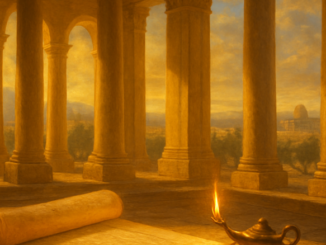
Golden seven-branched lampstand flanked by two olive trees in soft light
Christianity

Zechariah’s Golden Lampstand: A Mirror of the Inner Self

In the Book of Zechariah, there stands a lampstand. Not an ordinary one, but a golden lampstand with seven lamps, fed by two olive trees that channel their oil directly into its reservoir. This striking image from the fourth chapter of the prophetic text invites us to pause and reflect. What does it mean to receive light without effort of your own? And what might this ancient vision tell us about the way we build ourselves — and the world around us — today? A Lampstand That Feeds Itself Imagine a lamp that never needs refilling. The oil flows on its own; the flame never dies. In Zechariah’s vision, this golden lampstand stands at the center, flanked by two olive trees. The prophet asks what it all means, and the answer is profound: “Not by might, nor by power, but by my Spirit.” With those words, the focus shifts away from human effort toward a deeper, inexhaustible source. The lampstand becomes a symbol of what happens when we open ourselves to something greater than our own will. In Freemasonry, light plays a central role. The search for light is the search for knowledge, for insight, for that which was hidden […]
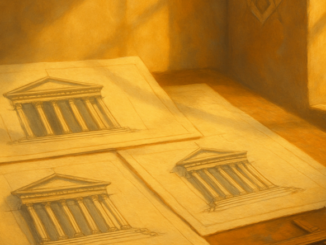
Three symbolic Masonic temples representing history, humanity, and inner growth
Symbolism & Rituals

Three Temples, One Journey: What’s the Difference?

When Freemasons speak of “the temple,” they rarely mean the same thing. One refers to a biblical structure erected thousands of years ago. Another speaks of a collective ideal that encompasses all of humanity. And yet another points inward, toward something only he can build. Three temples, three perspectives — and yet they seem inseparably linked. So what exactly is the difference? And more importantly, what does that difference tell us about the journey every seeker undertakes? Solomon’s Temple: The Historical Foundation The first temple at the heart of Masonic symbolism is Solomon’s Temple. According to biblical tradition, this structure was built in tenth-century Jerusalem, and it serves as the backdrop against which the ritual work of Freemasonry unfolds. Here, stonemasons, architects, and craftsmen worked together on something greater than themselves. Solomon’s Temple represents the external, the visible, the tangible result of human cooperation. For those outside the Craft, this temple is often the most recognizable symbol. It is a story of stone, cedarwood, and gold — of King Solomon who sought wisdom and the master builder Hiram who applied his skill. From this perspective, the temple is treated as a historical given, a place that once existed and now […]

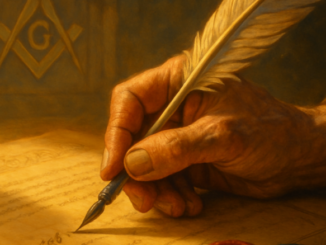
Quill pen signing a parchment document symbolizing Masonic transition
Symbolism & Rituals

What a Presidential Resignation Reveals About Masonic Symbolism

In 1215, an English king pressed his seal onto a document that would curtail his own power. The Magna Carta was not signed out of conviction but under the weight of circumstances that left no alternative. More than eight centuries later, a Hungarian president signed a document sealing his own departure from office. The signature — as a symbol of power, surrender, and transformation — carries a rich history that reaches deep into the traditions of Freemasonry. The Historic Power of Ink on Parchment Looking back at medieval traditions, we see that the signature was far more than a formality. Kings and nobles used signet rings to authenticate documents, and the seal itself carried profound symbolic weight. Breaking a seal was an act of dishonor; affixing one was a sacred promise. In the craft guilds from which Freemasonry evolved, the same principle held true: a master who placed his mark upon a finished work bound his honor to its quality. In this context, the signature represents no simple act of identification. It is a visible trace of an inner state — a moment in which the invisible is made visible. When someone signs, they simultaneously reveal their willingness to bear […]

Open book with Masonic square and compasses symbolizing truth and self-reflection
Michel de Montaigne – The Essays

Montaigne on Liars: Philosophical Roots of Truthfulness

Have you ever wondered why a lie can sting so deeply, even when its content is entirely trivial? There’s something fundamentally violated when someone knowingly speaks an untruth — and you feel it in your bones. Michel de Montaigne, the sixteenth-century French essayist, grappled with the very same question. In his ninth essay, “On Liars,” he explores not merely what lying is, but why it is so reprehensible. To understand how he arrived at his insights, we need to look at the philosophical traditions that shaped his thinking: Stoicism, Skepticism, and Renaissance Humanism. The Stoic Legacy: Truth as Virtue Montaigne’s deep aversion to lying is firmly rooted in Stoic philosophy. Thinkers like Seneca and Epictetus regarded truthfulness not as a social convenience, but as a cardinal virtue. For the Stoics, human beings were fundamentally rational creatures, and lying represented a betrayal of that rationality. When you lie, they reasoned, you disturb the natural order of the logos — the universal reason that binds all things together. Seneca, whose letters Montaigne studied with great devotion, wrote extensively about the relationship between one’s words and one’s character. A man who lies, Seneca argued, cannot truly know himself. This is precisely the insight […]

Symbolic ruins of a temple being rebuilt representing Masonic inner work
Christianity

Haggai and the Temple: Rebuilding as an Inner Calling

Imagine standing before the ruins of something that was once magnificent. Perhaps it’s a building, perhaps a relationship, perhaps a part of yourself you’ve long neglected. The foundations are still there, but the glory has faded. What do you do? Turn away and walk on — or pick up the first stone and start again? The brief biblical book of Haggai, just two chapters long, poses exactly this question. And the answers it offers resonate with striking power through the symbolism that Freemasons have cherished for centuries. A Prophet Standing Between Rubble and Possibility Haggai emerged during one of the most pivotal moments in the history of the Jewish people. After decades of exile in Babylon, a remnant of the nation returned to Jerusalem. What they found was a devastated city — and what struck them most deeply was the sight of Solomon’s Temple lying in ruins. This was no ordinary building. It was the spiritual heart of their community, the place where heaven and earth met in their experience of the divine. Yet despite their return, something curious happened. Instead of rebuilding the Temple, the people turned their attention to their own houses. They made their private dwellings comfortable […]

Square and compass symbolizing truth and integrity in Freemasonry
Content & Summary

Montaigne on Liars: Truth as the Foundation of Character

Have you ever considered what really happens when someone lies? Not just to the truth itself, but to the bond between people? In his ninth essay from the first book of his famous Essais, Michel de Montaigne tackles precisely this question. ‘On Liars’ is a compact yet powerful meditation on the nature of falsehood, the role of memory, and why sincerity forms the bedrock of every meaningful human relationship. Let’s explore the core of this timeless essay — and why it still matters, especially for those who value integrity and brotherhood. The Starting Point: A Poor Memory Montaigne opens his essay with a striking confession: he has an extraordinarily poor memory. This personal trait becomes the launching pad for his entire reflection on lying. He observes that people with weak memories are often suspected of being liars because they struggle to tell their stories consistently. Yet Montaigne turns this assumption on its head. Precisely because he knows his memory fails him, he has learned to always speak the truth. A liar, after all, needs an excellent memory to keep track of all his fabrications. This insight feels remarkably modern. Montaigne demonstrates that honesty is not merely a moral choice — […]

Candlelit Masonic lodge with open Bible showing the Book of Zephaniah
Christianity

Zephaniah and the Day of Purification: A Prophetic Mirror

Candles flicker softly in the dim light of the lodge as a brother reads aloud from an ancient text — a prophet warning of a day of reckoning, yet promising that from the ashes something new will rise. The brethren listen in silence, recognizing in these age-old words something strikingly contemporary: the necessity of inner purification before any true building can begin. The Book of Zephaniah, written in the kingdom of Judah during the seventh century BCE, speaks with an urgency that still resonates today. The Prophet and His Time Zephaniah was active during the reign of King Josiah, a period when Judah was struggling with religious decay and societal corruption. The prophet spoke to a people who had neglected their foundations — a nation that maintained the outer temple walls while allowing the inner temple to crumble. His message was twofold: first, a confrontation with what had become rotten; then, a promise of restoration for those willing to be reshaped. This small book, only three chapters long, opens with a gripping description of what Zephaniah calls the “Day of the Lord.” This is no simplistic fire-and-brimstone sermon but a call to fundamental reflection. The prophet does not only address […]

A flickering candle flame dancing in the darkness of a Masonic lodge
Symbolism & Rituals

The Flickering Candle: A Spiritual Perspective on Light in Motion

There is a moment — often unnoticed — when a flame begins to dance. Not the calm, upright flame of still air, but that restless flicker that makes us look up from whatever we were doing. A flickering candle carries a spiritual significance that reaches far beyond the simple physics of moving air. In Freemasonry, where candlelight has played a central role in rituals and gatherings for centuries, this flicker takes on a deeper layer of meaning — one that invites contemplation about the human soul and its ceaseless quest for truth. Why a Flickering Candle Speaks to Us Spiritually The human eye is irresistibly drawn to movement. From an evolutionary standpoint, this was a survival mechanism — but somewhere along the way, it also gave rise to a capacity for wonder. When a candle flame begins to flicker, we no longer see a static object. We see something that lives. The flame seems to breathe, to respond, almost to communicate. Across countless spiritual traditions, the behavior of fire is interpreted as a sign, a message, or a presence. Freemasonry does not stand in opposition to these interpretations but examines them through a symbolic lens. The flickering light is not […]

Open book with Masonic symbols representing Montaigne's philosophy and Freemasonry
Freemasonry & Connection

Montaigne on Idleness: The Restless Mind and the Search for Light

When the mind has no direction, Michel de Montaigne wrote in the sixteenth century, it thrashes about like a horse without a rider. This brief but powerful essay from his famous collection touches on a paradox that both the philosopher and the Freemason will recognize: rest without purpose brings not peace, but turmoil. What can two traditions — separated by centuries and vastly different in form — teach each other about the value of directed silence? The Philosopher Speaks: A Mind Without Reins In his essay “Of Idleness,” Montaigne describes how he withdrew to his country estate after a busy life, fully expecting his mind to settle into peaceful contemplation. The opposite happened. Without the discipline of daily occupation, his thoughts began to race like a runaway horse. Strange images, half-formed ideas, and unfinished reflections piled up like weeds in an untended garden. The philosopher concluded that the mind, much like the body, requires exercise to remain healthy. Crucially, this was not an indictment of rest itself, but of aimless idleness. Montaigne drew a sharp distinction between doing nothing and being without purpose. The former can be restorative; the latter undermines the clarity of the soul. To tame his wild […]

Ancient watchtower at dawn symbolizing Habakkuk's search for light
Christianity

Habakkuk: The Doubter and the Seeker of Light

When an ancient prophet raises his fists toward the heavens and demands to know why evil goes unpunished, he touches something deeply universal. The Book of Habakkuk is not a triumphant hymn of praise — it is a struggle, a conversation with the unknown. For the religious reader, a man speaks to his God. For the Freemason, an echo resounds of the eternal quest for light amid darkness. Two perspectives, one fundamental question: how do we live with uncertainty? The Prophet as Doubter Habakkuk occupies a unique place among the prophetic books of the Bible. Where most prophets speak on behalf of the divine to the people, Habakkuk reverses the direction entirely. He speaks to the divine on behalf of himself — and in doing so, on behalf of every person who has ever wrestled with injustice. His opening question is raw and unvarnished: why must I witness violence? Why do you make me look upon destruction? This is no rhetorical device. It is genuine anguish. For the traditional reader of scripture, Habakkuk represents the believer who grows through doubt into deeper trust. The prophet eventually receives a vision — an answer that urges him to wait and to have […]

Open book of Montaigne's Essays with philosophical symbols and candlelight
Michel de Montaigne – The Essays

Montaigne on Idleness: Philosophical Roots of an Essay

In the eighth essay of the first book of his Essays, Michel de Montaigne takes on the subject of idleness. But where a modern reader might expect a case for relaxation, what emerges instead is a profound reflection on the dangers of an unoccupied mind. This short but powerful piece reveals how deeply Montaigne was rooted in the classical philosophical traditions of his era — and how his thinking built a bridge between ancient wisdom and Renaissance humanism, with insights that still resonate within traditions devoted to inner work and self-knowledge. The Stoic Legacy: Idleness as Moral Danger For the Stoics, whose writings Montaigne studied thoroughly, idleness was no innocent pastime. Seneca, one of the authors Montaigne returned to most often, repeatedly warned against the dangers of a mind without direction. In his Letters to Lucilius, he stressed that an empty mind becomes susceptible to anxiety, restlessness, and destructive thoughts. Montaigne takes this warning to heart when he writes that an unoccupied mind, much like fallow land, produces all manner of weeds. The Stoic tradition drew a sharp distinction between two kinds of rest. On one hand, there was valuable contemplation, directed toward self-knowledge and moral progress. On the other, […]

Ancient ruins of Nineveh symbolizing the fall of tyranny and Masonic justice
Christianity

Nahum and the Fall of Nineveh: Lessons on Justice

In 612 BCE, the mighty Assyrian Empire collapsed. Nineveh, its grand capital and the nerve center of an unparalleled military power, was razed to the ground by a coalition of Babylonians and Medes. This seismic historical event lies at the heart of one of the shortest yet most intense books in the Old Testament: the Book of Nahum. Spanning only three chapters, this prophetic text raises profound questions about justice, the fall of tyranny, and the possibility of moral reconstruction — questions that resonate deeply within the traditions of Freemasonry. The Historical Context of Nahum For nearly three centuries, the Assyrian Empire dominated the ancient Near East. The city of Nineveh, situated on the banks of the Tigris River in what is now northern Iraq, was renowned for its imposing walls, lavish palaces, and vast libraries. Yet the Assyrians were equally infamous for their ruthless methods of warfare. Conquered peoples were deported en masse, cities were burned to ash, and enemies were publicly humiliated. For the smaller kingdoms of Israel and Judah, Assyria represented a constant and existential threat. The prophet Nahum — whose name fittingly means “comforter” or “one who brings consolation” — likely composed his vision shortly before […]

Rough ashlar stone symbolizing Montaigne's philosophy of the inconsistent self
Michel de Montaigne – The Essays

Montaigne and the Philosophy of the Inconsistent Self

A stone being worked bears the marks of many hammer blows. Some make it smoother; others leave cracks behind. This is precisely how the sixteenth-century thinker Michel de Montaigne viewed the human soul — as a piece of work that never quite reaches completion, continually shaped by contradictory forces. His essay on the inconsistency of our actions drew from a rich philosophical tradition reaching back to antiquity. Which thinkers whispered to him what it truly means to be human in all our inconsequence? The Rough Ashlar as Starting Point In Freemasonry, the rough ashlar is a well-known symbol: the unworked stone representing the apprentice at the beginning of his path. This stone is not flawed — it is simply unfinished. It awaits the work of reflection and experience. Montaigne would have recognized this image immediately. His essay on inconsistency opens with the observation that we human beings possess no fixed core, but instead consist of layers, fractures, and surprising turns. The philosopher treated himself as his own subject of study and discovered within a fundamental mutability that did not trouble him, but fascinated him. This view of the human being as a work in progress had deep roots in Renaissance […]

Rough ashlar stone symbolising human inconstancy and Masonic self-knowledge
Content & Summary

Montaigne on Inconstancy: Man as an Unfinished Symbol

There is an ancient symbol familiar to most Freemasons: the rough ashlar. It represents the human being in an unworked state — raw, unpolished, and full of contradictions. When we turn to the very first essay in Michel de Montaigne‘s celebrated Essais, that image becomes almost tangible. In his reflections on the inconstancy of our actions, the sixteenth-century philosopher holds up a mirror in which we recognise ourselves as beings who constantly shift, act in contradiction with themselves, and in doing so reveal something profoundly human. The Core Idea: Man as a Riddle to Himself Montaigne opens his essay with a sharp observation. Anyone who tries to judge another person by their actions runs into a fundamental problem: our deeds constantly contradict one another. The same individual who acts with courage today may prove a coward tomorrow. The person who gives generously now may cling to possessions later. For Montaigne, this is not a moral failing — it is simply the human condition laid bare. He resists the temptation to sort people into fixed categories. Labels like “brave” or “greedy” do not do justice to reality. We are not statues of virtue or vice, but living beings who move, stumble, […]

Open book with Montaigne essays and candlelight evoking quiet contemplation
Content & Summary

Montaigne on Idleness: An Essay on the Restless Mind

You may recognise this: a day off with no obligations, a chance to finally relax — and yet your thoughts race in every direction. Your mind feels busier than ever. The sixteenth-century philosopher Michel de Montaigne described exactly this phenomenon in his short but powerful essay On Idleness. He discovered that an empty mind does not lead to peace, but to chaos. What begins as a search for rest turns out to be a confrontation with ourselves. The Core Idea of the Essay In this eighth essay from his first book, Montaigne examines a paradox that remains strikingly familiar today: when we fail to engage our mind with purposeful activity, it does not settle into calm — it runs wild. Montaigne writes that an unoccupied mind gallops off in every direction, like a horse without a rider. Thoughts multiply, take on bizarre shapes, and produce what he calls “monsters” and “chimeras.” The essay is deeply personal in tone. Montaigne describes how, after retiring from public life, he settled on his country estate fully expecting his mind to find peace. The opposite happened. Without the discipline of daily obligations, his thoughts began to churn uncontrollably. This unsettling experience became the very […]

Open Volume of Sacred Law with Masonic square and candle in a lodge setting
Christianity

Micah and Freemasonry: Do Justice, Love Faithfulness

The candle flickers softly as a Brother opens the Volume of the Sacred Law. His fingers trace the pages until they rest on a passage he has read dozens of times before — yet tonight, the words seem to carry a different weight. “What does the Eternal require of you?” he reads aloud, and the question lingers in the stillness of the lodge room. The Book of Micah, written by a prophet in the eighth-century Kingdom of Judah, poses a question that has echoed through millennia. What does it truly mean to live a good life? The answer Micah offers is deceptively simple and yet infinitely demanding: do justice, love faithfulness, and walk humbly. For anyone familiar with the traditions of Freemasonry, these words resonate like echoes of deeply familiar principles. The Heart of Micah’s Message Micah prophesied during a time of profound social inequality. The wealthy enriched themselves at the expense of the poor, judges accepted bribes, and religious leaders sold their services to the highest bidder. Against this backdrop, the prophet raised his voice — not with elaborate theological arguments, but with a clear moral appeal. His most famous pronouncement appears in the sixth chapter: “He has told […]

Masonic level and plumb line symbolizing balance and self-reflection
Symbolism & Rituals

When Conviction Capsizes: The Hidden Risk of Certainty

Here is a paradox worth contemplating: the more firmly convinced you are of something, the greater the danger of capsizing. Not figuratively — literally. The word “convinced” traces back to nautical language, where it described a ship carrying so much weight on one side that it listed dangerously, no longer responded to the helm, and risked rolling over at the first strong gust of wind. Certainty as a risk factor. Firmness as a source of instability. Isn’t that one of the most uncomfortable truths language has been quietly trying to tell us all along? Certainty Makes You Lose the Helm Let’s take that paradox seriously. In everyday speech, we say “I’m convinced” as though it’s a virtue — a sign of resolve and strength. We admire people who stand firm, who don’t budge an inch. But an old-time sailor would have raised an eyebrow at such admiration for imbalance. To him, being “over-convinced” wasn’t a badge of honor — it was a diagnosis. A ship that had shifted all its weight to one side was a ship in distress. The rudder rendered useless, the crew at the mercy of forces they could no longer steer against. The shift in meaning […]

Masonic symbols illustrating allusive meaning and subtle reference
Symbolism & Rituals

Allusive Meaning: The Subtle Art of Reference in Freemasonry

You’ve probably had a conversation where someone said something that sounded perfectly innocent on the surface — yet you sensed a deeper layer beneath the words. A subtle nod to something unspoken. A reference only you could recognize. That is the essence of what we call allusive meaning. This ability to communicate through indirect reference — through symbols, gestures, and carefully chosen words — opens up a world of subtle exchange that reaches far beyond the literal. In Freemasonry, this hidden language plays a central and defining role. What Does “Allusive” Actually Mean? The word “allusive” derives from the Latin alludere, which literally means “to play toward something.” An allusive expression plays with meaning without stating it directly. It’s an indirect reference, a hint that only comes alive when the receiver recognizes the underlying layer. Think of a smile that says more than a thousand words, or a hand gesture that evokes a shared memory. In everyday language, we make allusive remarks more often than we realize. When someone says “that was a titanic effort,” they’re indirectly referencing the famous maritime disaster without explicitly naming it. The power of allusive meaning lies in the shared knowledge between speaker and listener. […]

An open antique book with Masonic square and compasses in candlelight
Freemasonry & Connection

Montaigne on Intentions: The True Measure of Our Inner Work

It is late in the evening. A Freemason sits alone in his study, a yellowed book open before him. He reads a passage by a sixteenth-century French thinker and feels the words reaching across the centuries, as though they were written for him personally. The question that surfaces is at once simple and unsettling: not what he has done, but why he did it. In that moment, two traditions touch — separated by four hundred years, yet united in the same search for sincerity. The Heart of Montaigne‘s Essay In one of his brief but penetrating essays, Montaigne argues that our actions cannot be separated from the intentions behind them. The results of what we do may shine in the eyes of the world, but the true value lies in what moved us when we began. A good deed performed out of vanity carries a very different weight than the same act born of genuine compassion. Montaigne invites us to look beyond the surface — past the praise and criticism of others — into the quiet chamber of our own conscience. This is no idle thought experiment. Montaigne warns that we are remarkably skilled at deceiving ourselves. We construct noble […]

Jonah emerging from the whale as a symbol of Masonic transformation
Christianity

Jonah and the Whale: A Masonic Journey to Self-Knowledge

In the eighth century before the Common Era, a short but powerful story emerged within the Hebrew tradition: the Book of Jonah. Spanning just four chapters, it tells of a prophet who flees his divine calling, is swallowed by a great fish, and ultimately comes to a profound reckoning with himself. For centuries, this tale has captivated people not only as a religious text but as a timeless allegory about human resistance and the difficult path toward self-acceptance. For Freemasons, the Book of Jonah offers a surprisingly rich source of recognition and reflection. A Prophet in Flight The story opens with a clear command: Jonah must travel to Nineveh to warn its inhabitants about their moral decay. Nineveh was the capital of the Assyrian Empire at the time — a powerful and feared city notorious for its cruelty. Rather than obey, Jonah boards a ship sailing in the opposite direction, heading for Tarshish, believed to have been a trading port at the very edge of the known world. His flight is not mere cowardice. It is a deeper refusal to confront his own calling. Historically, the story reflects the tension that existed between the Israelites and their neighbors. The Assyrians […]