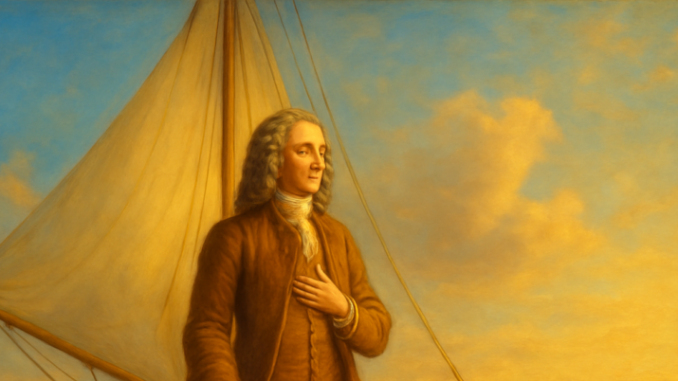
Tolerance is often treated as a passive attitude today — a matter of letting others do as they please so long as they don’t bother you. Voltaire saw things very differently. For him, tolerance was an active virtue demanding courage, self-reflection, and wisdom. When we place his ideas alongside the Masonic tradition, a remarkably rich conversation emerges about what it truly means to be tolerant.
The Outsider Sees Tolerance as Weakness
Let’s be honest: for many people in the eighteenth century, tolerance was seen as a sign of indifference or even cowardice. The reasoning went that anyone who took their own convictions seriously could not possibly bear others thinking radically differently. Voltaire knew this criticism all too well. In his time, religious minorities were persecuted, dissenters were banished, and books were burned. The social norm was not tolerance but conformity.
From this perspective, tolerance was suspicious. It implied that you didn’t truly believe in anything — that you lacked principles. Intolerance was often dressed up as virtue: one was simply protecting truth against error. Those who showed tolerance, it was claimed, had chosen no side and therefore had nothing meaningful to offer.
Voltaire’s Reversal: Tolerance Requires Strength
Voltaire turned this logic completely on its head. In his writings on tolerance, he argued that open-mindedness is actually the most difficult and demanding stance a person can adopt. It is easy to condemn others, to claim the monopoly on truth, and to silence dissenting voices. What truly requires courage is the recognition that your truth need not be the only truth.
Tolerance is not weakness but an act of moral courage: the willingness to examine your own certainties while leaving the other person’s dignity intact.
For Voltaire, intolerance was the hallmark of a mind afraid of inquiry, of questions, of the unknown. Tolerance, by contrast, arises when someone has developed enough self-knowledge to realize that their own insights are limited. It is not passivity but active engagement in the search for truth.
The Freemason Recognizes a Familiar Path
When we place these ideas alongside the Masonic tradition, striking parallels come into view. The lodge has always been a space where people of different religious and social backgrounds come together — not in spite of their differences, but in recognition of them. The Freemason learns that truth is not the exclusive property of any single tradition, culture, or individual.
This goes beyond polite coexistence. Masonic rituals and symbols constantly point toward the necessity of self-reflection. The rough ashlar that must be worked into a perfect cube refers to the lifelong labor of shaping one’s own character. Tolerance fits naturally within this framework as a fruit of that inner work: those who know themselves, who dare to face their own shadow, are far less inclined to pass judgment on others.
Two Perspectives, One Shared Core
What Voltaire and the Masonic tradition share is the conviction that tolerance is inseparably linked to moral growth. Both see tolerance not as an endpoint but as a starting point for deeper development. Voltaire expressed this in philosophical terms; Freemasonry embodies it through rituals and symbols.
Self-reflection: Both Voltaire and Freemasonry emphasize that tolerance begins with an honest look at yourself.
The search for truth: Both acknowledge that truth is multifaceted and cannot be imprisoned in dogma.
Brotherhood: Seeing the other as a fellow human being, regardless of origin or belief.
Light and knowledge: Enlightenment comes not from excluding others but from cultivating openness.
The Virtue in Practice
Voltaire was no armchair philosopher issuing theories without engagement in the real world. He actively championed victims of religious persecution, wrote pamphlets that put him in personal danger, and wielded his pen as a weapon against injustice. For him, tolerance was not a casual philosophy but a call to action.
The Freemason, too, is called upon not to limit his principles to the privacy of the lodge. The values cultivated there must find their way into daily life. Tolerance only becomes a true virtue when it proves itself in dealings with people who think, believe, or live in radically different ways. It is easy to be tolerant toward those who resemble us; the real test lies with those who seem foreign to us.
What Both Traditions Teach Us Today
In an age of increasing social division, when dialogue between people who disagree seems ever more difficult, both Voltaire and the Masonic tradition offer an ancient yet urgent insight. Tolerance is not capitulation, not indifference, not weakness. It is the courageous choice to accept the complexity of reality without reducing the other person to an enemy or a caricature.
The Freemason who delves into Voltaire’s work will find much that feels familiar. Both speak of an inner journey that is necessary before one can be truly tolerant. Both warn against the temptation of snap judgments and lazy certainties. And both believe that human beings are capable of moral refinement — provided they are willing to take the work on themselves seriously.
Voltaire’s vision of tolerance as a virtue and the Masonic path toward inner growth are two voices singing the same melody. Where the philosopher cast his arguments in words, the lodge speaks through symbols and rituals. But the message converges: tolerance is not a passive attitude but an active art of living, rooted in self-knowledge and directed toward connection. It is a virtue that must be practiced — daily, deliberately, and with the humility to know that the work is never finished.
Copyright text & image: devrijmetselaar.nl
Texts are based on the ideas and content of the author of devrijmetselaar.nl, reviewed, corrected, and supplemented with the assistance of OpenAI. Images are created based on the ideas of the author of devrijmetselaar.nl using OpenAI/DALL-E.


Be the first to comment