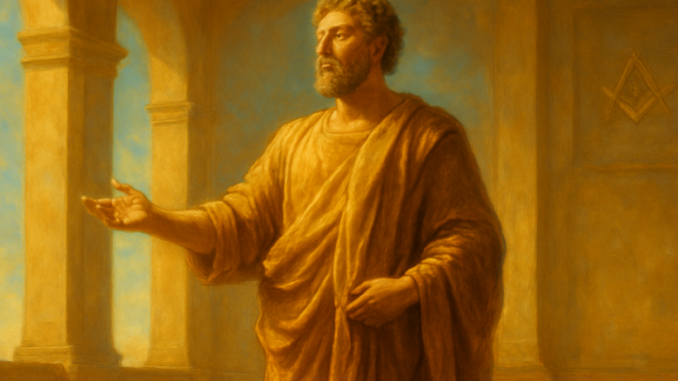
Have you ever wondered why certain ancient wisdom still strikes such a powerful chord? Nearly two thousand years ago, Marcus Aurelius wrote about the art of living among others, and his words feel as though they could have been penned yesterday. In Book VI of his Meditations, the Roman emperor-philosopher reveals what it truly means to live as a human being among human beings. For Freemasons, these reflections sound remarkably familiar — because the values Marcus Aurelius describes also form the very foundation of the Craft.
Humanity as One Body
Throughout Book VI, Marcus Aurelius returns again and again to the theme of human interconnectedness. He does not see humanity as a collection of isolated individuals, but as parts of a single great organism. Just as a hand or a foot only finds its purpose as part of the body, so too does a person discover meaning through relationship with others. This is not idle philosophical musing — it is a call to action.
When you wake in the morning and feel annoyed at the people you will encounter that day, Marcus Aurelius reminds you that they are your kindred. Not because you share the same blood, but because you share the same rational soul. You were made to work together, just as the legs, the hands, and the eyelids do. To work against one another is therefore contrary to nature itself.
Freemasonry and the Chain of Unity
This vision of interconnectedness lies at the very heart of Freemasonry. The Chain of Union — in which lodge members join hands during ritual — is far more than a ceremonial gesture. It symbolizes precisely what Marcus Aurelius describes: the recognition that we are fundamentally bound to one another. The strength of the chain depends on every single link, and every Brother bears responsibility for the whole.
True brotherhood does not arise from shared beliefs, but from the mutual recognition of each other’s dignity as human beings.
Marcus Aurelius and Freemasonry share a fundamental insight: brotherhood is not a sentiment — it is a practice. It demands daily effort, patience, and the willingness to look beyond personal irritations. In the lodge, people meet who might never have become friends outside its walls. Yet they forge a bond based on shared values and mutual respect.
Tolerating Others as an Exercise in Virtue
One of the most practical lessons in Book VI concerns dealing with difficult people. Marcus Aurelius writes that when someone hurts or irritates you, you should ask yourself what flaw within them led to this behavior. Not in order to judge, but in order to understand. This approach calls for compassion rather than anger.
For Freemasons, this resonates deeply with the concept of working the Rough Ashlar. The Rough Ashlar symbolizes the unrefined self — full of sharp edges and imperfections. Smoothing that stone is not merely an inward process; it happens precisely through contact with others. Every friction, every confrontation with a fellow Brother or someone in the wider world, offers an opportunity to refine your own character.
Acting for the Common Good
In Book VI, Marcus Aurelius insists that every action must be measured against the common good. What is good for the hive is good for the bee. This principle steers us away from selfishness and toward service. The Stoic philosopher did not regard his emperorship as a privilege, but as a duty to the community.
Freemasonry upholds a strikingly similar ethic. The goal is not personal elevation for its own sake, but to become a better person in service of society. The lodge is a training ground where Brothers learn to set aside their egos and work toward something greater than themselves. The idea that “labor ennobles” takes on a deeper meaning here: it refers to labor that contributes to the whole.
Impermanence as a Spur to Connection
A recurring theme in Marcus Aurelius is the impermanence of all things. Emperors, generals, entire cities — they all vanish into the stream of time. This realization could easily lead to nihilism, but the Stoic draws a different conclusion. Precisely because everything is transient, it matters that we act rightly now, seek connection now, and practice brotherhood now.
This awareness also plays a vital role in Freemasonry. The skull and the memento mori remind the Brother of his mortality — not as a grim fact, but as a spur to action. If your time is limited, how do you wish to spend it? In quarrel, envy, and isolation? Or in meaningful connection, in brotherhood, in contributing to something that endures long after you are gone?
The Daily Practice of Humanity
Perhaps the most important lesson Marcus Aurelius offers is that compassion toward others is not an abstraction. It unfolds in small acts: being patient with a colleague, greeting a neighbor, offering forgiveness to someone who has wronged you. It requires constant attention and the willingness to begin again, every single day.
Begin each day with the intention to meet your fellow human beings with goodwill. When irritation arises, ask yourself what drives the other person’s behavior. See every encounter as an opportunity to improve your own character. Remember that your well-being is inseparable from the well-being of others.
The Freemason who reads Book VI of Marcus Aurelius will recognize a kindred spirit. Both traditions understand that no person is an island, and that true growth takes place in relationship with others. The lodge and Stoic philosophy both offer a path — not toward personal glory, but toward meaningful connection.
The wisdom of Marcus Aurelius in Book VI is not a dusty relic of the past — it is a living invitation. An invitation to choose, each and every day, connection over division, understanding over judgment, brotherhood over isolation. Whether you are a Freemason or not, this message remains as relevant as ever: we are made for one another, and the art of living well is, ultimately, the art of living together.
Copyright text & image: devrijmetselaar.nl
Texts are based on the ideas and content of the author of devrijmetselaar.nl, reviewed, corrected, and supplemented with the assistance of OpenAI. Images are created based on the ideas of the author of devrijmetselaar.nl using OpenAI/DALL-E.
Frequently Asked Questions
How does Marcus Aurelius' concept of humanity as one body relate to Freemasonry?
Marcus Aurelius viewed humanity as interconnected parts of a single organism, where individuals discover meaning through relationships with others. Freemasonry embodies this philosophy through the Chain of Union ritual, where lodge members join hands to symbolize their fundamental bond. Both traditions recognize that we are made to work together and that isolating ourselves from others is contrary to our nature. The strength of this brotherhood depends on every single member accepting their responsibility to the whole.
What is the Chain of Union in Freemasonry, and what does it symbolize?
The Chain of Union is a ceremonial practice in which lodge members join hands during ritual. It is far more than a symbolic gesture—it represents the recognition that all members are fundamentally bound to one another. The strength of the chain depends on every single link being strong, meaning each Brother bears responsibility for the collective whole. This practice directly reflects Marcus Aurelius' philosophy of human interconnectedness and shared purpose.
According to the article, what is the difference between sentiment and true brotherhood in Freemasonry?
The article emphasizes that brotherhood is not merely a feeling or sentiment—it is a practice that demands daily effort, patience, and willingness to look beyond personal irritations. True brotherhood arises from mutual recognition of each other's dignity as human beings and shared values, rather than from shared beliefs or circumstances. In the lodge, people who might never have become friends outside its walls forge genuine bonds through shared commitment to these principles and mutual respect.

Be the first to comment