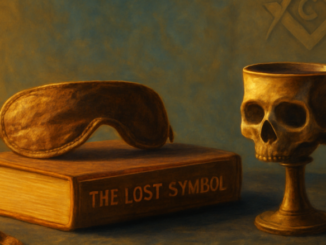
Symbolic illustration of noetic science and Freemasonry consciousness
Symbolism & Rituals

Noetic Science: Fact or Fiction in The Lost Symbol?

In The Lost Symbol, Dan Brown plunges readers into a world where the human mind supposedly exerts measurable effects on physical reality. At the heart of the story lies noetic science — a discipline that, according to the novel, proves that thoughts and intentions can influence matter itself. But how much of this is grounded in real science, how much is exaggeration, and how much is pure fiction? In this fact-check, we place the world of the novel alongside the world of established science to find out. What Is Noetic Science According to Dan Brown? In The Lost Symbol, Dan Brown portrays noetic science as a revolutionary field of research demonstrating that human consciousness can directly influence matter. The novel suggests that scientists in secret laboratories conduct experiments in which focused intentions produce measurable physical effects. This premise draws on a long tradition of esoteric ideas about the power of the mind — ideas that also circulate within Freemasonry as metaphors for inner transformation. Brown references the Institute of Noetic Sciences (IONS), an organization that actually exists in Petaluma, California. It was founded in 1973 by astronaut Edgar Mitchell following his Apollo 14 mission. During his return to Earth, Mitchell […]
Interior of the Sagrada Família basilica with its towering columns and light
Origin

Origin and the Sagrada Família: Separating Fact from Fiction

When Dan Brown published Origin in 2017, Barcelona’s Sagrada Família took centre stage as the dramatic backdrop for a confrontation between science and religion. Antoni Gaudí’s unfinished basilica was presented as a building brimming with hidden meanings and mysterious symbolism. But how much of what Brown suggests about this iconic structure is historically and architecturally accurate — and where does the novelist’s creative licence begin? This fact-check explores what we actually know about the Sagrada Família, stripped of the fictional layer that Origin drapes over it. The Building’s History: What the Facts Tell Us The Sagrada Família is undeniably one of the most extraordinary structures on Earth, and the facts about its origins are fascinating enough without fictional embellishment. The first stone was laid in 1882 under the direction of architect Francisco de Paula del Villar. A year later, Antoni Gaudí took over the project and would devote the rest of his life to it, right up until his death in 1926. Gaudí dramatically transformed the original neo-Gothic design and created an entirely unique architectural language inspired by organic forms found in nature. In Origin, Brown presents the basilica as a building with hidden layers of meaning that can only […]

Dan Brown Inferno novel with DNA helix and Masonic rough ashlar symbol
Inferno

Inferno and Transhumanism: Fact or Fiction in Dan Brown’s Novel

If you’ve read Dan Brown’s thriller Inferno, you’ve probably wondered: could any of this actually happen? The novel plays with ideas about genetic manipulation, overpopulation, and humanity’s relentless drive toward self-improvement. It’s a gripping story, but how much of it is grounded in real science? In this fact-check, we examine which transhumanist and biotechnological claims in Inferno are verifiably true, which are exaggerated for dramatic effect, and which belong entirely to the realm of fiction. What Does Inferno Claim About Transhumanism? At the heart of Inferno is a central conflict driven by a scientist who believes humanity must fundamentally redefine itself to survive. The novel suggests that large-scale genetic manipulation is not only possible but inevitable. Dan Brown has his characters speak of viruses capable of rewriting human DNA and of the transhumanist vision that technology can push us beyond our biological limitations. This raises a critical question: is this science fiction, or a preview of tomorrow’s science? The Science Behind Genetic Manipulation The core question is whether we can actually edit DNA the way Inferno suggests. The answer is nuanced. The technology known as CRISPR has made it possible since 2012 to precisely cut and modify genetic material. Scientists […]

The House of the Temple in Washington D.C., headquarters of the Scottish Rite
Symbolism & Rituals

The Temple of Washington: Fact and Fiction in The Lost Symbol

In Dan Brown’s thriller The Lost Symbol, a mysterious building in Washington, D.C. takes center stage: the so-called Temple of Washington. As protagonist Robert Langdon unravels secrets allegedly hidden within the architecture of the American capital, readers are left wondering — how much of what Brown writes is actually true? And where does the fiction begin? In this fact-check, we explore the real history behind the building, its Masonic connections, and the symbolic claims made in the novel. The House of the Temple: A Very Real Building Let’s start with the most concrete fact: the building Dan Brown calls the Temple of Washington in The Lost Symbol actually exists. Located at 1733 16th Street NW in Washington, D.C., it is officially known as the House of the Temple. This imposing structure has served since 1915 as the headquarters of the Supreme Council of the Scottish Rite, Southern Jurisdiction — one of the oldest Masonic organizations in the United States. Architect John Russell Pope designed the building in a neoclassical style, drawing inspiration from the Mausoleum at Halicarnassus, one of the Seven Wonders of the Ancient World. This is well documented and confirmed by architectural historians. The building features thirteen columns […]

Ancient chalice symbolizing the Holy Grail alongside Masonic and historical imagery
Symbolism & Rituals

Mary Magdalene and the Holy Grail: Fiction or Fact?

Perhaps you’ve experienced it too: you’re halfway through Dan Brown’s The Da Vinci Code, and you find yourself wondering — could any of this actually be true? The claim that Mary Magdalene was the wife of Jesus and that the Holy Grail actually represents their bloodline is so ingeniously constructed that it almost sounds plausible. But how much of this theory holds up under scrutiny? In this article, we examine the historical facts, the exaggerations, and the pure fiction behind one of the most talked-about claims in popular culture. Dan Brown’s Central Claim In The Da Vinci Code, Dan Brown presents the theory that Mary Magdalene was not merely a follower of Jesus, but his wife. According to the novel, she fled to France after the crucifixion while pregnant, and their bloodline continued through the centuries. The Holy Grail, then, is not a chalice at all — it is a metaphor for the womb of Mary Magdalene and the royal lineage that descended from her. It’s a bold hypothesis that has captivated millions of readers around the world. But how does it measure up against what historians and biblical scholars actually know? What the Historical Sources Actually Say The canonical […]

CERN particle accelerator tunnel representing antimatter research and science
Angels & Demons

Angels & Demons: Antimatter at CERN, Fact or Fiction?

In 2000, Dan Brown published his thriller Angels & Demons, in which a stolen container of antimatter from the European research center CERN threatens to obliterate Vatican City. The tension between science and faith lies at the heart of the story — but how much of this spectacular premise is grounded in actual science? As Freemasons, we cherish the pursuit of truth as one of our highest values. Let us, therefore, separate the facts from the fiction. Antimatter: From Theoretical Concept to Laboratory Reality The history of antimatter begins in 1928, when British physicist Paul Dirac formulated an equation that predicted the existence of antiparticles. Four years later, in 1932, Carl Anderson discovered the positron — the antiparticle of the electron — earning him the Nobel Prize. This was no longer science fiction; it was experimental science. Dan Brown’s Angels & Demons builds on this reality by presenting antimatter as a kind of ultimate energy source, albeit with considerable artistic license. At CERN, the European Organization for Nuclear Research in Geneva, antimatter is indeed produced. The Antiproton Decelerator and the ALPHA experiment are working facilities where scientists create and study antihydrogen atoms. So far, Dan Brown’s story checks out: CERN […]

Symbolic representation of noetic science and Freemasonry's pursuit of knowledge
Symbolism & Rituals

Noetic Science: What Does The Secret of Secrets Claim?

Can the human mind alter physical reality? This question, as old as philosophy itself, takes on a new form in Dan Brown’s The Secret of Secrets. The novel introduces readers to a fascinating yet controversial field: noetic science — a discipline that claims human thoughts and intentions can produce measurable effects on matter. But what does this claim actually amount to, and where does it intersect with the age-old quest for hidden knowledge that lies at the heart of Freemasonry? The Premise: Consciousness as a Force In The Secret of Secrets, Dan Brown presents noetic science as a legitimate field of research in which scientists experiment with the measurable influence of human intention on the physical world. According to the novel’s storyline, focused thoughts and collective meditation can actually alter the molecular structure of water, disrupt random number generators, and even accelerate healing processes. The book suggests that these insights have long been suppressed by powerful institutions but are now finally receiving scientific validation. Brown does not present these ideas in isolation. He connects them to a rich tradition of esoteric wisdom — Hermetic philosophy, the Kabbalistic Tree of Life, and the mystical traditions preserved within Freemasonry. The implication is […]

Vrijmetselarij - Maria Magdalena en de Heilige Graal volgens The Da Vinci Code
Symbolism & Rituals

Mary Magdalene and the Holy Grail in The Da Vinci Code

You probably know the image well: a chalice shrouded in mystery, the object of centuries-long quests. But what if the Holy Grail isn’t a cup at all? In his worldwide bestseller The Da Vinci Code, Dan Brown presents a radically different reading of this symbol — one that places Mary Magdalene at its very center. What exactly does the book claim, and how can seekers of truth approach these ideas in a meaningful, practical way? The Central Claim of the Book The Da Vinci Code, written by Dan Brown and published in 2003, revolves around a spectacular thesis: the Holy Grail is not a physical cup said to have caught the blood of Christ, but a metaphor for Mary Magdalene herself. According to the narrative Brown presents, she was not merely a follower of Jesus but his wife and the bearer of his bloodline. The Grail, then, refers to the lineage continued through her. Brown weaves this claim through his plot by way of a secret society that has allegedly guarded this truth for centuries. He points to the works of Leonardo da Vinci — most notably The Last Supper — arguing that the figure seated next to Jesus is […]

Interior of the Sagrada Família cathedral in Barcelona with light and columns
Origin

Origin and the Sagrada Família: Fact and Fiction About Gaudí

When the Sagrada Família in Barcelona received its first stone in 1882, no one could have imagined that this extraordinary building would become the dramatic backdrop for an international thriller more than a century later. Dan Brown deliberately chose Antoni Gaudí’s unfinished cathedral as the culminating setting for his novel Origin. But what does the book actually claim about this iconic structure, and how does its fiction compare to the historical reality surrounding Gaudí and the symbolic traditions that inspired him? Why an Unfinished Cathedral? Dan Brown is well known for using monumental architecture as a narrative device. After the Vatican, the Louvre, and the National Cathedral in Washington, he turned his attention to Barcelona in Origin. The Sagrada Família doesn’t merely serve as a backdrop in the novel — it functions as a symbol in its own right. Brown presents the building as a meeting point between science and faith, between the ancient and the modern. His protagonist, Robert Langdon, walks through the still-unfinished church as profound questions about the origin of humanity are revealed. The book emphasizes that the Sagrada Família has been under construction for well over a hundred years. This incompleteness is presented as deeply meaningful […]

Dan Brown Inferno book with Masonic symbols representing rebirth and transformation
Inferno

Inferno and the Dream of Human Enhancement: Dan Brown

A scientist stands before a surging crowd, eyes blazing with conviction. He speaks not of profit or fame, but of saving humanity itself. In Dan Brown’s novel Inferno, we enter a world where the line between medicine and playing God dissolves — where the question is no longer whether we can improve human beings, but whether we should. The Central Premise of Inferno In Inferno, Dan Brown constructs a thought experiment that strikes at the very foundations of human ethics. The story revolves around a brilliant geneticist who believes humanity teeters on the brink of extinction due to overpopulation. His solution is radical: a genetically engineered virus designed to alter human reproduction on a global scale. Brown is not crafting traditional science fiction here — he is exploring what is already scientifically within reach. Brown based his narrative on publicly known developments in genetics and biotechnology. In various interviews and reviews surrounding the book’s publication, he described months of research at genetic laboratories and conversations with scientists about the real possibilities of gene editing. Inferno does not claim such technology is available tomorrow, but it insists that the ethical questions it raises need to be confronted today. Transhumanism as a […]

The House of the Temple in Washington D.C. with Masonic symbolism
Symbolism & Rituals

The Lost Symbol: Washington’s Masonic Temple in Fiction

When readers first cracked open Dan Brown’s The Lost Symbol, they were swept into a Washington D.C. teeming with hidden symbols, underground chambers, and mysterious rituals. At the heart of the story lies what Brown presents as the Temple of Washington — a concept he frames as the beating heart of Masonic secrets in the American capital. But what exactly does the book claim? And how does this fictional vision compare to the way outsiders and initiated Freemasons actually view the same city? The Book’s Claim: Washington as a Masonic Blueprint In The Lost Symbol, Dan Brown advances the idea that Washington D.C. is not merely a city but a deliberately designed temple landscape. According to the novel’s premise, America’s Founding Fathers — many of whom were Freemasons — embedded symbolic patterns into the street plan and architecture. The Capitol, the Washington Monument, and numerous other buildings supposedly form a kind of sacred geometric whole. Brown suggests that this structure preserves hidden knowledge, a wisdom passed down through the ages by the initiated. The book casts the House of the Temple, the headquarters of the Scottish Rite in Washington, in a central role within this alleged network. Brown portrays the […]

Antimatter containment concept representing the themes of Angels and Demons
Angels & Demons

Angels & Demons: Antimatter as a Weapon of Destruction

Imagine that science could create the ultimate force of destruction — a substance so pure and so powerful that it could undermine the very foundations of faith. This is not an idle thought experiment. It is the central premise of Dan Brown’s bestselling thriller Angels & Demons, a novel that places antimatter at the heart of a conflict between reason and religion, between laboratory and cathedral. But what does Brown actually suggest about this mysterious substance, and how does his fictional narrative connect to the symbolic quest that Freemasons have pursued for centuries? The Promise of Total Annihilation In Angels & Demons, Dan Brown presents antimatter as the most destructive material humanity has ever produced. According to the storyline, a minuscule quantity — captured within a specially designed containment system — would be enough to obliterate an entire city. The energy released when matter and antimatter collide, the book suggests, surpasses every conventional bomb and even nuclear weapons. Brown paints a scenario in which scientists at the European particle research center manage to produce and store measurable quantities of antimatter, unwittingly placing the key to apocalyptic devastation in human hands. This depiction raises a fundamental tension that runs through the […]

Historic Prague cityscape with Gothic and Baroque architecture at twilight
Symbolism & Rituals

Prague as a Mystic City: Freemasonry and the Facts Behind Fiction

When Dan Brown leads readers through the winding streets of Prague in The Secret of Secrets, he conjures images of alchemists, secret societies, and hidden knowledge. The Czech capital does indeed possess a rich mystical past stretching back to the sixteenth century. But how does Brown’s fiction compare to the actual history of Freemasonry in this city? And which misconceptions deserve to be corrected? A journey through time reveals some surprising insights. The Prague of Rudolf II: A Historical Epicenter To understand Prague’s mystical reputation, we need to travel back to the late sixteenth century. Emperor Rudolf II, who reigned from 1576 to 1612, transformed Prague into the intellectual heart of the Holy Roman Empire. He invited astronomers, alchemists, and scholars from across Europe to his court. Tycho Brahe and Johannes Kepler both conducted their groundbreaking astronomical research in Prague. The famous English occultist John Dee visited the city alongside Edward Kelley, seeking alchemical knowledge. This historical reality laid the groundwork for later mystification. The Golden Lane on Prague Castle’s grounds — where, according to legend, alchemists once labored — still draws visitors today. However, it is essential to recognize that these early esoteric activities predate organized Freemasonry as we […]

Dan Brown Origin book with Masonic symbols and artificial intelligence concept
Origin

Dan Brown’s Origin: AI, Religion, and Freemasonry Explained

Can a machine understand the human soul? And what happens when technology promises answers to the questions that religion has guarded for centuries? In Origin, Dan Brown puts these provocative questions front and center. But how does his fictional world compare to actual Freemasonry? Let’s explore the tension between imagination and reality, between what Brown’s thriller claims and what the Craft truly stands for. What Does Origin Actually Claim About AI and Faith? In Origin, Dan Brown paints a world where artificial intelligence doesn’t merely calculate — it tackles the great existential questions of human existence. The novel presents a scenario in which technology threatens to supplant religion as the authority on life’s biggest mysteries. A futuristic computer mind could potentially explain where we come from and where we’re going — questions that have been the domain of priests, rabbis, and imams for millennia. It’s fiction, of course, but it touches on genuine anxiety. Many readers find themselves wondering: could technology truly replace religion? And what would that mean for organizations devoted to the search for meaning — organizations like Freemasonry? How Does Freemasonry Actually View Technology? Here’s where a fascinating gap opens up between Brown’s fiction and reality. Freemasonry […]

Ancient Masonic symbols alongside Dante's Inferno book representing fiction and reality
Inferno

Dan Brown’s Inferno: Freemasonry in Fiction vs Reality

If you’ve read Dan Brown’s Inferno, chances are you walked away with questions. What’s real? What’s invented? And what about all those references to secret societies and ancient symbols? As a Freemason, these questions come up regularly — especially when popular thrillers paint vivid pictures of mysterious brotherhoods operating in the shadows. It’s worth taking a clear-eyed look at what Inferno suggests about symbolism and hidden knowledge, and how that compares to the reality of Freemasonry. Dante Alighieri as Inspiration Dan Brown didn’t choose the title Inferno at random. It’s a direct reference to Dante Alighieri’s Divine Comedy, the fourteenth-century masterpiece in which the poet descends into Hell, journeys through Purgatory, and ultimately reaches Paradise. This threefold path from darkness to light resonates deeply with Freemasons because it mirrors their own ritual journey — from ignorance to enlightenment, from rough stone to polished stone. Dante himself was not a Freemason — he couldn’t have been, since Freemasonry as we know it didn’t emerge until the eighteenth century. Yet his works are frequently referenced in lodge meetings and philosophical discussions. The symbolism of the journey, the confrontation with personal shortcomings, and the search for truth are themes that Freemasons readily recognize […]

Masonic lodge interior with symbolic elements from The Lost Symbol
Symbolism & Rituals

The Lost Symbol: Are Dan Brown’s Masonic Rituals Accurate?

If you’ve read Dan Brown’s The Lost Symbol, you’ve probably wondered: does any of this actually happen inside a Masonic lodge? The skulls, the solemn oaths, the mysterious initiation ceremonies in darkened chambers — it makes for gripping fiction, but how much of it reflects reality? As a Freemason, you get asked these questions all the time, often by people whose entire understanding of the Craft comes from this one novel. It’s time to take a closer look at what Dan Brown gets right, what he gets wrong, and where the line falls between literary thriller and Masonic truth. The Allure of the Unknown Dan Brown is a master at building suspense around mystery. In The Lost Symbol, he places Freemasonry at the heart of a story filled with secret knowledge, danger, and intrigue. The setting is Washington D.C., where monuments and buildings are supposedly saturated with hidden Masonic messages. The book plays cleverly on our natural fascination with secrets and our tendency to search for hidden meanings everywhere we look. For many readers, this novel is their very first encounter with Freemasonry. That makes it all the more important to understand where literary license ends and historical reality begins. […]

Masonic square and compasses contrasted with fictional secret society symbols
Symbolism & Rituals

The Priory of Sion: Fiction Unmasked from a Masonic Perspective

It’s a quiet evening after lodge. A brother settles into his chair, coffee in hand, and asks with a half-smile: “So, that Priory of Sion from Dan Brown’s book — is that basically the same thing as Freemasonry?” The question lingers. It’s one many Freemasons have heard before, because ever since The Da Vinci Code hit bookshelves, all secret societies tend to get lumped together in the public imagination. But does that picture hold up? And what can Freemasons learn from the stubborn confusion between fiction and reality? The Origins of a Modern Myth In The Da Vinci Code, Dan Brown presents the Priory of Sion as an ancient secret society dating back to the Crusades. According to the novel, this organization guards an explosive secret about the bloodline of Jesus Christ. Illustrious figures from art and science are listed as its supposed Grand Masters: Leonardo da Vinci, Isaac Newton, Victor Hugo. It sounds fascinating — almost too good to be true. And that is precisely the point. The historical reality is far more mundane. The Priory of Sion was founded in 1956 in the small French town of Annemasse by Pierre Plantard, a man with a highly questionable reputation. […]

A glowing forge with hammer and rough stone symbolizing Masonic transformation
Culture & Media

Heat and Creativity: What Art Teaches Us About Change

Weather forecasts are predicting a heatwave, with temperatures pushing toward 90°F. For most people, that simply means discomfort. But for the reflective mind, it presents an opportunity. How do we respond to sudden change? What can artists and the Masonic tradition teach us about harnessing intense conditions? In this article, we explore how heat — both literal and figurative — has served for centuries as a catalyst for creative breakthroughs and personal growth. The Forge as a Metaphor for Transformation In Masonic tradition, the figure of the smith holds deep symbolic significance — and not by accident. The forge is the place where raw material is transformed through intense heat into something useful and beautiful. This image forms one of the core metaphors of Lodge work. The rough ashlar that must be shaped into a perfect cube likewise demands effort, pressure, and yes, discomfort. Heat is not the enemy here — it is an indispensable ally. When temperatures rise outside, we are invited to experience this metaphor firsthand. Just as metal only becomes malleable at high temperatures, our ingrained patterns and rigid beliefs often only become visible when circumstances push us out of our comfort zones. The real skill lies […]

Ambigram design with Masonic square and compasses on a dark background
Angels & Demons

Angels & Demons: Ambigrams and the Illuminati Myth Debunked

You’ve read the thriller or watched the film. The suspense, the mysterious symbols, the secret societies. Dan Brown’s bestseller Angels & Demons has captivated millions of readers with tales of the Illuminati and their alleged war against the Catholic Church. But how much of that symbolism is actually real? And what do Freemasons have to do with any of it? If you’ve ever wondered where the line falls between gripping fiction and historical fact, this article offers practical tools to help you tell the difference for yourself. What Are Ambigrams — and Why Are They So Fascinating? In Angels & Demons, ambigrams play a central role. These are words or designs that can be read from multiple orientations — most commonly, they look the same when turned upside down. In the novel, branding irons featuring this property are presented as ancient Illuminati symbols. The fascinating thing about ambigrams is that they do exist as an art form, but they are modern typographic creations from the twentieth century, not relics of a bygone era. The ambigrams in the book were specially designed for the novel by a contemporary graphic artist named John Langdon (whose surname, not coincidentally, Brown borrowed for his […]

Vrijmetselarij - The Lost Symbol: Are the Masonic Rituals Accurate?
Symbolism & Rituals

The Lost Symbol: Are the Masonic Rituals Accurate?

When Dan Brown published The Lost Symbol in 2009, it unleashed yet another wave of public curiosity about Freemasonry. Millions of readers found themselves wondering: are those mysterious rituals real? Are candidates actually blindfolded? Do Freemasons really drink wine from human skulls? It’s time for an honest fact-check, drawing on historical sources and the actual practices of lodges around the world. What Does Dan Brown Actually Describe? In The Lost Symbol, Dan Brown paints a dramatic picture of Freemasonry. The opening scene takes place in a temple room where an initiation ritual is underway. The candidate is blindfolded, wears specific ceremonial attire, and swears an oath. Later in the novel, higher degrees come into play, each with increasingly theatrical elements. But how much of this is actually rooted in real Masonic practice? Is the Blindfold Historically Accurate? Yes — this one checks out. The use of a blindfold during the initiation of an Entered Apprentice is a centuries-old tradition practiced in virtually every recognized lodge worldwide. Known in Masonic terminology as the “hoodwink,” the blindfold symbolizes the state of darkness in which the candidate exists before receiving light. This ritual element dates back to the eighteenth century and is referenced […]