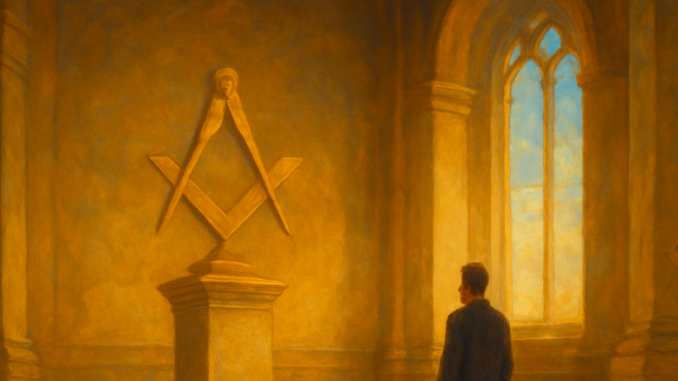
If you’ve read Dan Brown’s The Lost Symbol, you’ve probably wondered: does any of this actually happen inside a Masonic lodge? The skulls, the solemn oaths, the mysterious initiation ceremonies in darkened chambers — it makes for gripping fiction, but how much of it reflects reality? As a Freemason, you get asked these questions all the time, often by people whose entire understanding of the Craft comes from this one novel. It’s time to take a closer look at what Dan Brown gets right, what he gets wrong, and where the line falls between literary thriller and Masonic truth.
The Allure of the Unknown
Dan Brown is a master at building suspense around mystery. In The Lost Symbol, he places Freemasonry at the heart of a story filled with secret knowledge, danger, and intrigue. The setting is Washington D.C., where monuments and buildings are supposedly saturated with hidden Masonic messages. The book plays cleverly on our natural fascination with secrets and our tendency to search for hidden meanings everywhere we look.
For many readers, this novel is their very first encounter with Freemasonry. That makes it all the more important to understand where literary license ends and historical reality begins. While Brown has clearly done significant research, his work is first and foremost a thriller — not a documentary.
What Dan Brown Gets Right
Let’s give credit where it’s due: Dan Brown did his homework. Several elements in The Lost Symbol will feel familiar to any Freemason. The emphasis on symbolism, the presence of ritual, the historical connections to Enlightenment thinkers like George Washington and Benjamin Franklin, and the architectural symbolism embedded in buildings — all of this has a genuine basis in reality. The themes of brotherhood and the search for deeper truth also resonate with what Freemasonry aims to cultivate at its core.
Brown correctly presents Freemasonry as a tradition rooted in Enlightenment values, with personal development and moral improvement at its center. The historical figures he references — including several of America’s Founding Fathers — were indeed Freemasons. In that sense, the book has helped bring broader public awareness to these historical connections, and that’s no small thing.
Where Fiction and Reality Part Ways
This is where things get interesting. The Lost Symbol presents Masonic rituals as dark, almost occult ceremonies brimming with drama and danger. The reality is considerably more sober. Yes, Freemasons have initiation rituals involving symbolic actions. But these are designed to encourage contemplation and self-examination — not to shock or frighten.
The skull as a symbol does appear in certain Masonic contexts, but it serves as a reminder of mortality — much like the memento mori tradition in Stoic philosophy, from Seneca to Marcus Aurelius. Oaths are not taken under threat, but as personal pledges of discretion and moral conduct. There is no secret knowledge capable of changing or destroying the world. And lodges are not underground bunkers — they’re often historic buildings where brothers gather for ritual, conversation, and a shared meal.
Masonic rituals are not spectacles staged for initiates. They are quiet moments of reflection in which symbols speak to the individual conscience.
The Myth of the Great Secret
The central plot of The Lost Symbol revolves around a hidden secret said to contain immense power. It’s a compelling premise for a thriller, but it reflects a fundamental misunderstanding of Freemasonry. The “secrets” of the Craft are not hidden formulas or magical knowledge. They are experiences. Someone who has never participated in a ritual will find it difficult to fully grasp its meaning — not because it’s forbidden, but because it requires lived experience to truly understand.
Think of it this way: reading about meditation is not the same as actually meditating. The true value lies in the experience, not the description. What Freemasons keep “secret” is primarily the personal meaning that rituals hold for them. That’s not conspiracy — it’s introspection.
Why This Distortion Exists
Dan Brown writes to captivate, not to educate. Every thriller needs conflict and mystery. A faithful portrayal of a lodge meeting — brothers drinking coffee, philosophizing about ethics, and performing ritual work in an atmosphere of respectful silence — wouldn’t exactly keep readers on the edge of their seats. Brown does what skilled storytellers do: he amplifies, dramatizes, and selects.
The problem arises when readers mistake fiction for fact. This isn’t unique to The Lost Symbol. The same dynamic played out with The Da Vinci Code and its alleged secrets of the Catholic Church. Popular fiction creates images that prove far more persistent than factual nuance ever could.
An Invitation to Explore for Yourself
If The Lost Symbol sparked your curiosity about Freemasonry, that in itself is valuable. Curiosity is the first step toward understanding. But let that curiosity carry you beyond fiction. Talk to a Freemason. Visit a lodge open house. Read about the actual history — from James Anderson’s Constitutions of 1723 to modern-day Masonic practice.
You’ll discover that reality may be less sensational, but it’s no less fascinating. Freemasonry doesn’t offer secret power — it offers a path of self-development within a framework of brotherhood. That’s not a thriller plot, but it can be a lifelong adventure.
The Lost Symbol is high-quality entertainment, but it’s not a reliable guide to Freemasonry. Anyone who wants to understand what truly happens inside a lodge will need to look beyond the sensationalism. The rituals are real. The symbolism is real. But the meaning doesn’t reside in darkness or danger — it lives in the quiet invitation to self-knowledge that every brother receives when he crosses the threshold of the lodge. Fiction can open the door, but only personal experience can carry you through it.
Copyright text & image: devrijmetselaar.nl
Texts are based on the ideas and content of the author of devrijmetselaar.nl, reviewed, corrected, and supplemented with the assistance of OpenAI. Images are created based on the ideas of the author of devrijmetselaar.nl using OpenAI/DALL-E.

Be the first to comment