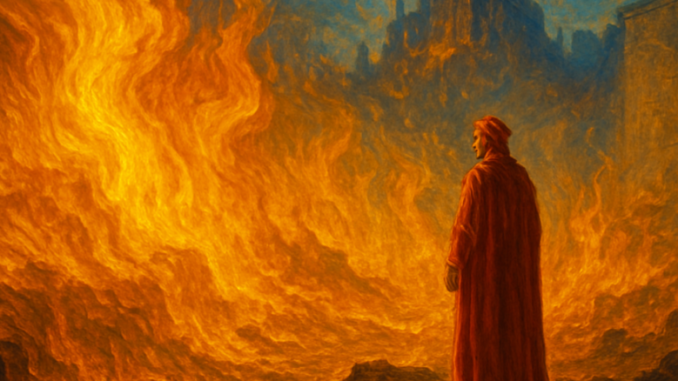
If you’ve read Dan Brown’s Inferno, chances are you walked away with questions. What’s real? What’s invented? And what about all those references to secret societies and ancient symbols? As a Freemason, these questions come up regularly — especially when popular thrillers paint vivid pictures of mysterious brotherhoods operating in the shadows. It’s worth taking a clear-eyed look at what Inferno suggests about symbolism and hidden knowledge, and how that compares to the reality of Freemasonry.
Dante Alighieri as Inspiration
Dan Brown didn’t choose the title Inferno at random. It’s a direct reference to Dante Alighieri’s Divine Comedy, the fourteenth-century masterpiece in which the poet descends into Hell, journeys through Purgatory, and ultimately reaches Paradise. This threefold path from darkness to light resonates deeply with Freemasons because it mirrors their own ritual journey — from ignorance to enlightenment, from rough stone to polished stone.
Dante himself was not a Freemason — he couldn’t have been, since Freemasonry as we know it didn’t emerge until the eighteenth century. Yet his works are frequently referenced in lodge meetings and philosophical discussions. The symbolism of the journey, the confrontation with personal shortcomings, and the search for truth are themes that Freemasons readily recognize in their own initiation rituals.
What Inferno Suggests About Secret Societies
In Inferno, Dan Brown weaves a narrative around hidden messages, ancient manuscripts, and powerful organizations pulling strings behind the scenes. It’s a familiar pattern from his earlier novels. The image that emerges is one of secret societies with dark agendas, hoarding knowledge from ordinary people and willing to go to extreme lengths to protect their secrets.
For thriller purposes, this works brilliantly. As a reader, you’re swept into a world where nothing is as it seems. But problems arise when you place this fiction alongside reality. Freemasonry is not a secret organization wielding hidden power. It is a fraternity that exists openly, with well-known lodge buildings, published constitutions, and members who can freely share their names.
How Symbolism Actually Works in Freemasonry
Where Dan Brown presents symbols as clues in a puzzle leading to earth-shattering secrets, symbolism in Freemasonry functions very differently. The square and compasses, the rough and polished stone, the building metaphors — these aren’t codes to be cracked. They are teaching tools. They invite self-reflection and moral development.
Masonic symbols are not keys to hidden treasures — they are mirrors that invite you to look at yourself.
Take the journey from darkness to light, a theme central to both Dante and Freemasonry. In Inferno, this is translated into a literal hunt through underground passages and hidden chambers. In the lodge, this journey is entirely internal: a candidate is symbolically confronted with his own ignorance before gradually receiving more light, step by step. It’s not about secret information — it’s about personal transformation.
Misconceptions Created by Fiction
Books like Dan Brown’s Inferno regularly create the impression that Freemasons pursue power or possess dangerous knowledge. In reality, Freemasonry is a fraternity focused on ethics, brotherly bonds, and personal growth. There are no secret plans, no hidden agendas aimed at reshaping the world.
Freemasons hold no secret knowledge that is deliberately kept from others. The rituals are not designed to acquire power but to encourage character development. Lodges are not secret power centers — they are meeting places for brothers. And symbols serve as tools for self-reflection, not as cryptic messages waiting to be decoded.
It’s understandable that thrillers feed these kinds of misconceptions. Suspense demands mystery, and a centuries-old fraternity provides rich material for the imagination. But anyone who genuinely wants to understand what Freemasonry is about would do well to look beyond the pages of a novel.
Why the Distinction Matters
You might ask: it’s just fiction, isn’t it? Why worry about a thriller? The answer lies in the power of stories. What we read shapes our perception of reality — often unconsciously. When millions of people read Inferno, it colors how they think about secret societies, symbols, and ancient traditions.
For Freemasons, this means regularly explaining what their fraternity actually stands for. That’s not a burden — it’s an opportunity. Every conversation sparked by a book like Inferno offers a chance to talk about the values Freemasons truly cherish: tolerance, brotherly love, a love of truth, and the ongoing work of improving oneself.
The Enduring Appeal of Dante
Setting aside Dan Brown’s thriller constructions, Dante Alighieri’s work remains a rich source of inspiration in its own right. Philosophers like Montaigne referenced it, and within Freemasonry, the symbolism of life’s journey is a regular topic of discussion. The descent into one’s own darkness, the confrontation with human weakness, the ultimate enlightenment — these are universal themes that transcend what any single thriller can make of them.
Perhaps that’s the most important lesson to take away when reading Inferno. Enjoy the adventure, the suspense, and the puzzles. But remember that the real symbolism of both Dante and Freemasonry isn’t about secrets waiting to be revealed — it’s about an inner journey that no one can make for you.
Dan Brown’s Inferno makes for thrilling reading, but it paints a picture of secret societies that is far removed from reality. Freemasonry is not about hidden power or dangerous secrets. It is a fraternity built on self-improvement, ethical reflection, and brotherly connection. The symbols, the rituals, and the journey from darkness to light all serve one purpose: helping each individual become a better person. That’s a story worth telling — even if it doesn’t quite fit the plot of a thriller.
Copyright text & image: devrijmetselaar.nl
Texts are based on the ideas and content of the author of devrijmetselaar.nl, reviewed, corrected, and supplemented with the assistance of OpenAI. Images are created based on the ideas of the author of devrijmetselaar.nl using OpenAI/DALL-E.

Be the first to comment