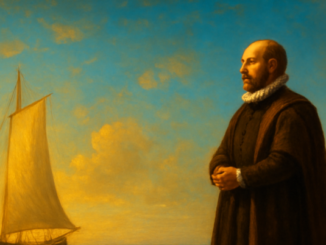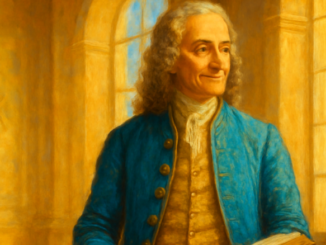
Voltaire portrait with Masonic symbols representing virtue and Enlightenment philosophy
Symbolism & Rituals

Voltaire on Virtue: Where Freemasonry and Philosophy Meet

What does virtue actually mean in a world that so often revolves around success, status, and snap judgments? Is it something you’re taught, or does it grow from within? François-Marie Arouet — better known as Voltaire — grappled with exactly this question in the eighteenth century. In his Philosophical Dictionary, he devoted a sharp and remarkably accessible essay to the concept of virtue. What he wrote turns out to be strikingly relevant today, and it touches the very heart of what Freemasons have pursued for centuries: moral perfection through inner growth and connection with others. Voltaire’s View of Virtue: Practical and Universal In his entry on virtue, Voltaire wastes no time with abstract definitions. For him, virtue is not a theological concept reserved for a devout elite — it is a practical attitude that every person can cultivate. Virtue, as Voltaire sees it, means acting in ways that benefit society. It is not about following rules out of fear of punishment, but about genuinely wanting to contribute to the well-being of others. This starting point aligns seamlessly with the Masonic worldview. In the lodge, you are not told what to think — you are guided in how to grow as […]
Ancient Roman letter scroll symbolizing Seneca's philosophy and Masonic ideals
Lucius Annaeus Seneca – Letters to Lucilius

Seneca’s Letter 47: Philosophical Roots of Human Dignity

Imagine living in the Roman Empire, surrounded by wealth and power, while all around you human beings are treated as property. Now imagine picking up a pen and arguing that a slave can be your friend. That is exactly what Lucius Annaeus Seneca did nearly two thousand years ago. His forty-seventh letter to Lucilius is no ordinary ethical treatise — it is the culmination of centuries-old philosophical traditions that placed the human being at the center of moral concern, regardless of social status. For anyone drawn to Freemasonry, with its emphasis on brotherhood and equality, this ancient letter holds up a surprisingly clear mirror. The Stoic Revolution from Within When Seneca took up his pen to write about the treatment of slaves, he drew on a rich Stoic tradition that had been building for three centuries before him. Zeno of Citium, the founder of Stoicism, introduced a radical idea: all human beings share in the same divine logos, the universal reason that permeates the cosmos. This meant that the social hierarchies of the Greek and Roman world were ultimately artificial. What makes someone truly human is not birth or possessions, but the capacity for rational thought and moral choice. Seneca’s […]

Platonic solids and cosmic order representing Plato's Timaeus and Freemasonry
Plato – Philosophical Background

Plato’s Timaeus: The Demiurge and the Ordered Universe

Imagine standing beneath a clear night sky, gazing at the stars, and asking yourself: who or what brought all of this into order? This very question drove Plato to compose his dialogue Timaeus, in which he envisioned a divine craftsman who shaped the cosmos. The idea of a creative, ordering force resonates powerfully to this day — particularly in Freemasonry, where the Great Architect of the Universe stands at the heart of the Craft. But what philosophical currents shaped Plato when he wrote this cosmic narrative, and why does it still matter to Freemasons today? The Timaeus in Its Historical Context Plato likely composed the Timaeus around 360 BCE, during the later phase of his life. It stands as one of his most ambitious works, weaving together cosmology, natural philosophy, and metaphysics into a single tapestry. Set after the events of The Republic, the dialogue presents a creation story that would permanently reshape Greek philosophy. Unlike the mythological explanations offered by Hesiod and Homer, Plato sought a rational account for the order we observe in the universe. He built upon the insights of his teacher Socrates, but went further by forging a connection between the world of the senses and […]

Mirror and feather symbolising Montaigne's essay On Cannibals and self-reflection
Michel de Montaigne – Content & Summary

Montaigne on Cannibals: Summary and Deeper Meaning

A feather. A simple feather, worn by a man from a distant land. To the sixteenth-century European, it was a curiosity — an exotic souvenir from the New World. But to Michel de Montaigne, that same feather became a mirror, a symbol that raised an uncomfortable question: who, exactly, is the barbarian here? In his essay On Cannibals, Montaigne turns the gaze inward and confronts the reader with the shadow side of their own civilisation. More than four centuries later, this essay remains a powerful invitation to self-reflection — a theme that also lies at the very heart of Freemasonry. The Occasion: Encounters with the New World Montaigne wrote this essay around 1580, at a time when stories about newly discovered continents were flooding into Europe. He drew on the accounts of explorers, but also on something far more personal. He had actually met three indigenous Brazilians who had been brought to the French court. Through an interpreter, he asked them about their way of life, their customs, and their impressions of Europe. It is these direct encounters that give the essay a remarkable sense of authenticity. The title sounds deliberately provocative, and Montaigne chose the word “cannibals” with full […]

Skull and crossbones memento mori symbol representing Stoic and Masonic wisdom
Marcus Aurelius – Content & Summary

Marcus Aurelius Book IX: Death, Immortality & Freemasonry

What does it truly mean to be mortal? And how can our mortality liberate us rather than confine us? In Book IX of his Meditations, Marcus Aurelius wrestles with these fundamental questions. As Roman Emperor, he wrote these private reflections not for publication but as an inner compass amid war, disease, and political turmoil. Book IX stands out as a particularly penetrating section in which the Stoic philosopher-emperor approaches death not as an enemy, but as a teacher — a perspective that resonates deeply with the Masonic tradition. The Core Idea: What Remains When Everything Passes? The central question running through Book IX is deceptively simple: if everything is transient, what remains of value? Marcus Aurelius answers by arguing that the very recognition of our finitude compels us to make essential choices. He does not see death as a dark endpoint but as a natural transformation within the cosmic order. The emperor reminds himself that countless rulers, philosophers, and ordinary citizens preceded him in death — and that this fact should not paralyze him but spur him toward virtuous action. This perspective aligns closely with the broader Stoic tradition in which Seneca and Epictetus also wrote. For all of them, […]

Portrait of Voltaire with Masonic symbols representing virtue and Enlightenment
Symbolism & Rituals

Voltaire on Virtue: The Philosophical Roots of His Thinking

In 1764, Voltaire published his Philosophical Dictionary, a collection of sharp essays tackling the great questions of human existence. His entry on virtue reveals a thinker deeply rooted in classical philosophy yet looking forward to a new kind of morality. What intellectual traditions shaped his thinking? And why do his ideas continue to resonate within Freemasonry centuries later? The Legacy of Stoicism Voltaire grew up intellectually immersed in the works of Seneca, Epictetus, and Marcus Aurelius. These Stoic thinkers had a profound influence on his conception of virtue. For the Stoics, virtue was not an abstract ideal but a practical way of life. They taught that a person could shape their character through rational self-discipline, regardless of external circumstances. In his essay on virtue, Voltaire echoes this conviction. He rejects the notion that virtue is innate or that it can only be obtained through divine grace. Instead, he emphasizes that every individual can develop their moral compass through personal effort. This message resonated powerfully in the eighteenth century, a time when the autonomy of the individual was becoming an increasingly central concern. Locke and the Empirical Approach to Morality Beyond the classical philosophers, Voltaire was profoundly influenced by John Locke, […]

Ancient Roman scroll symbolizing Seneca's Letter XLVII on human dignity
Lucius Annaeus Seneca – Content & Summary

Seneca on Slavery: The Timeless Wisdom of Letter XLVII

Evening falls over a Roman estate. A wealthy master reclines at his table, surrounded by servants who wait in silence. One of them coughs softly and immediately freezes in terror. It was within this kind of everyday scene, nearly two thousand years ago, that Lucius Annaeus Seneca wrote a letter that would strike at the very foundations of human dignity. Letter XLVII, addressed to his friend Lucilius, is a remarkably modern argument for the equality of all people — regardless of their social standing. The Core Message of Letter XLVII Seneca opens his letter with a remark that was nothing short of revolutionary in his time: he has heard that Lucilius treats his slaves with kindness, and he commends him for it. The central thesis of the letter is as simple as it is powerful — slaves are human beings, just like their masters. They share the same human nature, the same vulnerability to fortune, and therefore deserve respect and compassion. Seneca pushes back against the prevailing Roman view that slaves were mere property, no different from cattle or household furniture. The philosopher argues that the circumstances of birth and fortune are entirely arbitrary. The man who is a master […]

Ancient Greek temple columns symbolizing Plato's cosmic order and geometry
Plato – Content & Summary

Plato’s Timaeus: The Divine Craftsman and the Universe

Imagine standing in your workshop, tools in hand, ready to create something. Not just anything — the most beautiful, most harmonious object you can conceive. This image lies at the heart of Plato’s Timaeus, a dialogue in which the philosopher describes how a divine craftsman shaped the universe. Written around 360 BC, this remarkable text offers surprisingly practical insights for anyone who builds — whether that means constructing something tangible or shaping one’s own character. The Central Idea: The Universe as Conscious Design In the Timaeus, Plato has the philosopher of the same name recount the origin of the cosmos. The central figure is the Demiurge — a word that literally means ‘craftsman’ or ‘maker.’ This divine creator looked upon the eternal, perfect Forms and used them as a blueprint to shape the physical world. The universe, then, is no accident. It is the result of purposeful craftsmanship. This sets the Timaeus apart from many other creation stories. The Demiurge does not create out of nothing. Instead, he orders pre-existing, chaotic matter according to rational principles. He works like an architect following a ground plan, or like a sculptor who already perceives the hidden form within a block of rough […]

Open book with Montaigne essays beside Masonic square and compasses symbol
Michel de Montaigne – Freemasonry & Connection

Montaigne on Moderation: Practical Lessons for Freemasons

You probably know the feeling: you’re so convinced of a position that your voice grows louder, your arguments sharper. Or you throw yourself into a project with such devotion that the people around you barely see you anymore. Michel de Montaigne warned against exactly this kind of excess in his essay ‘On Moderation.’ His sixteenth-century insights turn out to be remarkably relevant for anyone pursuing personal growth and meaningful connections with others — and especially for Freemasons who strive to build brotherhood on a foundation of self-knowledge. What Montaigne Actually Means by Moderation For Montaigne, moderation is not lukewarmness or a lack of passion. It is the ability to consciously direct your passions so that they serve you rather than control you. In his essay, he describes how even virtues can derail when pushed too far. A just person can become a tyrant if their sense of justice knows no limits. A devout believer can justify cruelty in the name of a higher cause. Montaigne draws on classical examples to make his point. He references Aristotle, who regarded the golden mean as the foundation of virtue. Not too much, not too little, but exactly enough. It sounds simple, but it […]

Rough ashlar stone and Stoic philosophy symbol representing Masonic self-improvement
Marcus Aurelius – Freemasonry & Connection

Marcus Aurelius on Judgment: Lessons for Freemasons

You are about to judge someone. Perhaps a colleague who is always late, a neighbor who neglects their yard, or a brother in the lodge who holds views different from your own. In that moment of judgment, it is not the other person who determines your state of mind — it is you. Marcus Aurelius understood this nearly two thousand years ago. In Book VIII of his Meditations, the Roman emperor reveals how our prejudices hold us captive and how we can set ourselves free. These insights find a remarkably direct application in Freemasonry, where the work of smoothing the rough ashlar begins with recognizing our own imperfections. The Core of Book VIII: You Are Your Judgment Marcus Aurelius writes in Book VIII that it is not events themselves that wound us, but the judgments we pass upon them. It sounds simple, but the implications are profound. When someone insults you, it is not the insult that causes pain — it is your own reaction to it. You choose to feel hurt. This core Stoic principle demands radical self-reflection: are you willing to put your own thinking under scrutiny? In practical terms, this means something very concrete. When you notice […]

Seneca Letter XLI and Freemasonry: the divine spark and brotherhood
Lucius Annaeus Seneca – Freemasonry & Connection

Seneca’s Letter XLI: Lessons in Brotherhood and Connection

Picture this: you’re standing at the threshold of a hectic day, surrounded by obligations, expectations, and the noise of the world. And yet, somewhere deep within, a quiet voice is asking for your attention. Nearly two thousand years ago, the Stoic philosopher Lucius Annaeus Seneca wrote to his friend Lucilius about exactly this feeling. In Letter XLI, he describes how something divine resides in each of us — something that connects us to one another and to something far greater than ourselves. How can this ancient insight still be applied today? And what does it have to do with the brotherhood and connectedness that Freemasons place at the very heart of their Craft? Recognizing the Divine Spark Within Seneca opens his letter with a striking observation: true human greatness does not lie in possessions, status, or outward display, but in the soul. He describes how a spark exists within all of us — one that connects us to the divine. This is not some abstract philosophical concept. It is a direct invitation to look at yourself differently. When you glance in the mirror each morning, do you see only someone who needs to perform and produce? Or can you also […]

Open book of Montaigne's Essays with classical philosophical texts in background
Michel de Montaigne – Philosophical Background

Montaigne on Moderation: The Philosophical Roots Explored

When Michel de Montaigne picked up his pen in the sixteenth century to write about moderation, he drew on a rich tradition of thinkers who came before him. His essay on the subject is no isolated meditation — it is a tapestry woven from Stoic wisdom, Skeptic restraint, and Humanist insight. For anyone searching for balance today, this essay offers not only historical context but also a mirror in which we can recognize our own pursuit of temperance. The Philosopher’s World: Montaigne’s Intellectual Landscape Michel de Montaigne lived in an era of violent religious conflict, political upheaval, and intellectual rebirth. The French Wars of Religion raged across his homeland, while the Renaissance made possible a rediscovery of classical texts. In his tower study, surrounded by the works of Greek and Roman thinkers, Montaigne found the stillness to reflect on life’s fundamental questions. His library contained works by Plutarch, Seneca, Cicero, and the Skeptic philosopher Sextus Empiricus. These thinkers formed the foundation upon which he built his famous Essays. His essay on moderation emerged precisely from this tension between extremes. While Catholics and Huguenots were locked in deadly conflict, Montaigne sought a middle path — not out of cowardice or indecision, […]

Symbolic cave with light streaming in representing Plato's allegory and Freemasonry
Plato – Freemasonry & Connection

Plato’s Cave Allegory: A Practical Guide to Connection

You probably know the feeling. You experience an insight that changes your life — a moment of clarity that shifts everything. And then comes the real challenge: how do you share it with others? How do you help someone else see the same light? This is precisely the question Plato posed more than two thousand years ago in his famous cave allegory. And it is precisely the question that Freemasonry answers anew every day within its lodges. The Prisoner Who Returns In Book VII of The Republic, Plato describes a group of prisoners chained inside a cave. All they can see are shadows flickering on the wall, and they mistake these shadows for reality. When one prisoner is freed and steps outside, he discovers sunlight and the real world for the first time. But here is the crucial point: he goes back into the cave. Not because he has to, but because he chooses to. He feels a responsibility to help the others. This is not some abstract philosophical thought experiment. It is a practical calling you can act on today. The freed prisoner chooses to seek connection with those still in darkness. He could have stayed outside, basking in […]

Marble bust of Marcus Aurelius with Masonic square and compass symbolism
Marcus Aurelius – Meditations

Marcus Aurelius on Judgment: Philosophical Roots of Masonry

What if our worst enemy doesn’t dwell outside us, but inhabits the silent space between perception and conclusion? Marcus Aurelius — the Roman emperor who philosophized amid war and plague — proposed a radical thesis in the eighth book of his Meditations: it is not events that torment us, but the judgments we pass upon them. This idea, deceptively simple on the surface, carries the weight of centuries of philosophical tradition and casts a surprising light on the ethical quest that Freemasons know well. The Stoic Legacy of Judgment To understand the intellectual world of Marcus Aurelius, we must travel back to the Stoa of Zeno of Citium, the philosophical school that emerged in Athens around 300 BCE. The Stoics developed a psychology of judgment that was revolutionary for their time. They drew a sharp distinction between phantasia — the initial impression that reality makes upon us — and synkatathesis — the assent we choose to give or withhold from that impression. Epictetus, the freed slave whose lectures Marcus Aurelius studied as a young man, refined this doctrine into a practical art of living. His famous distinction between what lies within our power and what does not forms the backbone […]

Open book with Enlightenment symbols representing Voltaire and Freemasonry
Symbolism & Rituals

Voltaire on God: Where Reason Meets Freemasonry

What did Voltaire actually mean when he wrote about God? And why do Freemasons feel such a strong kinship with his ideas? In his Philosophical Dictionary, the French thinker tackles a question that has occupied seekers for centuries: how do human reason and the divine relate to one another? Let us sit across the table from Voltaire himself and explore where his philosophy intersects with the Masonic path. What Did Voltaire Really Write About God? Voltaire was no atheist, despite what his critics often claimed. In his entry “On God” in the Philosophical Dictionary, he argues that the existence of an ordering force in the universe is entirely reasonable. He observes nature — the regularity of the stars, the mathematical precision of natural laws — and concludes that behind it all lies a formative principle. But here is the crucial point: Voltaire explicitly rejects the anthropomorphic God of many religious traditions. He speaks instead of a Supreme Being that manifests in the harmony of the cosmos, not through dogmas or revelations. This position places him squarely within the tradition of deism — the belief that God created the world but does not actively intervene in human affairs. For Voltaire, this […]

Ancient Stoic philosophy scroll with Masonic square and compasses symbolism
Lucius Annaeus Seneca – Letters to Lucilius

Seneca’s Letter XLI: The Philosophical Roots of the Divine

What exactly did Lucius Annaeus Seneca mean when he wrote that a god dwells within us? And why does that idea still resonate in the rituals and symbols of Freemasonry? To truly understand Letter XLI, we need to travel back to the philosophical sources from which Seneca drew his inspiration — an intellectual journey that reveals surprising connections between ancient Stoicism and the Craft. Why Did Seneca Speak of an Inner Divinity? This question takes us straight to the heart of Stoic philosophy. Seneca did not write in a vacuum. He stood in a tradition that began with Zeno of Citium, the founder of Stoicism, and was further developed by thinkers like Cleanthes and Chrysippus. For these philosophers, the universe was permeated by an ordering principle — the logos — a divine reason that connected all things. Human beings, they believed, carry a spark of this universal reason within them. Seneca called this the daimon or genius that resides in each of us. This was no abstract idea. The Stoics believed that by cultivating this inner divinity, one could live in harmony with nature. When Seneca writes in Letter XLI that you need not raise your hands toward heaven to […]

Artistic depiction of Plato's Cave Allegory showing shadows and light
Plato – Philosophical Background

Plato’s Cave Allegory: The Philosophical Roots of Light

A fire flickers behind chained figures. Shadows dance across a stone wall. The prisoners see nothing but these flickering shapes and take them for reality. This image — perhaps the most famous philosophical parable in Western history — lies at the heart of Book VII of Plato’s Republic. But this story did not emerge from a vacuum. It carries the traces of centuries of Greek philosophy, mystical traditions, and one extraordinary teacher whose death would mark Plato forever. The Shadow of Socrates No figure casts a longer shadow over Plato’s thought than Socrates. The man who roamed the Athenian marketplace compelling his fellow citizens toward self-examination through relentless questioning becomes, in the Cave Allegory, the freed prisoner who returns to liberate the others. This is no coincidence. When Athens condemned Socrates to death in 399 BCE, Plato lost not only his teacher but also his illusions about the enlightenment of his own city-state. The return of the freed man to the cave — where he is mocked and threatened by the very people he seeks to liberate — mirrors the fate of Socrates. Here we see how personal experience and philosophical abstraction flow together. The allegory is simultaneously a metaphysical […]

A balanced scale symbolizing moderation and Masonic wisdom
Michel de Montaigne – Content & Summary

Montaigne on Moderation: The Art of Finding the Middle Way

A scale rests in perfect stillness when both pans are precisely balanced. Add even a single grain to one side, and the equilibrium is lost. Michel de Montaigne saw in this simple image a profound truth about human life: even the most exalted virtue can become a vice when it exceeds its proper measure. In his essay “Of Moderation,” he examines how excess can lead us astray — even when we are pursuing what is good. The Core Idea: Even Virtue Has Its Limits The central theme of this essay is surprising and counterintuitive. Montaigne argues that even virtuous behavior becomes dangerous when practiced to an extreme. This seems paradoxical at first. How can something good go too far? Yet through numerous examples, Montaigne demonstrates that excessive devotion to a principle or practice ultimately achieves the opposite of what was intended. The virtue of moderation, he insists, must also govern how we practice all other virtues. Montaigne draws on the wisdom of antiquity to make his case. Aristotle taught that virtue lies at the mean between two extremes. Plato warned against the danger of unbridled passions, even when they are directed toward the good. These classical philosophers understood what many […]

Open book of Marcus Aurelius Meditations beside a rough and polished ashlar
Marcus Aurelius – Content & Summary

Marcus Aurelius Book VIII: On Judgment and Prejudice

A stone dropped into water sinks to the bottom. That is its nature. But what is the nature of human judgment? Marcus Aurelius, Roman emperor and Stoic philosopher, devoted a significant portion of his eighth book to this very question. In his private writings — now known to us as the Meditations — he examines how our prejudices and snap judgments can hold us captive. This article explores the heart of Book VIII and reveals why mastering our judgment is the key to genuine freedom. The Central Insight of Book VIII Throughout Book VIII, Marcus Aurelius returns again and again to one fundamental truth: it is not events themselves, but our judgments about those events, that determine our suffering or our peace. He writes to himself as a reminder — a kind of inner compass meant to steer him away from the pitfalls of thoughtless reaction. The emperor understood that even the most powerful man in the world can be enslaved by his own prejudices if he fails to question his first impressions. The central theme is best described as the art of suspension — not the suspension of action, but the suspension of judgment. Marcus Aurelius invites us to […]

Vrijmetselarij - Plato over de ziel: innerlijke harmonie als vrijmetselaarspad
Plato – Freemasonry & Connection

Plato on the Soul: Inner Harmony as a Masonic Path

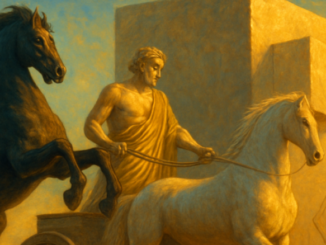
A charioteer grips the reins of two horses. One is fiery and untamable, the other calm and obedient. Only when the driver keeps both horses in balance can the chariot reach its destination. This image, drawn from Plato’s work, perfectly mirrors what the philosopher sets out in Book IV of The Republic about the human soul. For those familiar with Masonic values, a striking parallel emerges: the work on the rough ashlar turns out to be deeply connected to the ordering of forces within our own souls. Plato’s Tripartite Soul In The Republic, Plato identifies three distinct parts of the human soul: the rational part, the spirited part, and the appetitive part. The rational part seeks truth and wisdom. The spirited part craves honor and recognition. The appetitive part is drawn toward bodily pleasures and material satisfaction. Plato argues that justice within the soul arises when each part fulfills its proper function and reason takes command over the other two. This is far from abstract theory. Plato describes something we all experience daily — the tension between what we know to be right, what our pride demands, and what our desires whisper to us. The philosopher invites us to recognize […]