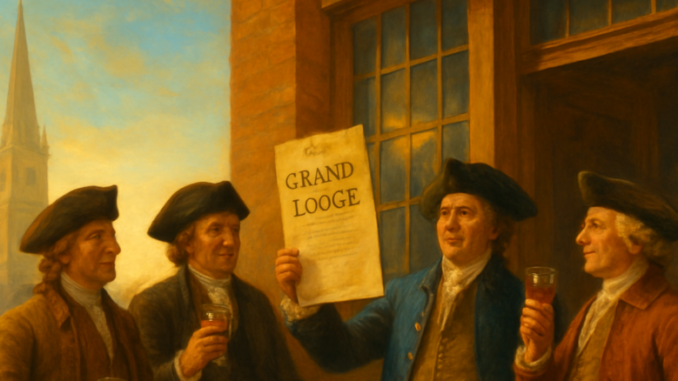
The 18th century was not only the age of Enlightenment — it was the era in which Freemasonry transformed from a handful of local lodges into a worldwide network with lasting influence on society. This extensively updated article explores how Masonic lodges served as incubators for revolutionary ideas about liberty, equality, and fraternity, and how the Craft shaped some of the most consequential events in modern history.
The 1700s were a time of revolution, intellectual awakening, and the rapid spread of ideas about freedom and equality. It was also a pivotal century in the history of Freemasonry. From the founding of the first Grand Lodge to the Craft’s involvement in world-changing political movements, the 18th century established Freemasonry as a powerful force for social and philosophical change.
The First Grand Lodge of London (1717)
The century opened with a landmark moment for the Craft: the founding of the first Grand Lodge in London in 1717. Four London lodges came together to form a central governing body — an event widely regarded as the official birth of modern Freemasonry.
The establishment of the Grand Lodge did far more than create an organizational framework. It introduced a standardized structure of degrees, rituals, and governance that gave the fraternity a sense of cohesion and legitimacy. This new structure attracted men from every walk of life — craftsmen and aristocrats alike — drawn by the Craft’s rich symbolism and its ethical principles of moral self-improvement.
Freemasonry and the Enlightenment
Freemasonry and the Enlightenment were deeply intertwined. Masonic lodges became meeting places where intellectuals, philosophers, and political reformers could exchange ideas in a spirit of tolerance and free inquiry. Some of the era’s greatest thinkers — Voltaire, Montesquieu, and Benjamin Franklin among them — were active Freemasons who used the lodge as a platform to discuss and promote concepts of equality, brotherhood, and rational thought.
The influence of these ideas extended far beyond the lodge room. The values debated and refined within Masonic circles helped inspire the social and political movements that would reshape the Western world, most notably the American and French Revolutions.
Freemasonry and the American Revolution
Freemasonry played a remarkable role in the birth of the United States. Many of the Founding Fathers — including George Washington, Benjamin Franklin, and Paul Revere — were members of the Craft. The ideals of liberty and equality that were discussed and cultivated in American lodges formed a philosophical foundation for the creation of a new democratic nation.
Masonic symbolism and concepts also found their way into the iconography of the young republic. The notion of building a “New World” resonated with Masonic themes of construction and renewal. Even the famous Great Seal of the United States, with its all-seeing eye above an unfinished pyramid, is frequently associated with Masonic influence — though historians continue to debate the extent of that connection.
Freemasonry and the French Revolution
Across the Atlantic, Freemasonry also played a significant part in the upheaval that transformed France. Many leading revolutionaries were lodge members, including prominent figures such as Mirabeau and the Marquis de Lafayette. French lodges functioned as brotherhoods in which ideas of reform, justice, and popular sovereignty were openly debated and disseminated.
While the precise degree of Masonic influence on the French Revolution remains a subject of scholarly discussion, there is no denying that the revolution’s core motto — liberté, égalité, fraternité — echoed values that had long been central to the Masonic tradition.
International Expansion of the Craft
The 18th century also saw Freemasonry expand far beyond the British Isles. Lodges were established across continental Europe, throughout the Americas, and even in colonial territories such as India and the Caribbean. The Craft became a truly global community, united by shared rituals and universal values that transcended national and cultural boundaries.
This rapid growth was not without its challenges. Differences in interpretation, ritual practice, and governance led to internal tensions — most notably the rivalry between the “Antients” and the “Moderns” in England. These two competing Grand Lodges coexisted for decades before finally uniting in 1813 to form the United Grand Lodge of England, creating a stable foundation that endures to this day.
The Lasting Legacy of 18th-Century Freemasonry
Freemasonry in the 18th century was a powerful catalyst for change and renewal. It provided a unique platform for progressive ideas at a time when open discourse was often dangerous. The Craft played a role in some of the most important historical movements of the era, and its influence on democratic ideals, civil liberties, and the concept of universal brotherhood remains deeply felt in the modern world.
The 18th century stands as a golden age for Freemasonry. The founding of the first Grand Lodge, the deep connection with Enlightenment philosophy, and the Craft’s involvement in revolutionary movements made this period a defining chapter in Masonic history. The ideals forged in 18th-century lodges continue to inspire Freemasons around the world — and the story continues into the 19th century, an era of industrialization and sweeping social reform.
Copyright text & image: devrijmetselaar.nl
Texts are based on the ideas and content of the author of devrijmetselaar.nl, reviewed, corrected, and supplemented with the assistance of OpenAI. Images are created based on the ideas of the author of devrijmetselaar.nl using OpenAI/DALL-E.
Frequently Asked Questions
What was the significance of the First Grand Lodge founded in London in 1717?
The founding of the first Grand Lodge in London in 1717 marked the official birth of modern Freemasonry and transformed the Craft from scattered local lodges into an organized fraternity. It established standardized degrees, rituals, and governance structures that gave Freemasonry cohesion and legitimacy, while attracting men from all walks of life who were drawn to its rich symbolism and ethical principles of moral self-improvement.
How did Freemasonry influence the American Revolution?
Many of the Founding Fathers, including George Washington, Benjamin Franklin, and Paul Revere, were active Freemasons whose ideals were shaped by lodge discussions about liberty and equality. The philosophical concepts of freedom and brotherhood cultivated in American Masonic lodges formed a foundational influence on the creation of the United States as a democratic nation.
What was the relationship between Freemasonry and the Enlightenment?
Freemasonry and the Enlightenment were deeply interconnected, with Masonic lodges serving as intellectual meeting places where philosophers, reformers, and great thinkers like Voltaire, Montesquieu, and Benjamin Franklin could freely exchange ideas about equality, brotherhood, and rational thought. The values debated within these lodges helped inspire revolutionary social and political movements that reshaped the Western world.
What type of men were attracted to Freemasonry in the 18th century?
Freemasonry in the 18th century attracted men from every walk of life, including both craftsmen and aristocrats, as well as some of the era's greatest intellectuals and philosophers. The Craft's emphasis on moral self-improvement, ethical principles, and symbolic teachings appealed to individuals seeking personal growth and meaningful brotherhood across social boundaries.

Be the first to comment