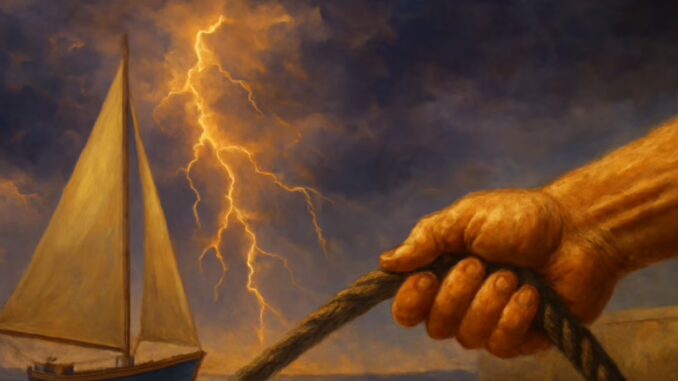
The evening sky above the harbor turns purple, and the first flash of lightning illuminates the masts of moored boats. A man walks calmly to his vessel and unplugs the shore power cable. Behind him, other boat owners laugh: “That storm is nothing to worry about!” But when the morning sun breaks through the clouds, every single one of them has quietly done the same thing. Sometimes a single action says more about character than a thousand words.
The Silence Before the Storm
There is a peculiar moment just before a thunderstorm breaks. The wind drops, birds fall silent, and the air itself seems to hold its breath. In that instant of tension, something essential about human behavior reveals itself. Some people ignore the signs and carry on as if nothing is happening. Others take quiet precautions — not out of fear, but out of prudence. It is precisely this distinction that Freemasonry has explored for centuries: the difference between outward display and inner authenticity.
The man who unplugs his shore power is not acting out of panic. He is following an inner compass that tells him: take responsibility for what you can influence, and accept what you cannot control. It is a small gesture, barely visible to anyone else, but it speaks of a character that needs no external validation. While those around him choose bravado over caution, he quietly follows his own judgment.
Bravado as a Mask
Why do people feel the need to downplay danger? The answer runs deeper than simple overconfidence. Bravado often functions as a mask — a shield against the uncertainty that threatening weather stirs up inside us. By loudly declaring that something is “nothing to worry about,” we create an illusion of control. We place ourselves above the situation, above the elements, above our own vulnerability.
In Freemasonry, this tendency is recognized as a fundamental obstacle on the path to self-knowledge. The ritual work invites honesty about our own limitations. The rough ashlar — that enduring symbol of the unworked self — has no ornamentation or pretense. It is what it is, in all its imperfection. Only when we acknowledge our own roughness can we begin to shape it. The man on the dock who mocks caution is, in truth, revealing his own discomfort with uncertainty.
The Night as a Proving Ground
The storm that night was fierce. Wind tore at mooring lines, lightning illuminated the harbor in sharp white flashes, and thunder made the boats shudder in their berths. In moments like these, the possibility of performance disappears entirely. There is no audience anymore — only the storm and yourself. What you do then, who you are then, that is your true character.
Character is what you do when nobody is watching.
This timeless wisdom resonates deeply with the Masonic conviction that inner labor matters more than outward recognition. The lodge is not a stage for applause; it is a workshop for self-development. What happens there remains largely invisible to the outside world — much like the decision to slip out in the middle of the night and quietly unplug that shore power cable, unseen by anyone but the person who makes it.
The Morning After
The real revelation comes with the morning light. The scoffers of the previous evening, it turns out, did not follow through on their own words. Or rather, their actions in the silence of the night spoke a different language than their words in the company of others. They too had unplugged their cables. Not openly, not with any explanation, but quietly, when no one was looking.
This is no cause for triumph or mockery. On the contrary, it is a moment of recognition. We are all capable of wearing masks. We all have moments when our words and our actions fail to align. The question is not whether we are perfectly consistent — no human being is. The question is whether we are willing to examine our inconsistencies, acknowledge them, and learn from them.
The Power of Silent Example
What stands out in this story is that the man who first unplugged his cable never tried to convince anyone. He offered no explanation, sought no vindication, and did not respond to the ridicule. He simply acted according to his own insight and let his deed speak for itself. And it was precisely that quiet action that left an impression — perhaps more than any argument ever could have.
Freemasonry speaks of “working in silence.” This does not mean we must never speak, but rather that the value of our actions does not depend on recognition or applause. A good deed remains a good deed, even if no one sees it. A precaution is no less wise because others laugh at it. The character revealed in such moments is one of inner certainty — of trust in one’s own judgment, of the courage to act differently from what the group expects.
The Storm as a Mirror
Throughout the ages, thunderstorms have served as symbols of trial and tribulation — of forces greater than ourselves. In ancient rituals and stories, the storm is often the moment when heroes reveal their true nature. Not by defeating the storm, for no one can do that, but by navigating through it with integrity.
The harbor after the storm looks unchanged. The boats are still in their berths, the docks are intact, and life goes on. But something invisible has shifted. Relationships have been subtly rearranged. The person who quietly did the right thing need say nothing — his actions have spoken. And those who scoffed have learned their own lesson in the silence of the night, even if they may never admit it aloud.
The next time the sky darkens and thunder rumbles in the distance, ask yourself: am I acting according to my own judgment, or according to the expectations of those standing around me? The storm always passes. But what it reveals about our character endures.
Copyright text & image: devrijmetselaar.nl
Texts are based on the ideas and content of the author of devrijmetselaar.nl, reviewed, corrected, and supplemented with the assistance of OpenAI. Images are created based on the ideas of the author of devrijmetselaar.nl using OpenAI/DALL-E.
Frequently Asked Questions
What does Freemasonry teach about handling uncertainty and fear?
Freemasonry teaches that true character is revealed in how we respond to challenges when no one is watching. Rather than masking fear with bravado, the fraternity encourages members to acknowledge their limitations and vulnerabilities as the first step toward genuine self-improvement and inner strength.
What is the significance of the 'rough ashlar' symbol in Freemasonry?
The rough ashlar represents the unworked, imperfect self we all begin with—unadorned and honest about its limitations. This symbol teaches Masons that acknowledging our roughness and imperfections is essential to personal growth, and that self-knowledge comes before self-improvement.
How does Freemasonry distinguish between genuine character and outward appearance?
Freemasonry emphasizes that true character is demonstrated through quiet, responsible actions taken out of principle—not for external validation or applause. The fraternity's ritual work invites members to examine their motivations and develop authenticity, teaching that what we do in private, when no audience exists, defines who we truly are.
Is the Masonic lodge focused on public recognition or personal development?
The Masonic lodge is fundamentally a workshop for self-development rather than a stage for recognition. The meaningful work of self-improvement happens internally and largely invisibly, reflecting the Masonic conviction that inner labor and genuine transformation matter far more than outward applause or status.

Be the first to comment