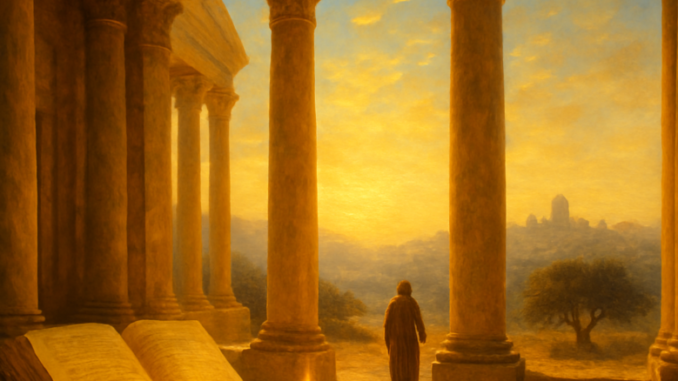
Sometimes words written centuries ago strike with unexpected force, resonating with something deeply personal in your present experience. A sentence that cuts through the noise, an image that lingers long after you’ve read it. The First Epistle of John — a short but remarkably powerful text from the New Testament — has exactly that quality. It speaks of light and darkness, of genuine love and authentic community. These are themes that also lie at the very heart of Freemasonry, and they invite a deeper reflection on what it truly means to live a connected and meaningful life.
The Essence of the First Epistle of John
The First Epistle of John was most likely written toward the end of the first century, during a time when early Christian communities were grappling with internal divisions and questions about authenticity. The author, traditionally attributed to the Apostle John, addresses his readers with a message that is simple yet profoundly urgent: God is light, and those who walk in that light live in truth and love. The text wastes no words. It cuts directly to the essence of what it means to live among others.
What stands out is the deliberate repetition of core concepts. Light and darkness. Love and hatred. Truth and falsehood. These contrasts are not abstract philosophy — they are concrete calls to self-examination. John challenges his readers to measure their actions against their words. Anyone who claims to walk in the light but harbors hatred toward a brother remains in darkness. It is an invitation to look at yourself with unflinching honesty.
Light as a Universal Symbol
The symbol of light appears across virtually every spiritual tradition, and Freemasonry is no exception. Within the lodge, light represents knowledge, insight, and moral clarity. The search for light is a journey from ignorance to wisdom, from darkness to understanding. When John writes that God is light and that in Him there is no darkness at all, he touches upon the same fundamental human experience: the desire to understand, to see what is hidden.
In Freemasonry, every candidate begins his journey as someone dwelling in darkness. The symbolic blindfold that is removed marks the moment he receives his first light. This ritual mirrors precisely what John describes — the transition from a life of unawareness to an existence in which you consciously choose truth and integrity. Light is not something you passively receive. It is something toward which you must actively walk.
Brotherly Love as the True Test
One of the most repeated themes in the First Epistle of John is the call to brotherly love — not as a sentimental feeling, but as concrete action. John writes that anyone who claims to love God but hates his brother is a liar. This may sound harsh, but it points to something essential: belief and ethics are inseparable. What you profess to believe must become visible in how you treat others.
True brotherhood reveals itself not in words, but in acts of love that transcend self-interest.
For Freemasons, brotherhood is not a casual concept. It is a daily practice of supporting one another, engaging in honest inquiry, and growing together. The lodge serves as a training ground for this ideal. Just as John calls upon his community to love one another, so are Brethren in Freemasonry invited to live outside the lodge what they promise within it. The trowel, one of the working tools of Freemasonry, symbolizes exactly this: smoothing over conflicts and building harmonious relationships.
The Inner Journey and Self-Knowledge
John speaks of testing the spirits — discerning what is true from what is false. This demands a posture of critical self-reflection. Not everything that presents itself as truth actually is. Freemasonry places a similar emphasis on self-knowledge. The rough ashlar that the Entered Apprentice receives symbolizes the unworked human being he is at the beginning of his journey. It is his task to labor upon himself, to smooth the rough edges, and to grow toward a more harmonious existence.
The Church Father Augustine, who studied the writings of John in great depth, emphasized that self-knowledge is the first step toward knowledge of God. This insight resonates with the inscription above the Temple of Apollo at Delphi, which is also frequently cited in Masonic context: Know Thyself. It is no coincidence that ancient wisdom, early Christian texts, and Freemasonry converge at this very point. The inner journey is universal.
Community as a Building Project
John writes from within and for a community. His letter is not an individual meditative essay but a call to shared life. The collective voice dominates throughout: That which we have heard, which we have seen, which our hands have touched. This communal testimony forms the foundation of the fellowship. In Freemasonry, the lodge is understood as a symbolic temple that Brethren build together. Every stone, every contribution, is necessary to complete the whole.
The building metaphor is rich with meaning. Just as a structure requires strong foundations, a community rests upon shared values. John names love and truth as those foundations. Freemasonry adds brotherhood, tolerance, and personal responsibility. These are different words for closely related ideals: building something together that is greater than any one individual.
An Invitation to Reflect
The First Epistle of John is not dry doctrine — it is a warm invitation. It does not ask for blind acceptance but for honest self-reflection. Are you truly walking in the light, or are you hiding behind words? Is your love for others concrete, or does it remain limited to good intentions? These are questions every person can ask themselves, regardless of religious background.
Consider the key themes that unite this ancient text with Masonic philosophy:
• Light as a symbol for knowledge and moral clarity
• Brotherly love as concrete action, not mere sentiment
• Self-knowledge as the foundation for growth
• Community as a shared building project rooted in truth
The First Epistle of John and the teachings of Freemasonry speak across centuries and traditions, yet arrive at a remarkably similar destination. Both insist that walking in the light is not a passive state but an active commitment — a daily choice to pursue truth, practice genuine love, and contribute to a community built on shared values. Whether you encounter these ideas in scripture or in the lodge, the challenge remains the same: let your actions reflect your highest ideals, and never stop working on the rough stone that is yourself.
Copyright text & image: devrijmetselaar.nl
Texts are based on the ideas and content of the author of devrijmetselaar.nl, reviewed, corrected, and supplemented with the assistance of OpenAI. Images are created based on the ideas of the author of devrijmetselaar.nl using OpenAI/DALL-E.
Frequently Asked Questions
What is the main connection between the First Epistle of John and Freemasonry?
Both the First Epistle of John and Freemasonry emphasize the themes of light and darkness, truth, and authentic community. John writes that God is light and calls people to walk in that light with honesty and love, while Freemasonry uses light as a symbol of knowledge, insight, and moral clarity. Both traditions invite individuals to examine themselves unflinchingly and progress from ignorance toward wisdom and understanding.
What does light symbolize in Freemasonry?
In Freemasonry, light represents knowledge, insight, and moral clarity. It symbolizes a journey from ignorance to wisdom and from darkness to understanding. When a candidate is initiated, the removal of a symbolic blindfold marks the moment they receive their first light, representing a transition from unawareness to a conscious choice to live with truth and integrity.
When was the First Epistle of John written and what was its original purpose?
The First Epistle of John was most likely written toward the end of the first century during a time when early Christian communities were facing internal divisions and questions about authenticity. The author, traditionally attributed to the Apostle John, wrote to address these concerns by delivering a simple yet urgent message: that God is light, and those who walk in that light live in truth and love.

Be the first to comment