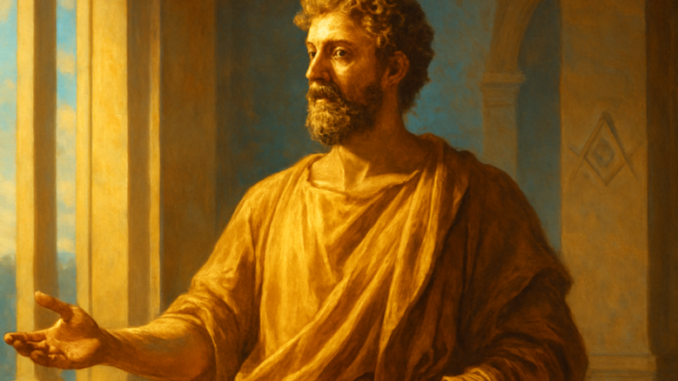
You probably know the feeling: you’re sitting in a conversation, but your mind has already drifted to tomorrow. You’re walking through the city, but you’re mentally somewhere else entirely. The present moment sometimes feels like the hardest place to truly inhabit. Marcus Aurelius, the Roman emperor-philosopher, wrestled with exactly the same challenge more than eighteen centuries ago. In the second book of his Meditations, he wrote some of his most penetrating thoughts on presence and connection. For Freemasons, his words touch on something essential — the question of how to be truly present, both for yourself and for your Brothers.
The Burden of Past and Future
Marcus Aurelius never wrote his Meditations for publication. They were private notes — a conversation with himself. That’s precisely why they feel so raw and honest. In Book II, he confronts himself with the waste that occurs when the mind constantly slips away to what has been or what is yet to come. He reminds himself that the present is the only thing anyone truly possesses. The past is gone, the future uncertain. Only this moment offers space for action, for growth, for genuine connection.
This wasn’t idle philosophizing. For Marcus Aurelius, it was a way of life that helped him function under extreme pressure. As emperor, he faced constant strain — wars, political intrigue, and devastating personal losses. Yet he kept returning to the same core truth: be here, now, completely.
Freemasonry as a Practice of Presence
Anyone who has ever stepped inside a Masonic lodge knows that the ritual invites you to leave the outside world behind. The doors close, the phone stays outside, and a space opens up that demands your full attention. This is no accident. The entire structure of the ritual work cultivates a form of awareness remarkably similar to what Marcus Aurelius describes. You are invited not to dwell on tomorrow or yesterday, but to engage fully with what is unfolding before you right now.
The ritual creates a kind of timelessness. The symbolic actions, the repeated words, the shared rhythm — everything works together to bring participants into a state of collective presence. In this sense, the lodge serves as a training ground for what Marcus Aurelius held up as an ideal: complete devotion to the current moment.
Connection as the Fruit of Presence
In Book II, Marcus Aurelius also reflects on his relationship with others. He reminds himself that people who irritate or disappoint him are still part of the same human community. True connection requires seeing the other person as they actually are — not as you expect or fear them to be. And that requires presence.
True brotherhood arises when you truly see the other — not through the veil of expectations, but in the full light of the present moment.
For Freemasons, this resonates deeply with the concept of brotherhood. Brotherhood is not an abstract ideal. It is something that must be realized again and again in concrete encounters. You can only truly be a Brother when you are willing to be present — not lost in thoughts about your workload or your worries, but offering your full attention to the person standing before you.
Self-Reflection as a Daily Practice
One of the most striking features of Book II is its tone of self-reflection. Marcus Aurelius addresses himself — sometimes sternly, sometimes with encouragement. He holds up a mirror to his own behavior. This practice of honest self-examination lies at the very heart of Freemasonry as well. The concept of the rough ashlar, slowly shaped into a more perfect form, represents precisely this process: you examine yourself critically, not to condemn, but to grow.
The Meditations show us that self-reflection is not a one-time event but a daily exercise. Every morning, every evening, Marcus Aurelius returned to the question: have I lived as I should have lived? This question has no final answer. It must be asked again and again, in the here and now.
The Brevity of Life as Motivation
A recurring theme in Book II is mortality. Marcus Aurelius continually reminds himself that life is short and every moment precious. This is not pessimism — it’s a call to action. Precisely because time is limited, it should not be squandered on distraction or hollow anxieties. For Marcus Aurelius, death is not something to fear but a perspective that brings clarity.
In Freemasonry, the symbol of death plays a similar role. Consider the skull that sometimes appears in lodge settings — not as a macabre ornament, but as a memento mori. It reminds every Brother that his time is finite and that he must use that time to truly live, truly work, and truly connect with others.
An Invitation to Practice
What Marcus Aurelius offers is not a theory but an invitation to practice. Every day, you can choose to be present. Every encounter offers a chance to truly see and be seen. The lodge provides a remarkable space for cultivating this skill, but the real test lies beyond the lodge walls — in everyday life.
Perhaps the greatest lesson of Book II is this: the here and now is not a given. You have to claim it, again and again. But in that moment of complete presence lies the possibility of genuine connection — with yourself, with others, with life itself. This is what Marcus Aurelius understood. And it is what Freemasonry, in its own way, seeks to cultivate.
The reflections of Marcus Aurelius in Book II are not dusty relics from a distant past. They speak directly to anyone who struggles with distraction, hurry, and the illusion that real life is happening somewhere else. For Freemasons, they offer a deepening of what the ritual already suggests: that genuine connection can only arise in the here and now. The invitation is clear. Not tomorrow, not when circumstances improve — but now. This moment. This encounter. This Brother.
Copyright text & image: devrijmetselaar.nl
Texts are based on the ideas and content of the author of devrijmetselaar.nl, reviewed, corrected, and supplemented with the assistance of OpenAI. Images are created based on the ideas of the author of devrijmetselaar.nl using OpenAI/DALL-E.
Frequently Asked Questions
What is the connection between Marcus Aurelius's philosophy and Freemasonry?
Marcus Aurelius emphasized being present in the moment and fully engaged with others, which aligns with Freemasonry's practice of ritual work. Both traditions create a space for complete awareness and devotion to the present moment, away from distractions of the past and future. The Masonic lodge serves as a training ground for the type of mindfulness and presence that Marcus Aurelius advocated for in his Meditations.
How does the Masonic ritual help practitioners achieve presence?
The Masonic lodge deliberately creates an environment of timelessness by closing off the outside world, leaving phones and distractions behind. The symbolic actions, repeated words, and shared rhythm of the ritual work together to bring participants into a collective state of presence. This structure invites Freemasons to focus entirely on what is unfolding in the moment, rather than dwelling on past events or future concerns.
What did Marcus Aurelius believe about the past and future?
Marcus Aurelius taught that the present moment is the only thing anyone truly possesses. The past is gone and cannot be changed, while the future remains uncertain. Only the here and now offers genuine space for action, growth, and meaningful connection with others. This philosophy helped him manage the extreme pressures he faced as a Roman emperor dealing with wars, political intrigue, and personal losses.


Be the first to comment