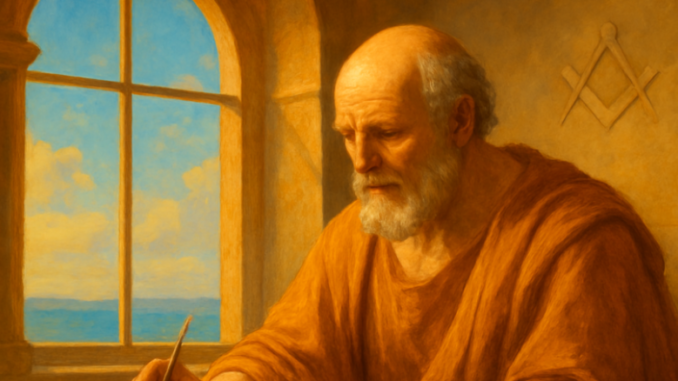
When Lucius Annaeus Seneca writes about old age in his twelfth letter to Lucilius, he draws from a rich philosophical tradition stretching back centuries before his time. This letter is no isolated musing of an aging man — it is a carefully woven tapestry of Stoic, Epicurean, and early Greek insights. How do these philosophical currents interact within Seneca’s reflections on impermanence? And what does this mean for the Freemason who studies the same text today? By placing two perspectives side by side — that of the academic philosopher and that of the seeking Brother — a surprising conversation unfolds about time, mortality, and the art of living.
The Philosopher’s Perspective: Seneca as Heir to Ancient Traditions
For the academic philosopher, Letter XII is a treasure trove of intertextuality. Seneca does not write in a vacuum. Trained in the Stoic school, his thinking is equally shaped by Epicurus, whose maxims he frequently quotes with approval. In this letter on aging, we recognize the influence of Zeno of Citium, the founder of Stoicism, who taught that virtue is the only true good and that external circumstances — including physical decline — belong to the so-called adiaphora: things that are morally indifferent.
At the same time, Seneca echoes the Epicurean notion that death is of no concern to us while we live. Epicurus himself wrote that we need not fear death, because where we are, death is not, and where death is, we are no more. Seneca adopts this thought but gives it a Stoic twist: it is not merely about the absence of fear, but about actively embracing every stage of life as a gift.
The Freemason’s Perspective: Old Age as Ritual Wisdom
The Freemason who reads Letter XII sees something altogether different. Where the academic traces sources and influences, the Brother recognizes universal truths that are lived within the Lodge. The aging Seneca describes is not merely biological decline — it is the phase in which the rough ashlar is progressively polished, in which the inner temple nears its completion. The symbolism of building, so central to Freemasonry, takes on a temporal dimension here: each day adds a stone, each experience sharpens the chisel.
In Masonic ritual practice, the confrontation with mortality plays an essential role. The symbols of the skull and crossbones, the meditative silence of the Chamber of Reflection — they remind the candidate of the brevity of life. Seneca would have recognized this immediately. His letter is, in essence, a memento mori — a reminder of death that does not paralyze but liberates.
Where Both Perspectives Converge
The philosophical and the Masonic perspectives are not opposites. They share a fundamental conviction: that wisdom does not come from without but is acquired through inner labor. Seneca’s Stoicism emphasizes the autonomy of the mind. Freemasonry speaks of working one’s own stone. Both traditions acknowledge that we are not powerless before the passage of time — that through conscious reflection, we can determine the quality of our days.
Old age is not adversity but a stage of completion, in which the wise person harvests what was sown in earlier years.
Both the philosopher and the Freemason understand that aging is a mirror. The philosopher sees in it the culmination of a life devoted to knowledge and virtue. The Freemason sees the reflection of his ritual journey — from Entered Apprentice through Fellow Craft to Master Mason. In both cases, old age is not an ending but a crowning achievement.
The Intellectual Context: From Athens to Rome
To fully appreciate Seneca’s Letter XII, we must return to the Greek roots of his thought. Plato wrote in the Republic about the ideal state in which wise elders govern — not despite but because of their age. Aristotle viewed old age with more nuance: on one hand it brought experience, on the other, sometimes bitterness. Seneca deliberately chooses the affirmative path, but not naively. He acknowledges physical decline, the pains, the limitations. His wisdom lies in refusing to see victimhood in any of it.
The Roman context adds another layer. In the Rome of Seneca’s day, old age was a mark of authority. The paterfamilias, the head of the household, derived his power partly from his years. Seneca transforms this social reality into a philosophical ideal: it is not the outward power of the old man that matters, but his inner freedom.
Lessons for the Modern Reader
What can we, as readers in the twenty-first century, learn from this dual reading? The academic reminds us that great texts never stand alone. They are rooted in traditions, they dialogue with predecessors, they anticipate future readers. The Freemason adds that knowledge only gains true value when it is lived. It is not enough to read about aging — the question is how we ourselves relate to the passage of time.
Letter XII invites an attitude of gratitude — not the forced gratitude of self-help books, but a deep recognition that every day, even one marked by physical discomfort, offers an opportunity for growth. Seneca would say: it is not about how many years we live, but about how we fill those years. The Freemason would respond: it is about the quality of the stones we lay, not the size of the edifice.
The Enduring Relevance of Ancient Wisdom
In a culture that glorifies youth and marginalizes old age, Seneca’s Letter XII offers a counter-voice. His philosophical foundation — rooted in Stoicism but enriched with Epicurean and Platonic elements — reaches far beyond his own era. Freemasonry, with its emphasis on personal development and symbolic architecture, provides a living context in which to practice this ancient wisdom today.
Together, these two traditions extend an invitation: see old age not as decline but as fulfillment. View each passing year not as loss but as an opportunity to refine the inner temple. Whether you approach this from the philosopher’s study or from the Lodge floor, the message is the same — time is not the enemy of the wise. It is, perhaps, their greatest teacher.
Seneca’s twelfth letter remains a powerful meditation on what it means to grow old with dignity and purpose. Read through the lens of philosophy, it reveals a masterful synthesis of Stoic, Epicurean, and Platonic thought. Read through the lens of Freemasonry, it becomes a guide for the inner journey every Brother undertakes — from rough stone to polished ashlar, from darkness to light. In bridging these two perspectives, we discover that the deepest wisdom about aging has never changed: it is not the length of our days that defines us, but the intention and craftsmanship we bring to each one.
Copyright text & image: devrijmetselaar.nl
Texts are based on the ideas and content of the author of devrijmetselaar.nl, reviewed, corrected, and supplemented with the assistance of OpenAI. Images are created based on the ideas of the author of devrijmetselaar.nl using OpenAI/DALL-E.
Frequently Asked Questions
What philosophical traditions does Seneca draw upon in Letter XII?
Seneca's Letter XII on aging weaves together Stoic, Epicurean, and early Greek philosophical traditions. He was trained in Stoicism, particularly drawing from Zeno of Citium's teachings that virtue is the only true good and that external circumstances like physical decline are morally indifferent. He also incorporates Epicurean ideas, especially Epicurus's concept that death should not be feared, but reframes these thoughts through a Stoic perspective that emphasizes actively embracing every stage of life as a gift.
How do Freemasons interpret Seneca's reflections on aging differently than academic philosophers?
While academic philosophers study Letter XII for its intertextual sources and philosophical influences, Freemasons see in Seneca's work universal truths lived within Lodge practice. For the Mason, aging is not merely biological decline but represents the progressive polishing of the rough ashlar and the completion of the inner temple. The symbolism of building in Freemasonry takes on a temporal dimension where each day and experience contribute to spiritual development, much like Seneca's vision of embracing each life stage.
What does Seneca mean by treating external circumstances like physical decline as 'adiaphora'?
According to Stoic philosophy, adiaphora refers to things that are morally indifferent or beyond our moral control. In Seneca's application to aging and physical decline, this means that while our bodies may deteriorate with age, these external changes are not morally significant and should not disturb our virtue or inner wisdom. What matters is our Stoic response to these changes—our ability to maintain virtue and wisdom regardless of our physical circumstances.




Be the first to comment