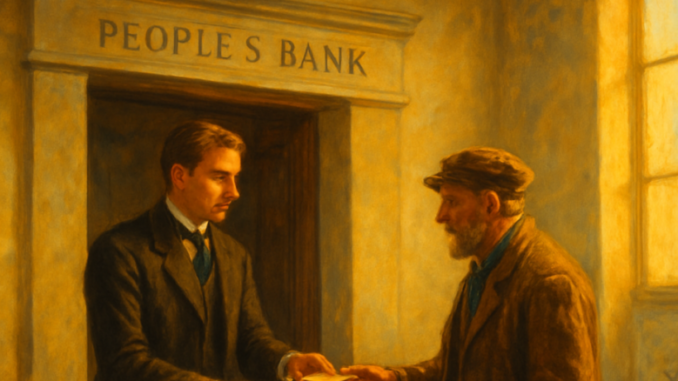
In an era when access to financial resources was largely reserved for the wealthy elite, people‘s banks represented nothing short of a revolution. These institutions, founded to support small entrepreneurs and laborers, found powerful allies in Freemasons — men driven by ideals of equality and brotherhood. Together, they helped establish people’s banks across the Netherlands, contributing to economic emancipation and self-reliance for those who needed it most.
The Origins of People’s Banks
People’s banks emerged during the 19th century, a period marked by stark economic inequality. Small business owners and working-class laborers had little or no access to traditional banking services. Instead, they were forced to rely on moneylenders who charged exorbitant interest rates. The concept behind people’s banks was straightforward: provide individuals with limited means access to affordable loans and savings facilities.
Freemasons, long known for their involvement in social reform, recognized people’s banks as a powerful vehicle for promoting economic equality. They leveraged their networks and organizational expertise to help establish these banks and ensure they operated successfully.
Freemasonry and Economic Emancipation
The support Freemasons offered to people’s banks was deeply rooted in their core values. Equality stood at the forefront — Freemasons envisioned a society where everyone had fair opportunities regardless of birth or social standing. Self-reliance was equally important: by giving workers and small entrepreneurs access to credit, they could take control of their own futures. And community spirit tied it all together, as people’s banks were typically organized at the local level with a strong emphasis on cooperation and solidarity.
The philosophy underpinning people’s banks closely mirrored the Masonic ideal that enlightenment and progress should be accessible to all, not just the privileged few. This alignment of values made the partnership between Freemasonry and the people’s banking movement a natural one.
Practical Contributions of Freemasons
Freemasons played a pivotal role in making people’s banks a success, contributing in several tangible ways. First, they were instrumental in fundraising — gathering the startup capital needed through donations and loans from lodge members. Second, many Freemasons served on the boards of these institutions, applying their business acumen and moral principles to ensure sound governance and ethical management.
Perhaps equally significant was their role in education and awareness. Freemasons actively promoted the principles of responsible borrowing and saving, ensuring that people’s banks offered more than just financial assistance — they provided genuine financial literacy. This holistic approach helped people’s banks spread rapidly and leave a lasting impact on local economies throughout the Netherlands.
People’s Banks and Freemasonry Today
While people’s banks in their original form have largely disappeared or been absorbed into larger financial institutions, their founding principles endure. Modern credit unions, cooperative banks, and microfinance programs around the world continue to build on the same fundamental idea: that financial resources should be accessible to everyone, not just those who already have wealth.
The role Freemasons played in establishing people’s banks contributed meaningfully to the development of a more inclusive financial sector. It remains a lasting legacy of their commitment to social justice and economic equality — a reminder that fraternal ideals, when put into practice, can reshape entire industries.
A Legacy of Meaningful Change
People’s banks stand as a powerful example of how Freemasonry translated philosophical ideals into practical solutions for real-world problems. By promoting financial self-reliance, Freemasons didn’t just help individuals — they strengthened entire communities and local economies. Their efforts demonstrated that access to capital is not merely a financial matter, but a question of dignity and equal opportunity.
In a time when economic inequality remains one of society’s most persistent challenges, the history of people’s banks offers genuine inspiration. It invites us to rethink how we ensure fair access to financial resources — and reminds us that meaningful change often begins with individuals united by shared values and a willingness to act.
Copyright text & image: devrijmetselaar.nl
Texts are based on the ideas and content of the author of devrijmetselaar.nl, reviewed, corrected, and supplemented with the assistance of OpenAI. Images are created based on the ideas of the author of devrijmetselaar.nl using OpenAI/DALL-E.
Frequently Asked Questions
What role did Freemasons play in establishing people's banks?
Freemasons were instrumental in creating people's banks by leveraging their networks and organizational expertise to help establish these institutions across the Netherlands. They contributed through fundraising, served on boards to ensure ethical management, and promoted financial literacy to help working-class people access affordable credit and achieve economic self-reliance.
Why were Freemasons interested in supporting people's banks?
Freemasons supported people's banks because these institutions aligned perfectly with their core values of equality, self-reliance, and community spirit. They believed that financial opportunities and enlightenment should be accessible to everyone, not just the wealthy elite, making the people's banking movement a natural extension of Masonic ideals.
What problems did people's banks solve in the 19th century?
People's banks addressed the severe lack of access to fair financial services for working-class laborers and small entrepreneurs, who were forced to rely on exploitative moneylenders charging exorbitant interest rates. By providing affordable loans and savings facilities, these banks enabled ordinary people to escape predatory lending and take control of their own economic futures.
How did Freemasons ensure people's banks operated successfully?
Freemasons contributed their business expertise and moral principles through board service, gathered startup capital from lodge members, and actively educated the public about responsible borrowing and saving. This multifaceted approach ensured people's banks provided not just financial assistance, but genuine financial literacy and ethical governance that led to their rapid expansion throughout the Netherlands.



Be the first to comment