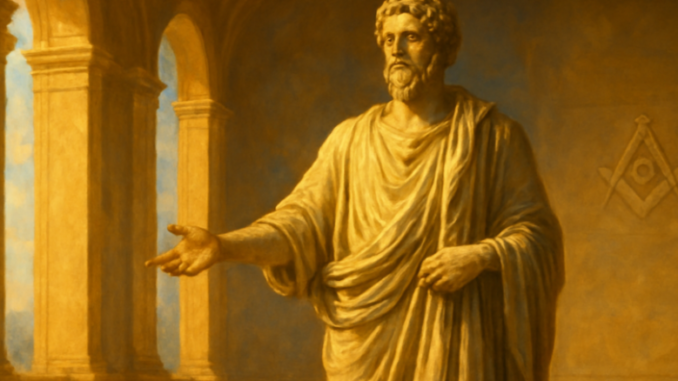
The fifth book of Marcus Aurelius’ Meditations opens with a remarkably intimate scene: the Roman emperor urging himself to get out of bed. This seemingly mundane moment carries a far deeper message. It is not about waking early — it is about the willingness to fulfill your duty, even when every fiber of your being resists. In Book V, Marcus Aurelius examines what it means to show true character when life pushes back, and how a sense of duty shapes us into who we are truly capable of becoming.
The Morning as a Symbolic Starting Point
Marcus Aurelius begins Book V with an inner dialogue that most of us will recognize instantly. He describes how the warmth of the bed beckons, how the mind invents reasons to stay lying down just a little longer. Yet he reminds himself that he was not born for comfort — he was born to act. The morning becomes a symbol for every new beginning, every choice where ease and duty stand in opposition. The moment of waking represents the awakening of consciousness to its responsibility.
This image of the morning struggle touches on a universal human experience. It is not only the physical act of getting up that proves difficult, but the mental effort of setting yourself in motion when challenges await. Marcus Aurelius shows us that strength of character does not begin with grand deeds, but with small, invisible victories over ourselves in the quiet of the early morning.
Duty as a Compass for Life
A central theme in Book V is the concept of duty — understood by the Stoics as acting in accordance with your nature and your role within the community. Marcus Aurelius emphasizes that every person has a task that arises from their position within the greater whole. The bee does not gather honey for itself; it serves the entire colony. So too with human beings: by fulfilling our duty, we contribute to the harmony of the universe.
Strength of character does not unfold by avoiding difficulty, but by embracing your duty when life turns against you.
This sense of duty is not an external compulsion but an inner calling. It does not demand heroism in the eyes of others — it demands faithfulness to yourself. Marcus Aurelius compares a person to a vine that produces grapes without expecting recognition for doing so. The act itself is the reward, not the praise that may follow.
The Rock as an Image of Steadfastness
In Book V, Marcus Aurelius employs the vivid image of a rock battered by waves yet standing unmoved. This symbol of steadfastness illustrates what he means by strength of character. It is not about being unfeeling or hardened — it is about cultivating an inner calm that does not depend on external circumstances. The waves of fortune, whether they take the form of setbacks, criticism, or loss, cannot dislodge the rock from its place.
This image resonates because it captures the very essence of Stoic resilience. The rock does not respond to the waves with anger, nor does it retreat. It simply stands. The person of character does the same: they need not overcome the storms of life through force, but through presence and inner stability.
The Cosmic Perspective
Marcus Aurelius continually places human duty within a larger framework. He invites the reader to see themselves as part of an all-encompassing order — a coherent whole in which everything is connected to everything else. This idea, known to the Stoics as the logos, forms the philosophical foundation of his ethics of duty. When you understand that your actions are part of a cosmic symphony, even the smallest deed acquires meaning.
This perspective puts personal frustrations into proportion. What is a sleepless night or an ungrateful colleague in the light of eternity? Marcus Aurelius does not use this shift in scale to trivialize human suffering, but to place it in context. By zooming out, it becomes easier to look upon yourself and others with gentleness and understanding.
Practical Examples from Daily Life
Book V is rich with concrete applications. Marcus Aurelius describes situations that every reader will recognize: the irritation caused by someone who wrongs you, the tendency to complain about the weather or circumstances, the temptation to postpone work. Each time, he returns to the same fundamental question: what is my task in this moment, and how can I fulfill it with integrity?
When irritated by others, he advises us to remember that they act according to their own understanding, however limited it may be. When facing physical discomfort, he reminds us that the body may complain, but the mind need not join in. When procrastination beckons, he challenges us to ask ourselves what we were born for — comfort, or purposeful action.
This practical approach is what makes the Meditations timeless. The specific situations may differ across centuries, but the underlying challenges remain remarkably familiar. It is in the small moments that character is forged, not in the grand historical events.
Connections to Symbolic Thinking
The way Marcus Aurelius imbues everyday objects and situations with deeper meaning connects to a tradition of symbolic thinking that also occupies a central place in Freemasonry. A hammer is not merely a tool — it represents the capacity to shape yourself. A morning is not simply a time of day — it is an invitation to inner awakening. By linking concrete objects to abstract values, Marcus Aurelius creates a language that reaches far beyond the literal.
This symbolic approach invites contemplation rather than quick comprehension. What matters is the slow unfolding of layers of meaning. Those who read Book V with an open mind will discover that each passage allows multiple readings, each attuned to the reader’s stage of life and personal experience. It is a quality shared by all great wisdom traditions: the text grows as the reader grows.
Book V of the Meditations offers no simple recipes for a good life, but it does provide a compass. Marcus Aurelius demonstrates that duty and strength of character are inseparably linked: the person who recognizes and accepts their task forges themselves into something enduring. Like the rock standing firm against the waves, like the vine bearing fruit without seeking applause, the person of character finds fulfillment not in recognition but in the act itself. For anyone walking a path of self-improvement — whether through Stoic philosophy, Masonic reflection, or simply the honest effort to live well — Book V remains a profound and inexhaustible guide.
Copyright text & image: devrijmetselaar.nl
Texts are based on the ideas and content of the author of devrijmetselaar.nl, reviewed, corrected, and supplemented with the assistance of OpenAI. Images are created based on the ideas of the author of devrijmetselaar.nl using OpenAI/DALL-E.
Frequently Asked Questions
What is the significance of the morning struggle in Marcus Aurelius' Book V?
Marcus Aurelius uses the morning struggle of getting out of bed as a symbolic representation of every choice between ease and duty. It demonstrates that strength of character begins not with grand deeds, but with small, invisible victories over ourselves. The moment of waking represents the awakening of consciousness to its responsibility and sets the tone for fulfilling our duties throughout the day.
How does Marcus Aurelius define duty according to Stoic philosophy?
In Book V, Marcus Aurelius defines duty as acting in accordance with your nature and your role within the greater community. He uses the example of a bee serving the entire colony and a vine producing grapes without expecting recognition. Duty is viewed as an inner calling rather than external compulsion, where fulfilling your responsibilities contributes to the harmony of the universe.
What does the rock battered by waves symbolize in Marcus Aurelius' teaching?
The rock battered by waves yet standing unmoved is a vivid symbol of steadfastness in Book V. It illustrates how strength of character develops not by avoiding difficulty, but by embracing your duty when life turns against you. This image demonstrates the Stoic ideal of maintaining inner resolve and commitment regardless of external challenges.

Be the first to comment