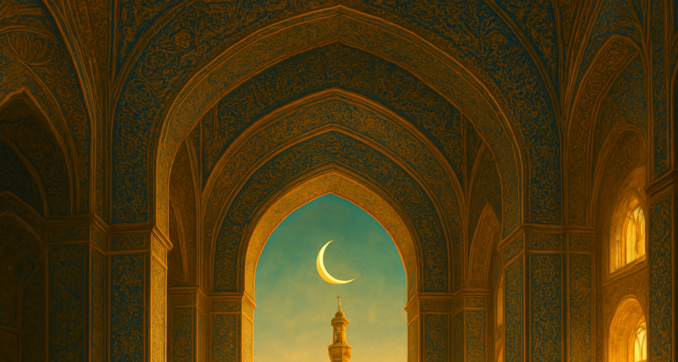
Imagine standing on a mountain ridge. On one side, a vast open valley stretches before you; on the other, a deep abyss drops away into shadow. You find yourself precisely on the boundary — not here, not there, but somewhere in between. That feeling of in-betweenness, of occupying a space where you haven’t yet arrived but can no longer turn back, is exactly what the seventh surah of the Quran speaks about. And it is an image that carries deep resonance within the traditions of Freemasonry.
What Does This Surah Tell Us?
The seventh surah of the Quran, known in Arabic as one of the longer chapters, bears a name that refers to elevated places or heights — Al-A’raf. Its central image is a liminal zone: a place where souls reside who do not immediately belong among the blessed, yet are not counted among those who have gone astray. These people on the heights can see both sides. They observe, they wait, and they hope.
The surah also recounts the stories of prophets who called their communities toward righteousness. You read about Adam, Noah, and Moses — about the eternal struggle between truth and self-deception. But what makes this text particularly striking is its recurring theme of choice: every human being bears the responsibility to determine their own path, knowing that there always exists a liminal space in which contemplation is possible.
Liminal Space as a Spiritual Concept
You may recognize this feeling from your own life — those moments when you weren’t sure which direction you were heading. Periods of doubt, of waiting, of not-yet-knowing. The surah suggests that this in-between space is not inherently negative. On the contrary, it is a place of perception, of gathering insight before moving forward. The people on the heights see both the light and the shadow, and that dual perspective makes them wiser.
This understanding of liminal space appears across mystical traditions worldwide. It echoes what some Christian mystics called purgatory — but without the emphasis on punishment. Here, the focus is on purification through awareness, on the necessity of seeing yourself honestly before you can progress. It is a space of becoming rather than a space of condemnation.
Connections with Freemasonry
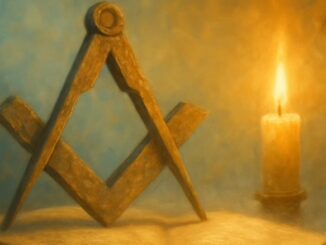
As a Freemason, you may recognize something familiar in this image of liminal space. The initiation rituals of Freemasonry also contain moments of symbolic death and rebirth, of blindfolding and the gradual reception of light. In those moments, you find yourself literally in a transitional zone: you are no longer who you were, but not yet fully who you will become.
The liminal space is not a place of stagnation, but of transformation. Those who dare to wait and observe grow in wisdom.
James Anderson and Jean-Théophile Désaguliers, who shaped modern Freemasonry in the eighteenth century, already emphasized the importance of moral growth as a process. You do not become a better person in a single moment. It is a continuous journey in which you repeatedly arrive at a crossroads. This idea aligns seamlessly with the image of the heights: a vantage point from which you can survey your own choices and their consequences.
The Prophets’ Stories as Mirrors
The surah contains extensive narratives about prophets who struggled with communities that refused to listen. Noah built his ark while being ridiculed. Moses stood against the might of Pharaoh. These stories are not abstract history lessons — they are mirrors for your own life. How often do you face incomprehension when you try to do what is right?
In Freemasonry, the act of building plays a central role, and the figure of Hiram Abiff — the Master Builder of Solomon’s Temple — embodies the craftsman who remains faithful to his principles, even in the face of violence and betrayal. The prophetic narratives in this surah carry a strikingly similar message: truth demands courage, and the path toward light often passes through darkness.
Reflection as Practice
What can you take away from this ancient text? Perhaps it is the invitation to stop fearing the liminal spaces in your own life and to embrace them instead. Those moments of uncertainty, of not-yet-knowing, are not failures. They are opportunities to pause, to observe, and to gather wisdom before taking your next step.
Allow yourself the grace of not having to know everything immediately. Use moments of doubt as time for genuine reflection. See both sides before passing judgment. Recognize that growth is a process, not a destination.
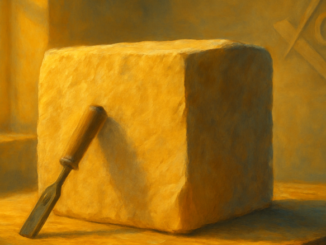
Freemasonry teaches that every brother builds his own inner temple, stone by stone. The heights described in this surah remind us that some stones can only be laid after a period of contemplation. Not every step forward needs to be rushed.
An Invitation to Look Beyond
Whether you are a person of faith or not, this text offers a valuable perspective on human existence. The question it poses is universal: how do you deal with the moments when you stand between two worlds? The wisdom of the heights suggests that it is precisely in that liminal space where the possibility of genuine growth resides. This is a thought that transcends the boundaries of individual religions and touches on something fundamentally human.
The seventh surah of the Quran speaks of elevated vantage points where souls wait and observe. This image of liminal space resonates deeply with Freemasonry, which equally values the power of contemplation — that charged moment between darkness and light. Perhaps the greatest lesson lies in the realization that you don’t always need to rush. Some insights only come when you dare to stand still on the high places of your own life, surveying the landscape of your choices with patience, humility, and an open heart.
Copyright text & image: devrijmetselaar.nl
Texts are based on the ideas and content of the author of devrijmetselaar.nl, reviewed, corrected, and supplemented with the assistance of OpenAI. Images are created based on the ideas of the author of devrijmetselaar.nl using OpenAI/DALL-E.
Frequently Asked Questions
What is Al-A'raf and why is it significant to this article?
Al-A'raf is the seventh surah of the Quran, whose name refers to elevated places or heights. It describes a liminal zone where souls reside who are neither among the blessed nor the astray, but rather in an in-between space where they can observe both sides. The surah is significant because it presents the concept of liminal space—a place of contemplation, choice, and perception—as a spiritually important state rather than a negative one.
How does the article describe liminal space and its spiritual purpose?
The article describes liminal space as moments of in-betweenness where one hasn't yet arrived but can no longer turn back—periods of doubt, waiting, and uncertainty. Rather than viewing this as negative, the article presents liminal space as a place of perception and insight where individuals gain wisdom through seeing both light and shadow. It emphasizes purification through awareness and self-honesty as necessary steps for spiritual progress.
What is the connection between Quranic liminal space and Freemasonry?
Both traditions use the concept of liminal space in their spiritual practices. Freemasonry's initiation rituals incorporate symbolic moments of death and rebirth, blindfolding, and the gradual reception of light. These ritualistic experiences place initiates in an in-between state similar to the liminal space described in Al-A'raf, serving as a transformative space for spiritual growth and enlightenment.


Be the first to comment