
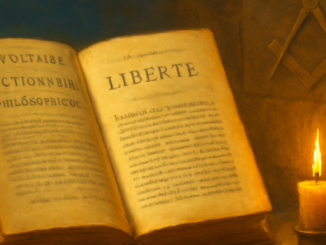
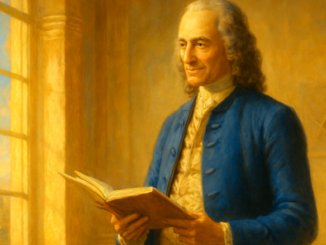
What is it about a seventeenth-century philosopher that still echoes through modern conversations about knowledge, freedom, and the limits of human understanding? When Voltaire devoted his third philosophical letter to John Locke, he did far more than introduce an English thinker to a French audience. He opened a door to an entirely new way of philosophizing — a method that would leave its mark on Enlightenment thought and, perhaps less obviously, on the principles embraced within Freemasonry.
Why Did Voltaire Choose Locke as His Guide?
The question is worth pausing over. In early eighteenth-century France, the ideas of René Descartes still dominated intellectual life. His rationalism — with its emphasis on innate ideas and the certainty of thought — formed the bedrock of philosophical culture. But during his exile in England from 1726 to 1728, Voltaire encountered a radically different approach. John Locke had argued in his Essay Concerning Human Understanding that the human mind at birth is a blank slate, a tabula rasa. All knowledge, Locke maintained, arises from sensory experience and our reflection upon it.
This empiricism appealed deeply to Voltaire. It offered an antidote to what he saw as the hollow speculations of scholasticism and the dogmatic certainty of Cartesian philosophy. Locke was modest where others were arrogant. He acknowledged the limits of human understanding rather than pretending that everything could be grasped through pure reason. This intellectual humility resonated profoundly with Voltaire’s own skeptical temperament.
The Philosophical Traditions That Laid the Groundwork
Locke’s thinking did not emerge in a vacuum, and Voltaire was well aware of this. Its roots reach back to the ancient skepticism of Sextus Empiricus, who questioned every claim to absolute knowledge. Michel de Montaigne, too, had emphasized the uncertainty of human judgment in his Essays. His famous question — “Que sais-je?” (What do I know?) — echoes through Locke’s acknowledgment that many things lie beyond our comprehension.
Pierre Gassendi also played a crucial role as a bridge between Epicureanism and modern empiricism. Gassendi had revived the atomistic natural philosophy of Epicurus and stressed the importance of sensory perception. Through this lineage, Voltaire connected himself to a tradition stretching back to Greek philosophy, now coupled with the emerging natural sciences.
Faith, Reason, and the Courage to Doubt
Here we touch on a sensitive point that Voltaire addressed with characteristic sharpness. Locke had argued that while reason has its limits, this does not mean we should surrender everything to revelation. On the contrary — precisely because our understanding is limited, we must be cautious with dogmatic claims, whether they come from church or state.
Recognizing the limits of our understanding is not a weakness, but the first step toward true wisdom.
Voltaire seized upon this to criticize the religious intolerance of his era. If we cannot even know with certainty how the mind works, how dare we condemn others for their beliefs? This argument would become a cornerstone of Enlightenment thought and directly influenced the principles of tolerance that were embraced within Masonic lodges.
The Connection to Freemasonry
The link between Voltaire’s admiration for Locke and the world of Freemasonry may seem unexpected, but the connections run deeper than they first appear. Early eighteenth-century Freemasonry breathed the same spirit of tolerance and inquiry that Voltaire so admired in Locke. Anderson’s Constitutions of 1723 already emphasized that Masons could encompass men of all faiths, provided they agreed to the moral law upon which all can find common ground.
This openness mirrors Locke’s conviction that people of different backgrounds can arrive at shared moral insights through reason and experience. The lodge became a laboratory for precisely this experiment: men of diverse convictions working together on their intellectual and moral development — not by imposing dogma, but by seeking together.
Other Currents of Thought at Play
Beyond skepticism and empiricism, Stoicism also played an important role. Thinkers such as Seneca and Marcus Aurelius had already pointed to the importance of self-knowledge and accepting the limits of human control. Locke’s emphasis on introspection — examining the workings of one’s own mind as a source of understanding how we think — connects naturally to this tradition.
Several major philosophical currents converged in this intellectual landscape:
- The skepticism of Montaigne and Sextus Empiricus — doubt as a method of inquiry
- The empiricism of Francis Bacon — knowledge gained through observation
- The natural philosophy of Newton — discovering laws rather than inventing them
- Stoicism — self-examination and moral discipline
Voltaire also greatly admired Isaac Newton, Locke’s contemporary and friend. Newton’s method of moving from observation to natural laws strengthened the empiricist program. In the combination of Locke and Newton, Voltaire saw a model for how philosophy ought to work: modest, methodical, and always willing to learn from the facts.
What Can We Take Away from This?
The philosophical background of Voltaire’s letter on Locke reveals a web of traditions that remains remarkably relevant. The willingness to doubt, the openness to experience, the tolerance for other viewpoints — these are not dusty academic principles. They live on in every brotherhood that truly seeks truth, in every lodge where men of different backgrounds gather not to judge, but to learn.
Voltaire’s choice to honor Locke was more than an intellectual preference. It was an act of philosophical courage — a plea for a way of thinking that takes the human mind seriously without overestimating it. Freemasons can still recognize themselves in this tradition. The question is not whether we have all the answers, but whether we are willing to keep asking the right questions — with humility and with openness.
Voltaire’s tribute to John Locke in his third philosophical letter was ultimately a declaration of values: intellectual modesty, tolerance, and the relentless pursuit of understanding through experience rather than dogma. These same values found fertile ground in the lodges of early Freemasonry, and they continue to guide Masonic thought today. In a world that still struggles with intolerance and the temptation of easy certainties, the philosophical roots that Voltaire celebrated remind us that wisdom begins not with having answers, but with the courage to keep questioning.
Copyright text & image: devrijmetselaar.nl
Texts are based on the ideas and content of the author of devrijmetselaar.nl, reviewed, corrected, and supplemented with the assistance of OpenAI. Images are created based on the ideas of the author of devrijmetselaar.nl using OpenAI/DALL-E.
Frequently Asked Questions
Why did Voltaire consider John Locke's philosophy significant enough to devote an entire letter to him?
Voltaire was profoundly influenced by Locke's empiricism during his exile in England from 1726 to 1728. Locke's theory that the human mind begins as a blank slate (tabula rasa) and that all knowledge arises from sensory experience offered a radical alternative to the dominant Cartesian rationalism of early eighteenth-century France. Voltaire appreciated Locke's intellectual humility and acknowledgment of the limits of human understanding, which contrasted sharply with what Voltaire saw as the arrogant dogmatism of Cartesian philosophy and scholasticism.
What philosophical traditions influenced John Locke's empiricism?
Locke's empiricism drew from a long philosophical lineage including ancient skepticism from Sextus Empiricus, who questioned absolute knowledge; Michel de Montaigne's Essays, which emphasized uncertainty in human judgment; and Pierre Gassendi, who revived Epicureanism and stressed the importance of sensory perception. Through these thinkers, Locke connected classical Greek philosophy with emerging modern natural sciences, creating a tradition that Voltaire recognized and valued.
How did Voltaire's interpretation of Locke relate to Freemasonry?
The article suggests that Voltaire's presentation of Locke's ideas influenced Enlightenment thought and shaped principles embraced within Freemasonry. Locke's emphasis on empiricism, intellectual humility, acknowledging the limits of human understanding, and the courage to doubt—rather than accept dogmatic certainty—aligned with Masonic values of rational inquiry and self-improvement through questioning and reflection.


Be the first to comment