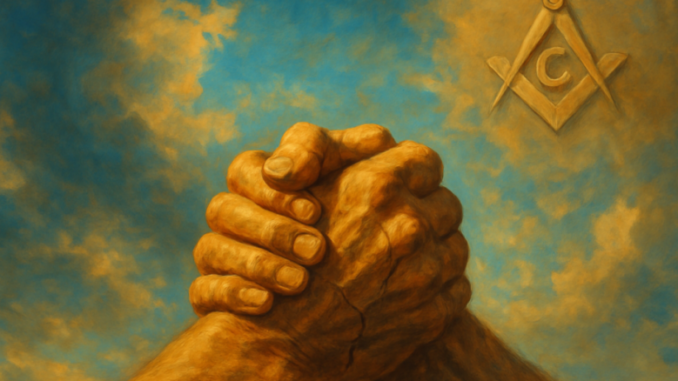
Imagine sitting in a meeting with people you’ve known for years. People with whom you’ve shared joys and sorrows, laughter and silence. Then word arrives that one of them has done something questionable — something now facing public scrutiny. The silence in the room becomes palpable. What do you do?
This scenario doesn’t only play out in Masonic lodges or circles of close friends — it unfolds in politics too. Recently, a local alderman in the Netherlands, a former presenter for a controversial broadcasting network, kept his position despite photographs surfacing that placed him in a pro-Russian light. The city council judged the misstep not severe enough to warrant dismissal. For outsiders, this raises pointed questions about loyalty, forgiveness, and their boundaries. For Freemasons, it echoes a dilemma as old as the Craft itself.
The Essence of Brotherhood
Brotherhood is not a casual concept within Freemasonry. It is a deliberate commitment to cultivate bonds with people you didn’t necessarily choose, but who walk the same path of personal development. Johann Wolfgang von Goethe, himself a Freemason, wrote extensively about the connection between individuals who strive together toward enlightenment. He understood that true brotherhood doesn’t mean ignoring each other’s faults — it means helping one another become better.
In the lodge, brethren learn that loyalty is not blind obedience. It is, in fact, the willingness to have difficult conversations, to hold up a mirror when the situation demands it. The real question is never simply whether you stand by someone despite their mistakes, but how you help them learn from those mistakes without betraying the values you share.
When Loyalty Conflicts with Principle
The tension between personal allegiance and shared values is as old as humanity itself. Aristotle wrote in his Nicomachean Ethics about friendship grounded in virtue, as opposed to friendship born of utility or pleasure. Only the first kind, he argued, can truly withstand the test of time. Because what happens when a friend acts contrary to the very virtues you pursue together?
True brotherhood does not demand unconditional support — it demands the courage to speak up when we stray from our shared values.
In the case of the alderman, we see this dilemma magnified. His colleagues on the council chose to support him, perhaps from a genuine conviction that the mistake was not irreparable. But that choice carries its own weight of responsibility: the duty to ensure the person in question actually learns and grows from the experience.
The Masonic Practice of Fraternal Correction
Within Freemasonry, there exists a long-standing tradition of brotherly admonition. This is not a public condemnation but a private conversation in which a brother is made aware of behavior that conflicts with the principles of the Order. The goal is never humiliation or exclusion — it is restoration and growth. James Anderson, who compiled the first constitutions of modern Freemasonry in 1723, emphasized that brethren must treat one another with gentleness and patience, even when correction is necessary.
This approach stands in sharp contrast to today’s culture of public accountability, where a single mistake can be enough to write someone off permanently. Freemasonry offers a different model: a space where errors can be acknowledged without it signaling the end of the relationship — provided there is genuine remorse and a sincere will to improve.
The Limits of Forgiveness
Yet even brotherhood has its boundaries. Not every misstep can be forgiven, and not every wrong can be made right. Voltaire, though critical of many institutions in his time, understood that communities can only function when there are shared standards that everyone respects. When someone repeatedly and deliberately violates those standards, a point arrives where the bond must be severed to protect the integrity of the community as a whole.
The question every community must ask itself — whether it’s a political party, a circle of friends, or a Masonic lodge — is: where does that line fall? And who decides when it has been crossed? In Freemasonry, this is determined collectively, after careful deliberation and in a spirit of justice.
What This Case Can Teach Us
The controversy around the alderman invites reflection on how we handle loyalty in our own lives. Do we support people out of habit or out of conviction? Do we dare to be critical of those closest to us? And are we willing to bear the consequences when we choose forgiveness?
Consider these principles that emerge from the Masonic perspective:
Brotherhood demands honesty, not silence. Staying quiet when a brother errs is not loyalty — it is complicity. The lodge teaches that true care sometimes takes the form of an uncomfortable truth spoken in private.
Loyalty is not an end in itself, but a means to grow together. When loyalty becomes a shield that prevents accountability, it ceases to serve its purpose. It becomes a barrier to the very development it was meant to foster.
Forgiveness is only meaningful when accompanied by genuine insight and change. Pardoning someone who shows no understanding of their error and no desire to change is not mercy — it is enabling.
Every community must know its boundaries and have the courage to enforce them. Without clear limits, shared values become hollow words. The strength of a community is measured not only by how it celebrates its members, but by how it responds when those members fall short.
Freemasonry does not offer ready-made answers to these questions, but it does provide a framework within which they can be honestly explored. In the privacy of the lodge, far from public opinion, brethren can seek together what is just — not to judge, but to understand, and where possible, to restore.
Brotherhood is not a shield against criticism — it is a foundation for growth. When a member of our community stumbles, every one of us is challenged to determine what our values truly mean. The choice to support someone or to let go is never simple, but it is precisely in that choice that the true nature of our bond becomes visible. Not in the fine words we speak, but in the difficult decisions we make together.
Copyright text & image: devrijmetselaar.nl
Texts are based on the ideas and content of the author of devrijmetselaar.nl, reviewed, corrected, and supplemented with the assistance of OpenAI. Images are created based on the ideas of the author of devrijmetselaar.nl using OpenAI/DALL-E.
Frequently Asked Questions
What does Freemasonry teach about loyalty when a brother makes a serious mistake?
Freemasonry teaches that true brotherhood is not about blind obedience or unconditional support. Rather, loyalty means having the courage to engage in difficult conversations and hold up a mirror when necessary. The goal is to help fellow members learn from their mistakes while maintaining shared values, not to ignore wrongdoing or enable poor behavior.
How does Freemasonry distinguish between true brotherhood and mere friendship?
According to Masonic principles and Aristotle's concept of virtue-based friendship, true brotherhood is grounded in shared values and personal development. It goes deeper than friendships based on utility or pleasure. Freemasons deliberately cultivate bonds with people on the same path of enlightenment, which means the relationship is built on mutual commitment to becoming better individuals, not just personal convenience.
Where is the line between supporting a brother and compromising on principles?
The article suggests that true loyalty does not demand unconditional support. Instead, it requires the courage to speak up when someone strays from shared values. Supporting a brother means helping them address their mistakes and learn from them, not enabling their actions or silencing legitimate concerns. The real test is whether your loyalty strengthens their character or weakens it.




Be the first to comment