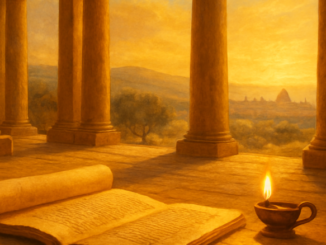
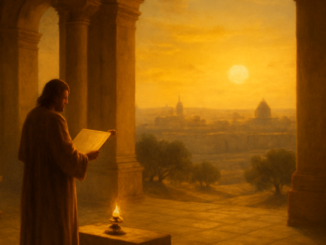
A silversmith's crucible over fire symbolizing the refiner's purification
Christianity

Malachi: The Messenger Who Brings Refinement

A crucible sits upon the fire. The metal within begins to glow, impurities rise to the surface and are skimmed away. What remains is purer, stronger, more valuable. This image from the daily life of ancient craftsmen carries a timeless truth within it. The last book of the Hebrew prophets — Malachi — speaks precisely about this process, not of metal, but of the human soul. As the closing chapter of the Old Testament, this brief text forms a bridge between what was and what is to come, between outward ritual and inner transformation. The Crucible as Mirror At the heart of Malachi stands the image of the refiner. The prophet describes a coming messenger who will sit as a silversmith, refining and purifying silver. This is not a destructive fire but a transformative one — and the distinction is essential. Destruction annihilates what is flawed, but refinement separates the valuable from the worthless so that the former can truly shine. The crucible in the silversmith’s workshop is, in this light, a symbol of conscious self-improvement. The fire that melts the metal is not random; it is carefully controlled by a craftsman who knows precisely when the purification is complete. […]

Golden seven-branched lampstand flanked by two olive trees in soft light
Christianity

Zechariah’s Golden Lampstand: A Mirror of the Inner Self

In the Book of Zechariah, there stands a lampstand. Not an ordinary one, but a golden lampstand with seven lamps, fed by two olive trees that channel their oil directly into its reservoir. This striking image from the fourth chapter of the prophetic text invites us to pause and reflect. What does it mean to receive light without effort of your own? And what might this ancient vision tell us about the way we build ourselves — and the world around us — today? A Lampstand That Feeds Itself Imagine a lamp that never needs refilling. The oil flows on its own; the flame never dies. In Zechariah’s vision, this golden lampstand stands at the center, flanked by two olive trees. The prophet asks what it all means, and the answer is profound: “Not by might, nor by power, but by my Spirit.” With those words, the focus shifts away from human effort toward a deeper, inexhaustible source. The lampstand becomes a symbol of what happens when we open ourselves to something greater than our own will. In Freemasonry, light plays a central role. The search for light is the search for knowledge, for insight, for that which was hidden […]

Symbolic ruins of a temple being rebuilt representing Masonic inner work
Christianity

Haggai and the Temple: Rebuilding as an Inner Calling

Imagine standing before the ruins of something that was once magnificent. Perhaps it’s a building, perhaps a relationship, perhaps a part of yourself you’ve long neglected. The foundations are still there, but the glory has faded. What do you do? Turn away and walk on — or pick up the first stone and start again? The brief biblical book of Haggai, just two chapters long, poses exactly this question. And the answers it offers resonate with striking power through the symbolism that Freemasons have cherished for centuries. A Prophet Standing Between Rubble and Possibility Haggai emerged during one of the most pivotal moments in the history of the Jewish people. After decades of exile in Babylon, a remnant of the nation returned to Jerusalem. What they found was a devastated city — and what struck them most deeply was the sight of Solomon’s Temple lying in ruins. This was no ordinary building. It was the spiritual heart of their community, the place where heaven and earth met in their experience of the divine. Yet despite their return, something curious happened. Instead of rebuilding the Temple, the people turned their attention to their own houses. They made their private dwellings comfortable […]

Candlelit Masonic lodge with open Bible showing the Book of Zephaniah
Christianity

Zephaniah and the Day of Purification: A Prophetic Mirror

Candles flicker softly in the dim light of the lodge as a brother reads aloud from an ancient text — a prophet warning of a day of reckoning, yet promising that from the ashes something new will rise. The brethren listen in silence, recognizing in these age-old words something strikingly contemporary: the necessity of inner purification before any true building can begin. The Book of Zephaniah, written in the kingdom of Judah during the seventh century BCE, speaks with an urgency that still resonates today. The Prophet and His Time Zephaniah was active during the reign of King Josiah, a period when Judah was struggling with religious decay and societal corruption. The prophet spoke to a people who had neglected their foundations — a nation that maintained the outer temple walls while allowing the inner temple to crumble. His message was twofold: first, a confrontation with what had become rotten; then, a promise of restoration for those willing to be reshaped. This small book, only three chapters long, opens with a gripping description of what Zephaniah calls the “Day of the Lord.” This is no simplistic fire-and-brimstone sermon but a call to fundamental reflection. The prophet does not only address […]

Ancient watchtower at dawn symbolizing Habakkuk's search for light
Christianity

Habakkuk: The Doubter and the Seeker of Light

When an ancient prophet raises his fists toward the heavens and demands to know why evil goes unpunished, he touches something deeply universal. The Book of Habakkuk is not a triumphant hymn of praise — it is a struggle, a conversation with the unknown. For the religious reader, a man speaks to his God. For the Freemason, an echo resounds of the eternal quest for light amid darkness. Two perspectives, one fundamental question: how do we live with uncertainty? The Prophet as Doubter Habakkuk occupies a unique place among the prophetic books of the Bible. Where most prophets speak on behalf of the divine to the people, Habakkuk reverses the direction entirely. He speaks to the divine on behalf of himself — and in doing so, on behalf of every person who has ever wrestled with injustice. His opening question is raw and unvarnished: why must I witness violence? Why do you make me look upon destruction? This is no rhetorical device. It is genuine anguish. For the traditional reader of scripture, Habakkuk represents the believer who grows through doubt into deeper trust. The prophet eventually receives a vision — an answer that urges him to wait and to have […]

Ancient ruins of Nineveh symbolizing the fall of tyranny and Masonic justice
Christianity

Nahum and the Fall of Nineveh: Lessons on Justice

In 612 BCE, the mighty Assyrian Empire collapsed. Nineveh, its grand capital and the nerve center of an unparalleled military power, was razed to the ground by a coalition of Babylonians and Medes. This seismic historical event lies at the heart of one of the shortest yet most intense books in the Old Testament: the Book of Nahum. Spanning only three chapters, this prophetic text raises profound questions about justice, the fall of tyranny, and the possibility of moral reconstruction — questions that resonate deeply within the traditions of Freemasonry. The Historical Context of Nahum For nearly three centuries, the Assyrian Empire dominated the ancient Near East. The city of Nineveh, situated on the banks of the Tigris River in what is now northern Iraq, was renowned for its imposing walls, lavish palaces, and vast libraries. Yet the Assyrians were equally infamous for their ruthless methods of warfare. Conquered peoples were deported en masse, cities were burned to ash, and enemies were publicly humiliated. For the smaller kingdoms of Israel and Judah, Assyria represented a constant and existential threat. The prophet Nahum — whose name fittingly means “comforter” or “one who brings consolation” — likely composed his vision shortly before […]

Open Volume of Sacred Law with Masonic square and candle in a lodge setting
Christianity

Micah and Freemasonry: Do Justice, Love Faithfulness

The candle flickers softly as a Brother opens the Volume of the Sacred Law. His fingers trace the pages until they rest on a passage he has read dozens of times before — yet tonight, the words seem to carry a different weight. “What does the Eternal require of you?” he reads aloud, and the question lingers in the stillness of the lodge room. The Book of Micah, written by a prophet in the eighth-century Kingdom of Judah, poses a question that has echoed through millennia. What does it truly mean to live a good life? The answer Micah offers is deceptively simple and yet infinitely demanding: do justice, love faithfulness, and walk humbly. For anyone familiar with the traditions of Freemasonry, these words resonate like echoes of deeply familiar principles. The Heart of Micah’s Message Micah prophesied during a time of profound social inequality. The wealthy enriched themselves at the expense of the poor, judges accepted bribes, and religious leaders sold their services to the highest bidder. Against this backdrop, the prophet raised his voice — not with elaborate theological arguments, but with a clear moral appeal. His most famous pronouncement appears in the sixth chapter: “He has told […]

Jonah emerging from the whale as a symbol of Masonic transformation
Christianity

Jonah and the Whale: A Masonic Journey to Self-Knowledge

In the eighth century before the Common Era, a short but powerful story emerged within the Hebrew tradition: the Book of Jonah. Spanning just four chapters, it tells of a prophet who flees his divine calling, is swallowed by a great fish, and ultimately comes to a profound reckoning with himself. For centuries, this tale has captivated people not only as a religious text but as a timeless allegory about human resistance and the difficult path toward self-acceptance. For Freemasons, the Book of Jonah offers a surprisingly rich source of recognition and reflection. A Prophet in Flight The story opens with a clear command: Jonah must travel to Nineveh to warn its inhabitants about their moral decay. Nineveh was the capital of the Assyrian Empire at the time — a powerful and feared city notorious for its cruelty. Rather than obey, Jonah boards a ship sailing in the opposite direction, heading for Tarshish, believed to have been a trading port at the very edge of the known world. His flight is not mere cowardice. It is a deeper refusal to confront his own calling. Historically, the story reflects the tension that existed between the Israelites and their neighbors. The Assyrians […]

Ancient temple ruins symbolizing rebuilding and Masonic transformation
Christianity

Second Chronicles: The Temple as a Living Symbol of Rebuilding

Imagine a structure that is destroyed time and again, yet keeps rising from the dust. Not just a building of stone and timber, but a living symbol of hope, resilience, and the human longing to connect with something greater. Second Chronicles — the fourteenth book of the Old Testament — tells precisely this story. It chronicles kings who fall and rise, a temple that is built, neglected, and rebuilt. But look deeper, and you’ll find more than history: this book speaks to the eternal human task of building ourselves. The Temple: More Than Stone and Mortar In Second Chronicles, the Temple of Jerusalem occupies center stage. Originally erected by King Solomon, it is described with breathtaking precision. Every pillar, every ornament, every golden vessel has its designated place. But what does such meticulous detail truly signify? Why would an ancient text devote so much attention to architectural specifications? The answer lies in the symbolic layer beneath the concrete. The Temple is not merely a house of prayer. It is a reflection of the cosmos — a meeting point between heaven and earth, between the divine and the human. For anyone familiar with Masonic symbolism, this resonates deeply. The lodge itself […]

Ancient genealogy scroll symbolizing the Masonic blueprint for the soul
Christianity

First Chronicles: The Genealogy as a Blueprint for the Soul

A list of names. Page after page, generation after generation. At first glance, First Chronicles seems like little more than a dry catalog of ancestors and descendants. But imagine looking at a blueprint without realizing it’s a blueprint. The lines and numbers mean nothing — until someone tells you that a cathedral will rise from those markings. That is precisely how this remarkable book of the Bible works: behind its apparent dryness lies a profound blueprint for spiritual construction. The Chain of Names as a Lifeline First Chronicles opens with nine full chapters of genealogical records. From Adam to the exiles who returned to Jerusalem, every link in the chain of generations is carefully documented. In our age of speed and surface-level engagement, such a catalog may seem pointless. But consider those names as the foundation stones of a building. Each name represents a life, a choice, a step in a greater story. Without that one stone, the entire structure loses its coherence. In Freemasonry, we know the concept of the unbroken chain — the connection between all brethren across the centuries. This chain does not consist solely of rituals or symbols; it is made up, above all, of the […]

Ruins of the Temple of Solomon symbolizing inner exile and Masonic renewal
Christianity

Second Kings: Fall and Exile as an Inner Journey

A kingdom that once flourished collapses into ruin. The temple built with such devotion is consumed by flames. What remains is exile — a foreign land, lost glory, and the ashes of what once was. Second Kings tells this story of downfall, but those who look deeper will discover a mirror for the human soul. Viewed through two lenses — that of the Bible reader and that of the Freemason — a wealth of meaning unfolds that reaches far beyond historical fact alone. The Story Through the Eyes of Tradition For those who read Second Kings as part of biblical history, a dramatic epic unfolds. The book spans more than two centuries, during which the kingdom of Israel fractures and both the northern and southern kingdoms are eventually overrun by powerful neighboring empires. Kings succeed one another — some righteous, many corrupt. The Temple of Solomon, once the radiant heart of worship, is plundered and destroyed. From this perspective, Second Kings is a cautionary tale about the consequences of unfaithfulness. Kings who stray from the path of wisdom bring calamity upon their people. The prophets — Elijah and Elisha among them — call for repentance, but their voices often go […]

Open Bible showing the Book of Obadiah with Masonic square and compasses
Christianity

Obadiah: The Shortest Book With the Greatest Lessons on Pride

At just twenty-one verses, Obadiah is the shortest book in the Old Testament. Yet within that brevity lies a powerful message that has resonated across centuries. Where the casual reader might see an ancient text about a forgotten conflict, the searching mind discovers timeless wisdom about pride, downfall, and the path toward inner improvement. In this article, we place two perspectives side by side: the historical context of Obadiah and the symbolic meaning that Freemasons can recognize within it. The Historical World of Obadiah Obadiah directed his prophecy against Edom, a brother nation of Israel descended from Esau, the twin brother of Jacob. The text condemns Edom for its arrogance and for standing idly by while Jerusalem was plundered. The Edomites dwelled in rocky heights and believed themselves untouchable because of their geographic position. Their arrogance sprang from a false sense of security. For its original audience, this was a text of comfort and justice. They saw a brother nation that had abandoned them when it mattered most. The prophecy promised that pride would ultimately lead to a fall — a theme that runs throughout all of biblical literature. The message was clear: whoever exalts himself above others will eventually […]

Temple of Solomon pillars representing Masonic symbolism and inner growth
Christianity

First Kings: The Temple as a Blueprint for Your Inner Life

Imagine you’re finally starting that great project you’ve been dreaming about for years. The building blocks are ready, the plans have been drawn, but now the real work begins. That must have been exactly how King Solomon felt when he received the charge to build the Temple. In the Book of First Kings, we find far more than a story about stone and cedar — we encounter a deeper truth about how to build something lasting, something greater than yourself. A Kingdom in Transition First Kings opens with the close of an era. King David — the shepherd who rose to become a ruler — passes his mantle to his son Solomon. This moment of succession is more than a political handover. It is a deeply human turning point: the moment you receive the torch from those who came before you and realize that the responsibility is now yours alone. You may recognize this feeling from your own life. A mentor stepping aside, a parent letting go, a role that suddenly falls on your shoulders. In every transition like this, there is both fear and possibility. When Solomon is given a choice, he does not ask for wealth or power. […]

Stone foundation being built symbolizing Masonic inner kingdom building
Christianity

Second Samuel: Building an Inner Kingdom Stone by Stone

Imagine that after years of preparation, you finally receive the responsibility you’ve been working toward. A new leadership role, your own business, or perhaps parenthood. The question that arises isn’t just how you’ll fill that role — it’s who you want to be within it. Second Samuel, the tenth book of the Old Testament, tells exactly this kind of story. It chronicles the establishment of a kingdom, but its symbolism reaches far beyond political power. Read through the lens of Freemasonry, and it unfolds as a guide for building an inner kingdom — stone by stone. The Heart of Second Samuel: From Warrior to Builder Second Samuel covers the reign of King David, from his anointing to the later years of his rule. Where the first book centered on the struggle for recognition, this sequel explores what happens after that recognition has been won. David conquers the city that would become his capital. He brings the Ark of the Covenant to its resting place and receives a promise that will endure across generations. But the book also reveals his deeply human weaknesses: moral failings, family conflicts, and the anguish of loss. For the Freemason, this narrative follows a familiar pattern. […]

Ancient horn of anointing oil symbolizing inner calling and Masonic transformation
Christianity

First Samuel: Anointing Oil as a Symbol of Inner Calling

A small flask of oil. Ordinary, unremarkable. And yet, when the prophet Samuel pours that oil over the head of a simple shepherd, everything changes. The First Book of Samuel is far more than a chronicle of kings and battles. It reveals a deeper truth about calling, transformation, and the invisible forces that can reshape a person from within. For those who read with symbolic eyes, this ancient text opens a world that resonates profoundly within Freemasonry: the journey from darkness to light, from ignorance to insight. The Horn of Oil: More Than a Ritual Object Picture the horn — a tangible, physical vessel filled with oil pressed from olives. In the daily life of ancient Israel, oil was indispensable: fuel for lamps, nourishment for the body, a balm for healing. But when that same oil is poured over the head of a chosen one, it takes on an entirely different character. The anointing oil becomes a carrier of something that transcends the senses. It marks a transition, a transformation that cannot be seen but is deeply felt. In Freemasonry, we recognize similar moments. When a candidate is initiated, certain actions and objects may appear deceptively simple at first glance […]

A plumb line hanging against rough stone symbolizing Masonic integrity
Christianity

Amos and the Voice of Justice: A Prophet for Builders

You probably know the feeling: you see something going wrong around you, but you hesitate to speak up. Who are you to raise your voice? You’re no expert, no leader, no authority. And yet, something keeps gnawing at you. That very tension lies at the heart of the Book of Amos — a text written over 2,700 years ago that still resonates with anyone who wrestles with the question: when should I speak, and when should I remain silent? A Herdsman Becomes a Prophet Amos was no priest, no scholar, and no man of rank. He describes himself as a herdsman and a dresser of sycamore figs from the small village of Tekoa. He had no formal training in sacred scripture and held no position in the temple. Yet he traveled to the northern kingdom of Israel to speak words that have echoed through the centuries. His message was uncomfortable: he called out those in power for their injustice, their greed, and their neglect of the most vulnerable members of society. Why should this matter to you? Perhaps you recognize that familiar hesitation — the reluctance to speak up when you see something that isn’t right. The nagging doubt about […]

Ruth gleaning in the cornfields symbolizing loyalty and Masonic transformation
Christianity

Ruth and the Cornfield: Loyalty and Symbolism in Freemasonry

Loyalty is a word that rolls easily off the tongue, but it only reveals its true nature when everything else falls away. What remains of a promise when there is nothing left to gain? When following someone leads not to prosperity but to uncertainty, poverty, and exile? The Book of Ruth poses exactly this question — and the answer it gives is so radical that it still unsettles us three thousand years later. Ruth does not choose loyalty because it is wise. She chooses loyalty because it is essential. The Paradox of Gaining Through Loss Let us begin at the beginning — which is to say, at the end. The Book of Ruth opens with a cascade of loss. Naomi loses her husband, then both her sons. She stands in a foreign land without protection, without a future, without a name that still carries weight. She renames herself Mara — the bitter one. It is a gesture of total surrender to emptiness. And precisely at that lowest point, in that absolute desolation, something takes root that proves stronger than any material certainty: the loyalty of a daughter-in-law who refuses to leave. Here we touch a paradox that Freemasonry knows intimately. […]

Masonic gavel on a workbench symbolizing the cycle of growth and renewal
Christianity

Judges and the Cycle of Falling and Rising: Symbols of Growth

A hammer rests on the workbench. It is motionless, yet it carries within it the potential for both creation and destruction. In much the same way, the Book of Judges lies before us — a collection of stories about leaders who rise and vanish, about a people who fail and recover, fail and recover again. What does this ancient text tell us about the human soul? And how does the symbolism of this seventh book of the Old Testament mirror the path that every Freemason walks? The Cycle as an Archetypal Pattern The Book of Judges does not describe a linear history — it traces a spiral. The people turn away from their path, fall into oppression, cry out for help, and a leader emerges to deliver them. After a period of peace, the cycle begins anew. This pattern repeats itself twelve times, like a mantra carved into the very fabric of the text. For the Freemason, this cycle is deeply familiar. The rough ashlar is not shaped into a perfect cube in a single stroke. It is a process of failure and correction, of straying and returning to center. The cycle in Judges is not a sign of weakness […]

Symbolic river crossing representing Masonic thresholds and spiritual growth
Christianity

The Book of Joshua: Crossing Thresholds as a Symbol of Growth

There are moments in life when you stand before a boundary you have never crossed. It might be a river, a doorway, or simply a decision that will change everything. The Book of Joshua in the Old Testament describes exactly such a moment: the people of Israel stand on the banks of the Jordan, ready to enter the Promised Land. But beneath this narrative of conquest and settlement lies a deeper layer of symbolism that still resonates more than three thousand years later. For Freemasons, this sixth book of the Hebrew Bible contains strikingly familiar themes about thresholds, courage, and the ongoing journey toward inner growth. The River as a Symbol of Transition The Jordan is no ordinary river in the story of Joshua. It serves as the dividing line between wilderness and fertile land, between wandering and arrival. Crossing it marks an irreversible change — there is no going back. The image of a river as a threshold appears across countless spiritual traditions. Water represents purification, but also the unknown — something fluid that has not yet taken solid form. In Freemasonry, the threshold plays an equally significant role. Entering the lodge is not merely stepping through a doorway. […]

Open Volume of the Sacred Law on a Masonic altar with symbolic light
Christianity

Deuteronomy and Masonic Symbolism: Two Paths, One Light

In a small lodge room somewhere in a quiet provincial town, silence falls as the Worshipful Master speaks the opening words. The brethren listen to ancient texts that speak of light, law, and the journey of the soul. Thousands of years earlier, a people stood at the edge of a promised future while their leader recited the law one final time. Two worlds, two eras — and yet the same search for wisdom and direction. Deuteronomy: The Repetition of the Law Deuteronomy, the fifth book of the Old Testament, literally means “second law” or “repetition of the law.” It forms the capstone of the Five Books of Moses and contains his final addresses to the people before they entered the Promised Land. No new laws are given here. Instead, the commandments already received are restated — this time with an urgent call to preserve them and pass them on to future generations. The central theme of Deuteronomy revolves around remembrance and transmission. The people had wandered through the desert for forty years, and a new generation stood ready to continue the work of their forebears. The law is not presented merely as regulation but as a living heritage meant to […]