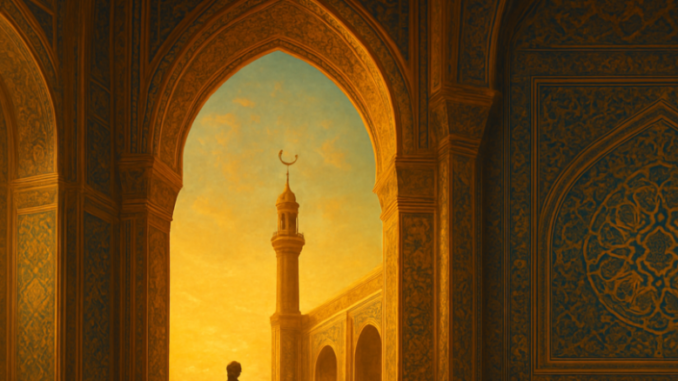
A covenant is more than an agreement. It is an invisible thread that binds people together precisely when circumstances threaten to tear them apart. In the thirty-third surah of the Quran, titled Al-Ahzab — The Allies — this theme unfolds against the backdrop of a historic siege. But beneath the narrative of armies and defense lies a deeper layer: the question of what truly holds us together when everything begins to shake. For those familiar with Freemasonry, the resonance is unmistakable — themes of brotherhood, trial, and the inner construction of character echo throughout.
The Trench as a Symbol of Protection
The central image in this surah is a defensive trench, dug around the city of Medina as an overwhelming coalition of adversaries drew near. On the surface, this is a matter of military strategy. But look deeper, and the trench becomes a universal symbol: a deliberate boundary between what we hold dear and the forces that threaten it. In Freemasonry, we find similar symbolism in the temple itself — a sheltered space where the profane does not enter, and where inner work can unfold in stillness.
The trench demands collective effort. No one digs it alone. This communal labor mirrors what brethren experience in the lodge: building something greater than yourself requires cooperation, trust, and the willingness to kneel side by side in the dust. Physical labor becomes a spiritual exercise in solidarity.
Trial as the Whetstone of Character
The Allies describes how the faithful come under intense pressure. The text speaks of fear that made hearts tremble, of doubt that caused some to waver. This is no heroic epic in which everyone stands fearless and unmoved. It is an honest account of human vulnerability in times of crisis — and it is precisely this honesty that makes the surah so valuable as a mirror for self-reflection.
Freemasonry does not regard trial as something to be avoided, but as a necessary condition for growth. Just as the rough stone only takes its form through the blows of hammer and chisel, so character is forged in moments of adversity. The question is not whether trials will come, but how we relate to them. Do we remain faithful to our inner covenants when the pressure mounts?
A covenant reveals its true worth not in quiet times, but in the hour when everything is at stake.
The Hypocrites and the Sincere
A striking element in this surah is the distinction it draws between those who are genuinely committed and those who belong to the community in name only. The text speaks of people who seek excuses to evade their duty — those who profess loyalty with their lips while their hearts have already departed. This theme of sincerity versus pretense touches on a core principle in Freemasonry: the difference between outward form and inner reality.
In the lodge, a brother is not judged by his social standing or eloquence, but by the quality of his inner striving. The question every Freemason asks himself reverberates here: Am I truly present in my commitments, or am I merely wearing the mask of involvement? The surah invites the same self-examination — not with condemnation, but with an invitation toward greater honesty.
The Light of Trust
Against the darkness of trial, the surah sets the light of trust. Those who stood firm did so not by their own strength alone, but through a deeper trust that carried them beyond visible circumstances. In the Islamic tradition, this trust is called tawakkul — surrender to a higher order while doing whatever is within one’s own power.
Freemasonry does not prescribe a dogmatic interpretation of this trust, but it does recognize the presence of a Grand Architect of the Universe. This concept allows room for personal understanding, yet points toward the same foundational feeling: that our labor is embedded in something greater, and that our striving gains meaning within a more encompassing whole. The light that stands at the center of the lodge symbolizes this trust — in knowledge, wisdom, and the ultimate meaningfulness of the human journey.
Brotherhood That Withstands the Storm
What remains after the siege is not the trench itself, but the community that was shaped by it. The Allies concludes with a renewed affirmation of the covenant — not as something taken for granted, but as a conscious choice made after endured trial. This is perhaps the most important lesson: a bond that has weathered the storm is more deeply rooted than one that was never tested.
In Freemasonry, this is experienced in the bond between brethren who have walked through rituals together, who have seen each other’s vulnerabilities and yet continue to stand side by side. It is not a theoretical brotherhood but a lived reality, forged in the heat of shared experience. The surah of The Allies reminds us that every authentic covenant needs this baptism by fire.
An Invitation to Contemplation
For anyone drawn to spiritual traditions, this surah offers rich material for reflection — not as a historical document about a battle, but as a symbolic exploration of universal themes. What are the trenches we dig to protect what is valuable? Which trials shape our character? And with whom do we truly stand shoulder to shoulder when it matters most?
The Allies speaks of covenant in the most literal sense: people building a defense together. But the surah reaches far beyond this concrete image. It invites reflection on the nature of our commitments, the value of trial, and the power of trust. For Freemasons, this is familiar territory. For every searching spirit, it is a wellspring of inspiration.
The trench was filled in long ago, but the questions it raised continue to dig into the hearts of those who listen. What binds us when the world trembles? What do we defend, and for whom do we labor? These are the questions that the thirty-third surah poses — and they are the very same questions that echo through the lodge, through every ritual, and through every moment a brother chooses to remain faithful to the covenant he has sworn.
Copyright text & image: devrijmetselaar.nl
Texts are based on the ideas and content of the author of devrijmetselaar.nl, reviewed, corrected, and supplemented with the assistance of OpenAI. Images are created based on the ideas of the author of devrijmetselaar.nl using OpenAI/DALL-E.


Be the first to comment