A fire flickers behind chained figures. Shadows dance across a stone wall. The prisoners see nothing but these flickering shapes and take them for reality. This image — perhaps the most famous philosophical parable in Western history — lies at the heart of Book VII of Plato’s Republic. But this story did not emerge from a vacuum. It carries the traces of centuries of Greek philosophy, mystical traditions, and one extraordinary teacher whose death would mark Plato forever.
The Shadow of Socrates
No figure casts a longer shadow over Plato’s thought than Socrates. The man who roamed the Athenian marketplace compelling his fellow citizens toward self-examination through relentless questioning becomes, in the Cave Allegory, the freed prisoner who returns to liberate the others. This is no coincidence. When Athens condemned Socrates to death in 399 BCE, Plato lost not only his teacher but also his illusions about the enlightenment of his own city-state.
The return of the freed man to the cave — where he is mocked and threatened by the very people he seeks to liberate — mirrors the fate of Socrates. Here we see how personal experience and philosophical abstraction flow together. The allegory is simultaneously a metaphysical argument and a working through of grief. Socrates’ daimonion, that inner voice that warned him whenever he was about to go astray, transforms in Plato’s hands into the light of the sun: the Idea of the Good that illuminates all other Ideas.
Pythagoras and Mathematics as a Ladder
Above the entrance to Plato’s Academy in Athens, tradition tells us, stood the inscription: “Let no one ignorant of geometry enter here.” This emphasis on mathematics as a prerequisite for philosophy stems directly from the school of Pythagoras. The Pythagoreans, active in southern Italy from the sixth century BCE onward, saw numbers not as abstract tools but as the fundamental structure of reality itself.
In the Cave Allegory, this influence returns in full force. The ascent from darkness proceeds through stages of knowledge: first the shadows, then reflections in water, next the things themselves, and finally the sun. This is not an arbitrary sequence but a hierarchy that runs parallel to the Pythagorean conviction that mathematical objects occupy a middle position between sensory phenomena and eternal truths. The circle you draw on paper is imperfect; the mathematical circle you conceive in your mind is more perfect; but the Idea of circularity transcends both.
The Cave Allegory shows us that true knowledge is not passively received but hard-won — a painful ascent from appearance to essence, from shadow to light.
Parmenides and the Eleatics: Being Versus Appearance
Half a century before Socrates, Parmenides of Elea formulated a radical thesis: change is an illusion. There is only Being — unchanging and eternal. The world of becoming and decay that our senses perceive is deception. This idea, however strange it may sound, forms the philosophical foundation beneath the walls of Plato’s cave.
The prisoners live in a world of constant change: shadows move, disappear, and return. They accept this flux as reality. But true reality, the allegory teaches, is unchanging. The Ideas of which the shadows are mere reflections know neither birth nor death. Parmenides’ distinction between the “Way of Truth” and the “Way of Seeming” echoes through Plato’s own distinction between knowledge and opinion, between the sunlit world outside and the twilight world within the cave.
Heraclitus and the Flame That Connects All Things
Yet Plato is no pure Eleatic. He also incorporates insights from Parmenides’ great opponent: Heraclitus of Ephesus, the philosopher of eternal becoming. “Everything flows,” runs his most famous declaration, and: “You cannot step into the same river twice.” The fire burning behind the prisoners in the cave is not just a light source. For Heraclitus, fire was the primordial element — the symbol of cosmic transformation.
Plato’s genius lies in reconciling these opposing visions. The sensory world is indeed in flux, as Heraclitus claimed. But behind that flux lie stable patterns — the Ideas — akin to Parmenides’ unchanging Being. The fire in the cave thus represents an intermediate realm: artificial illumination that creates movement and appearance but is not itself a source of truth. Only outside the cave, in sunlight, does one find the synthesis.
Mystery Cults and the Experience of Initiation
The Cave Allegory resonated not only with philosophical traditions but also with religious experiences that Plato’s contemporaries knew intimately. The Eleusinian Mysteries — secret initiation rites in honor of Demeter and Persephone — were undergone by thousands of Athenians. The initiates spent time in darkness before being exposed to an overwhelming vision of light.
The parallels are striking: the transition from darkness to light, the transformation of the initiate, the impossibility of fully conveying the experience to outsiders. Plato drew upon a shared cultural vocabulary of illumination and transformation. The freed prisoner who returns to the cave and can no longer see in the dark resembles the initiate who, after the Mysteries, returns to everyday life — forever changed but barely able to share what he has witnessed.
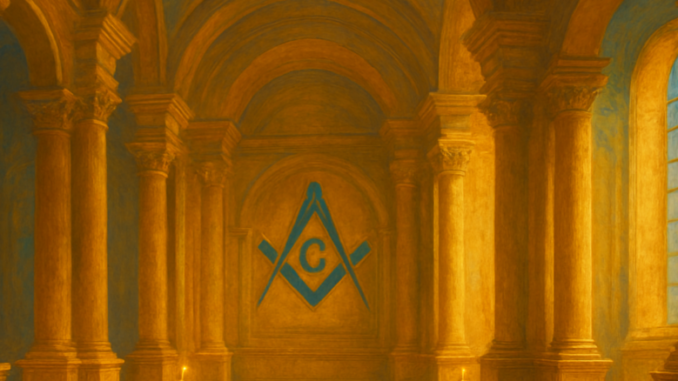
For those familiar with Masonic ritual, these themes will feel deeply familiar. The candidate’s journey from darkness to light, the gradual revelation of deeper truths, and the obligation to return to the world and serve others — all of these echo the structure of Plato’s ancient parable. The allegory reminds us that the symbolism of initiation did not begin in the eighteenth century; it reaches back to the very foundations of Western thought.
A Mirror for Later Ages
The philosophical richness of the Cave Allegory explains why it has proven so remarkably productive across the centuries. Neoplatonists such as Plotinus saw in the ascent a mystical union with the One. Christian thinkers like Augustine recognized the conversion from sin to grace. And in later symbolic traditions — including Freemasonry — the journey from darkness to light became a central motif of spiritual development.
This versatility is not a sign of vagueness but of depth. The allegory operates on multiple levels simultaneously: epistemological, ethical, spiritual, and political. Each age, each tradition, finds in it a reflection of its own deepest concerns. That is the mark of a truly great philosophical image — it does not merely describe reality but invites the reader to participate in the ascent.
Plato’s Cave Allegory endures because it speaks to something universal in the human experience: the longing to move beyond surface appearances toward deeper understanding. Its roots reach into Pythagorean mathematics, Eleatic metaphysics, Heraclitean flux, and the ancient mystery traditions of Greece. For Freemasons, the allegory holds a special resonance — it reminds us that the journey from darkness to light is not merely a ritual formula but a philosophical imperative as old as Western civilization itself. Every time a candidate takes that first step into the lodge, the echoes of Plato’s cave reverberate once more.
Copyright text & image: devrijmetselaar.nl
Texts are based on the ideas and content of the author of devrijmetselaar.nl, reviewed, corrected, and supplemented with the assistance of OpenAI. Images are created based on the ideas of the author of devrijmetselaar.nl using OpenAI/DALL-E.

Be the first to comment