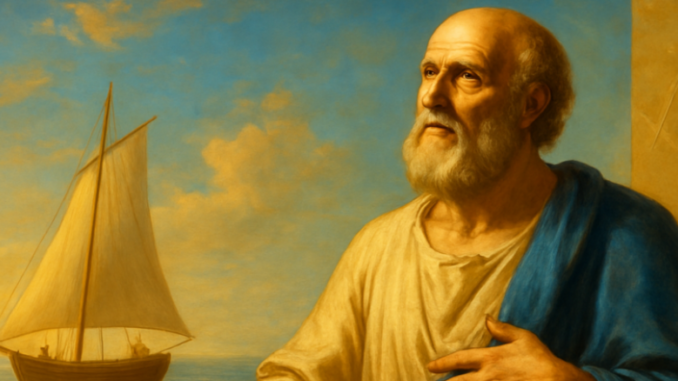
What exactly did Lucius Annaeus Seneca mean when he wrote that a god dwells within us? And why does that idea still resonate in the rituals and symbols of Freemasonry? To truly understand Letter XLI, we need to travel back to the philosophical sources from which Seneca drew his inspiration — an intellectual journey that reveals surprising connections between ancient Stoicism and the Craft.
Why Did Seneca Speak of an Inner Divinity?
This question takes us straight to the heart of Stoic philosophy. Seneca did not write in a vacuum. He stood in a tradition that began with Zeno of Citium, the founder of Stoicism, and was further developed by thinkers like Cleanthes and Chrysippus. For these philosophers, the universe was permeated by an ordering principle — the logos — a divine reason that connected all things. Human beings, they believed, carry a spark of this universal reason within them. Seneca called this the daimon or genius that resides in each of us.
This was no abstract idea. The Stoics believed that by cultivating this inner divinity, one could live in harmony with nature. When Seneca writes in Letter XLI that you need not raise your hands toward heaven to reach God, he means that the divine is already present in your own rational soul. You only need to recognize and nurture it.
Which Earlier Thinkers Influenced Seneca’s Vision?
Seneca drew from multiple sources. Plato had already written about the immortal soul and the divine element in humanity. In the dialogue Timaeus, Plato describes how the Demiurge — the divine craftsman — created the human soul from the same substance as the world soul. This idea of a cosmic kinship between humanity and the universe echoes powerfully in Seneca’s work.
Aristotle also contributed to this lineage of thought. His concept of nous — the highest part of the human soul that touches the divine — reverberates through Stoic psychology. Seneca knew these texts intimately and wove them into a practical philosophy of life. He was not an academic system-builder but a practical thinker who wanted to help his readers live well.
The divinity within us, in this view, is not a gift bestowed from the outside but an original quality of the human soul that we can make shine through the practice of virtue.
The Roman Context of Seneca’s Philosophy
Seneca lived in an era when philosophy and religion were deeply intertwined. The Roman elite was well-versed in Greek philosophical traditions and applied them to their own lives. At the same time, a rich tradition of household gods, ancestor veneration, and mystery cults flourished. Seneca navigated this world as an advisor to Emperor Nero — a position that forced him to translate abstract thinking into concrete ethical choices.
His letters to Lucilius were intended as spiritual guidance. Letter XLI belongs to a series in which Seneca encourages his friend to seek inner freedom, independent of external circumstances. The god within us is not a theological dogma but an ethical compass. By following this inner guide, a person can stand firm in difficult times and remain upright when the world around them falters.
What Does This Have to Do with Freemasonry?
This is where the conversation becomes particularly compelling. Freemasonry emerged in a very different time and place, yet it shares with Stoicism a core conviction: that human beings carry something precious within them, something that can be brought to full bloom through dedicated work on the self. Where Seneca speaks of nurturing the inner god, Freemasons speak of shaping the rough ashlar into a perfect cube.
The symbols of Freemasonry — the compasses, the square, the rough stone — all point to this process of inner refinement. The compasses drawing a circle around a center symbolize the restraint of the passions by reason. The square represents moral rectitude. These are not arbitrary images but visual translations of philosophical principles that reach back to the ancient world.
Is There a Direct Line from Seneca to the Lodge?
Not directly, but the influence is unmistakable. The Renaissance rediscovered Stoic texts and brought them back into the European intellectual tradition. Thinkers like Justus Lipsius and Michel de Montaigne repopularized Stoicism for a new age. Montaigne, whose essays are steeped in Seneca’s wisdom, helped create a cultural climate in which self-knowledge and moral autonomy became central values.
When speculative Freemasonry took shape in the seventeenth and eighteenth centuries, its founders drew from this humanistic tradition. James Anderson and John Theophilus Desaguliers — central figures in early English Freemasonry — were learned men who knew their classical philosophy. The emphasis on virtue, brotherhood, and personal development in Masonic rituals echoes Stoic ideals in ways that are difficult to dismiss as mere coincidence.
What Can We Learn from This Today?
Seneca’s Letter XLI is more than a historical document. It is an invitation to discover our own inner source of light. The Stoics believed this discovery did not necessarily require external rituals — but they acknowledged that rituals could help direct one’s attention inward. Freemasonry offers precisely such a framework: a structured practice that reminds the practitioner of the ongoing task of working on oneself.
The Stoic logos as an ordering principle finds a clear echo in the Masonic concept of the Grand Architect of the Universe. Seneca’s inner god corresponds to the light that the Freemason seeks in his journey through the degrees. And the emphasis on virtue and self-mastery binds both traditions together across the centuries.
A letter written two thousand years ago can still speak to anyone willing to listen. The philosophical background of Seneca’s words reveals a timeless wisdom about what it means to be human — and how we might call forth the best in ourselves. Letter XLI does not stand alone. It is a node in a vast web of philosophical thought that stretches from ancient Athens and Rome to the lodges of the modern world, reminding us that the work of self-improvement is as old as civilization itself, and as urgent as ever.
Copyright text & image: devrijmetselaar.nl
Texts are based on the ideas and content of the author of devrijmetselaar.nl, reviewed, corrected, and supplemented with the assistance of OpenAI. Images are created based on the ideas of the author of devrijmetselaar.nl using OpenAI/DALL-E.

Be the first to comment