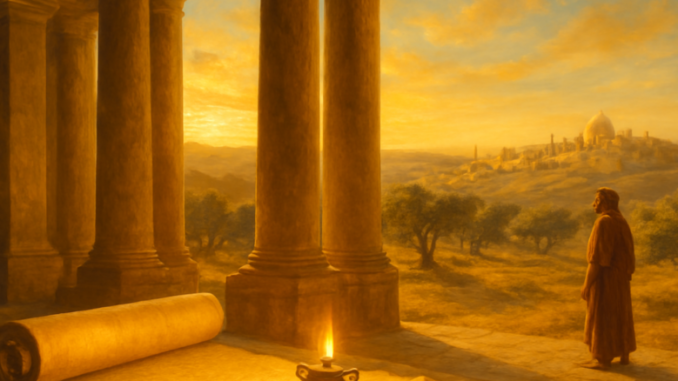
At just twenty-one verses, Obadiah is the shortest book in the Old Testament. Yet within that brevity lies a powerful message that has resonated across centuries. Where the casual reader might see an ancient text about a forgotten conflict, the searching mind discovers timeless wisdom about pride, downfall, and the path toward inner improvement. In this article, we place two perspectives side by side: the historical context of Obadiah and the symbolic meaning that Freemasons can recognize within it.
The Historical World of Obadiah
Obadiah directed his prophecy against Edom, a brother nation of Israel descended from Esau, the twin brother of Jacob. The text condemns Edom for its arrogance and for standing idly by while Jerusalem was plundered. The Edomites dwelled in rocky heights and believed themselves untouchable because of their geographic position. Their arrogance sprang from a false sense of security.
For its original audience, this was a text of comfort and justice. They saw a brother nation that had abandoned them when it mattered most. The prophecy promised that pride would ultimately lead to a fall — a theme that runs throughout all of biblical literature. The message was clear: whoever exalts himself above others will eventually be humbled.
The Symbolic World of the Freemason
From a Masonic perspective, attention shifts from the historical conflict to its inner meaning. The rock dwellings of Edom become a metaphor for a hardened spirit, one entrenched in complacency and self-satisfaction. The pride Obadiah speaks of is not merely the sin of a single nation — it is a universal pitfall for anyone who forgets that true wisdom walks hand in hand with humility.
In the ritual work of Freemasonry, the rough ashlar stands as a symbol of the unrefined self. The Mason’s task is to chisel, to smooth, to shape the stone into something that fits within a greater whole. Whoever exalts himself and believes he is already perfect stops doing this work. The lesson of Obadiah aligns seamlessly: the conviction that one is untouchable prevents any further growth.
Where Both Perspectives Meet
Although the historical reader and the Freemason approach Obadiah from different angles, they meet at the heart of its message. Both recognize that pride causes a hardening of the spirit; that true brotherhood demands solidarity in difficult times; that geographic or social position offers no guarantee of moral superiority; and that the fall of the proud is a natural consequence of self-exaltation.
The conflict between Jacob and Esau, which forms the backdrop of Obadiah, also mirrors the inner struggle every person knows. The choice between the higher self and baser impulses, between brotherly love and selfish detachment, plays out not only between nations but within every human soul.
“Though you soar as high as the eagle, though you set your nest among the stars, from there I will bring you down,” declares the Lord.
Brotherhood as a Mirror
Edom failed not only through pride but above all through a lack of brotherly conduct. When Jerusalem was attacked, the Edomites stood by and watched. They even rejoiced at the downfall of their kinsmen. This betrayal of brotherhood is, in the eyes of the prophet, perhaps the gravest sin of all.
For Freemasons, brotherhood is one of the pillars of the Craft. It is not a matter of superficial camaraderie but a deep awareness of connection with all who strive toward light and improvement. The lesson of Obadiah reminds us that brotherhood must be active. It is not enough to refrain from doing harm — one must also pursue the good when a brother is in need.
The Path of Humility
Where pride hardens the spirit, humility opens the door to wisdom. In Freemasonry, the candidate is reminded of his vulnerability and imperfection. This is not humiliation — it is an invitation to grow. The rough ashlar acknowledges that it needs to be worked upon. The perfect ashlar knows it has found its place within a greater edifice.
Obadiah speaks of a day of restoration, when Mount Zion will prevail. Read symbolically, this is the moment when the inner temple is completed — when a person has laid aside pride and aligned himself with a higher cosmic order. It is not a triumph of the ego but a return to harmony.
What We Can Learn
The historical reader and the Freemason approach Obadiah with different questions, but they leave with kindred insights. The first finds comfort in the promise of justice; the second finds a mirror for his own inner work. Both learn that pride is the enemy of growth, that brotherhood demands action, and that true elevation is only possible through humility.
In an age when superficiality and self-glorification often set the tone, this ancient, brief book offers a surprisingly relevant message. It reminds us that the true builder is not the one who raises himself above others, but the one who bends toward the stone that still needs to be shaped.
Obadiah may be the smallest book of the Old Testament, but its message carries great weight. Whether we look through the lens of an ancient historical conflict or through the symbolic language of Freemasonry, the essence remains the same: pride isolates, humility connects. In that simple truth lies the enduring power of this often-overlooked prophetic text — a reminder that true wisdom always comes with an awareness of our own limitations and our responsibility toward our fellow human beings.
Copyright text & image: devrijmetselaar.nl
Texts are based on the ideas and content of the author of devrijmetselaar.nl, reviewed, corrected, and supplemented with the assistance of OpenAI. Images are created based on the ideas of the author of devrijmetselaar.nl using OpenAI/DALL-E.
Frequently Asked Questions
What is the connection between the Book of Obadiah and Freemasonry?
While Obadiah is a historical biblical text about the downfall of Edom due to pride, Freemasons interpret it symbolically as a lesson about inner spiritual development. The rocky dwellings of Edom represent a hardened spirit, and the prophet's message about pride leading to downfall mirrors the Mason's journey of self-improvement and refinement, symbolized by shaping the rough ashlar into a perfect stone.
How does Freemasonry use the concept of pride from Obadiah in its teachings?
Freemasonry teaches that pride and self-satisfaction prevent personal growth and spiritual development. The lesson of Obadiah—that those who believe themselves untouchable and perfect stop improving—aligns with Masonic principles that encourage humility and continuous refinement of the self, ensuring that a Mason remains open to learning and growth throughout his journey.
What does the 'rough ashlar' symbol mean in relation to Obadiah's message?
The rough ashlar represents the unrefined self that must be chiseled and shaped through Masonic work and self-improvement. This directly reflects Obadiah's warning that pride prevents spiritual development; a Mason who becomes complacent or believes himself perfect stops doing the inner work necessary to shape his character and fit harmoniously within the greater brotherhood.
What does Freemasonry teach about brotherhood based on Obadiah's story?
Obadiah condemns Edom for failing to support Israel in its time of need, teaching that true brotherhood demands solidarity and mutual support during difficult times. Freemasonry upholds this principle, emphasizing that brotherly love transcends self-interest and that Masons have a sacred duty to support one another, reflecting the universal human struggle between selfish detachment and genuine community.

Be the first to comment