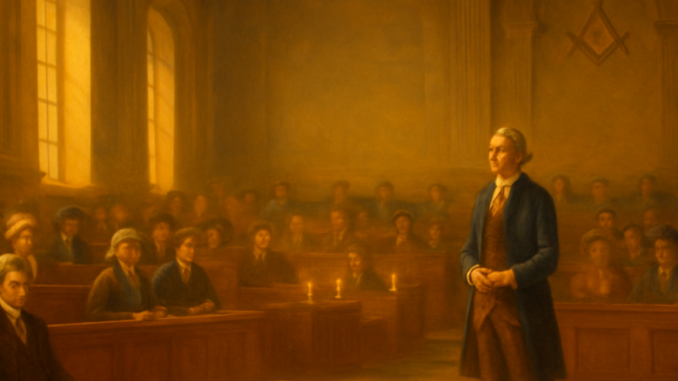
Who speaks for the voices in danger of being silenced? This question has resurfaced in political chambers across the Western world, but it is far older than any modern parliament. As early as the eighteenth century, thinkers grappled with the same dilemma: how do you ensure that dissenting voices aren’t drowned out by the noise of the majority? For Freemasons, this is not an abstract philosophical puzzle — it strikes at the very heart of what makes a lodge a true workshop.
Voltaire and the Right to Dissent
In 1763, Voltaire published his famous Treatise on Tolerance, in which he argued that a society that suppresses dissenting opinions ultimately weakens itself. Although Voltaire was not yet a Freemason when he wrote this work, he was later initiated into the Parisian lodge Les Neuf Sœurs. His ideas about tolerance and the protection of minority voices resonated deeply within the brotherhood. After all, the lodge had emerged as a sanctuary where men of different faiths and social backgrounds could meet as equals.
What Voltaire understood — and what the early lodges put into practice — was that a plurality of voices does not threaten unity. Rather, it is the very condition for genuine harmony. A choir that sings only one note is no choir at all. It is the tension between different voices that creates the music.
Anderson’s Constitutions: A Forgotten Principle
In 1723, James Anderson drafted the first constitutions of modern Freemasonry. One of its most revolutionary provisions was the prohibition of religious and political discussions within the lodge. This is often misunderstood as an attempt to avoid controversy. In truth, the opposite is the case. Anderson realized that the lodge could only function as a meeting place for people of differing views if no one was forced to defend or attack their deepest convictions.
This created a paradox that remains relevant to this day: by keeping certain subjects off the table, genuine dialogue became possible. Brothers who regarded each other as opponents in daily life could collaborate toward shared goals within the lodge. The question of who voices which opinion was replaced by a far more productive one: what can we build together?
The Ballot System as a Safeguard
One of the oldest ritual practices in Freemasonry is the ballot — the vote on new members using white and black balls. This system, which dates back to at least the seventeenth century, gives every brother a vote of equal weight. A single black ball can be enough to reject a candidate. It is a mechanism that protects the minority against the tyranny of the majority.
A healthy democracy is not measured by the strength of its majority, but by the space it offers to those who think differently.
This principle was not invented by Freemasonry, but it was consistently applied at a time when democracy itself was still a radical experiment. The early lodges functioned as laboratories for democratic practices that would eventually find their way into the broader fabric of society.
Montesquieu and the Separation of Voices
Charles de Montesquieu, whose The Spirit of the Laws (1748) laid the foundation for the separation of powers, was also a Freemason. His membership in a London lodge influenced his thinking about the distribution of power. Montesquieu recognized that the concentration of authority inevitably leads to the suppression of dissenting voices. His solution was not to eliminate power, but to divide it among different bodies that hold each other in balance.
When contemporary debates raise the question of who will give voice to certain perspectives, we are essentially echoing Montesquieu’s concerns. The relevant question is not whether opposing voices should exist, but how we guarantee they can be heard without themselves becoming oppressive.
The Workshop as a Model for Society
In Freemasonry, we speak of a workshop — not a meeting room or a clubhouse. That choice of words is significant. In a workshop, something is being built, and building requires different skills. The mason needs the stonecutter; the architect needs the builder. No single voice is expendable when something real must be constructed.
History teaches us that societies which silence minority voices ultimately impoverish themselves. The lodges of the eighteenth century flourished precisely because they made room for Catholics and Protestants, merchants and noblemen, conservatives and progressives alike. Their diversity was their strength.
A Lesson for Today
The question of who voices which opinion in public debate is ultimately the wrong question. The right one is this: do we have structures in place that ensure all voices can be heard? Voltaire would say we must defend the right to dissent, even when we disagree with its content. Montesquieu would point to the necessity of balanced power. Anderson would remind us of the value of a sanctuary where difference can exist without devolving into conflict.
For Freemasons, this is not a political stance — it is an ethical compass. The lodge has demonstrated for centuries that people with fundamentally different convictions can work together toward shared goals. Not in spite of their differences, but because of the understanding that every perspective contributes something to the whole.
History offers no ready-made answers, but it does reveal patterns worth learning from. What the early Freemasons understood — and what thinkers like Voltaire and Montesquieu articulated so powerfully — is that a plurality of voices requires active maintenance. It is not a natural state that sustains itself, but a structure that must be continually reinforced. The question is not who speaks for whom, but whether we are willing to make space for voices that challenge our own. Therein lies the true test of a mature society.
Copyright text & image: devrijmetselaar.nl
Texts are based on the ideas and content of the author of devrijmetselaar.nl, reviewed, corrected, and supplemented with the assistance of OpenAI. Images are created based on the ideas of the author of devrijmetselaar.nl using OpenAI/DALL-E.

Be the first to comment