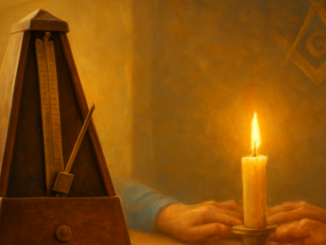
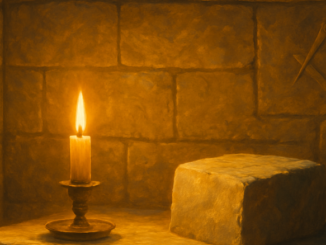
Candle burning in darkness symbolizing Masonic inner light and character
Personal Development & Leadership

Power Outage in Georgia: What Darkness Reveals About Character

Somewhere in a small town in Georgia, a man stands at his window. The streetlights have gone dark, the refrigerator has fallen silent, and even the distant hum of the highway has ceased. In the sudden stillness, he hears his own breathing, his own thoughts. The entire country is plunged into darkness by a massive power outage. And in that darkness, a question arises — one far older than electricity itself: who am I, really, when no one is watching? The Mask Falls in the Dark When the lights go out, masks fall with them. In everyday life, we constantly present curated versions of ourselves. We are the friendly colleague, the patient parent, the competent professional. But what happens when those spotlights are extinguished? The recent nationwide power outage in Georgia offers an unexpected laboratory for a question that Freemasons have explored for centuries: what lies at the core of our character? In Freemasonry, we speak of working the rough ashlar into a perfect cube. This is not a decorative metaphor — it is a lifelong assignment. The question it poses is not who we appear to be in the company of others, but who we truly are when we […]

Crested mangabey symbolizing the Masonic journey of departure and return
Personal Development & Leadership

What an Escaped Monkey Teaches Us About Personal Growth

For a full month, a crested mangabey roamed the Dutch countryside, far from his familiar enclosure at the Beekse Bergen safari park. Eventually, he was captured and returned to his group. This small news item from July 2026 raises a timeless question that lies at the very heart of Freemasonry: what happens to our personality when we break free from the familiar — and what changes when we return? The Primal Urge to Escape In the eighteenth century, when modern Freemasonry was establishing its first lodges, the understanding of human nature was deeply intertwined with ideas about freedom and constraint. Philosophers of that era wrestled with a fundamental question: is man by nature a social creature, or does he possess a deep-rooted longing to escape every structure that binds him? The English thinkers who laid the foundations of the lodge were well acquainted with their contemporaries’ writings on the social contract. They understood that brotherhood can only exist when individuals voluntarily choose to be part of something greater than themselves. The crested mangabey who spent a month wandering through the Brabant countryside acted on an impulse we all recognize. There is something in every living being that wants to cross […]

Rough ashlar stone on a builder's workbench symbolizing Masonic self-knowledge
Personal Development & Leadership

Departure as Self-Knowledge: What Breaking a Contract Reveals

In the seventeenth century, breaking an oath was considered one of the gravest transgressions a person could commit. Guild brothers swore loyalty to their craft, knights to their lord, and apprentices to their master. Today, we read about a footballer having his contract terminated and departing with immediate effect. Reactions range from understanding to outrage. But those who look deeper will recognize an ancient question lurking beneath the surface: what does a rupture reveal about the character of the one who breaks away? The Historical Weight of the Broken Word In the medieval guilds, a contract was far more than a business arrangement. It was a sacred promise, sealed through a ritual in which the apprentice placed his hand upon the tools of his trade or a holy object. Historians of the craft guilds describe how a departing member didn’t just lose his profession — he lost his name and reputation. The collective had invested in his formation, and a premature departure was seen as theft of that shared capital. Yet even those strict times recognized exceptions. When a journeyman discovered that his calling lay elsewhere, when a master proved unjust, or when circumstances changed fundamentally, there existed rituals of […]

Traffic jam on a highway with orange cones symbolizing patience and reflection
Personal Development & Leadership

Road Construction and Patience: What Traffic Jams Reveal

The summer of 2026 promises to be a season of orange cones, detour signs, and agonizingly slow miles. Countless highways are being torn up and rebuilt, and many a driver will feel their patience wearing thin as the minutes tick away in standstill traffic. But what if that delay is more than just lost time? What if the way we react to obstacles reveals the very thing we most prefer to keep hidden — our true character? Why Does Delay Frustrate Us So Deeply? Ask yourself honestly: what happens inside you when you’re stuck in traffic? Do you feel the tension creeping into your shoulders? Do you notice your thoughts beginning to spiral? Most people view a traffic jam as an external obstacle — something imposed on them by government decisions or unfortunate timing. But is that really the full story? Within Freemasonry, there is an ancient insight that every outward situation serves as a mirror of an inner state. The rough ashlar that the Entered Apprentice works upon is not merely a symbol. It represents everything within us that remains unrefined, unpolished, and impatient. When the highway transforms into a parking lot, that rough stone suddenly feels uncomfortably close. […]

Father and children symbolizing brotherhood and Masonic family values
Personal Development & Leadership

Fatherhood and Brotherhood: Lessons from an Eighth Child

A well-known celebrity recently announced the arrival of his eighth child, declaring himself ‘on cloud nine.’ The news slips past in the endless stream of celebrity updates and family announcements. But pause for a moment. Eight children. Eight unique souls bound together by blood. Doesn’t that raise a deeper question — what does it truly mean to be a brother or sister, and to build a community that extends beyond yourself? What Turns a Family Into a Brotherhood? Let’s start with a deceptively simple question: is a family automatically a brotherhood? On the surface, the answer seems obvious. Siblings share parents, a home, a last name. But if we’re honest with ourselves, we all know that blood ties alone don’t guarantee genuine connection. How many families do we know where members barely speak to one another, where old wounds have never healed? True brotherhood, as Freemasonry teaches us, is not born from the accident of birth. It is built — stone by stone, conversation by conversation, gesture by gesture. A father raising eight children faces the task of not merely educating individuals but forging a community. In a very real sense, he becomes the architect of a small Lodge within […]

Masonic square and compasses resting on architectural blueprints of a home
Personal Development & Leadership

Home and Character: What Your House Says About Your Inner Build

Housing prices may be cooling off, but for many people, owning a home remains a distant dream. Yet beyond the economics, there’s a far more compelling question worth asking: what does it actually mean to dwell somewhere? And what does the place you build or buy reveal — not just about who you are, but about who you are becoming? Why Do We Long for a Home of Our Own? On the surface, the desire to own a home looks like a purely financial matter — security, equity, the freedom to shape your own space. But if we’re honest with ourselves, something deeper is at work. A house is more than walls and a roof. It is an expression of identity, a physical manifestation of how we wish to be seen and how we experience ourselves. In the Masonic tradition, each person is likened to a rough ashlar — an unfinished stone that must be shaped and refined. This metaphor extends beyond inner development. It also raises the question: what are you building with that stone once it’s been worked? What structure rises from the labor of your life? The home you inhabit, whether rented or owned, reflects something of […]

Rough ashlar stone symbolizing personal growth in Freemasonry
Personal Development & Leadership

Bologna and the Wounded Soul: On Rage and Personality

When dozens of officers are injured during protests, when streets burn with collective outrage, an uncomfortable question arises: what happens to the human personality when a sense of justice tips over into destruction? The events in Bologna following a fatal arrest compel us not only to reflect on social tensions, but also on the fragile architecture of our own character. The Paradox of Righteous Anger Here lies a paradox that has fascinated philosophers throughout the ages: the person who rises up for justice can, in that very pursuit, become unjust. Those who protest against violence can themselves become violent. Those who cry out for humanity can lose their own humanity in the heat of the moment. This is not a judgment on protesters or authorities — it is an observation about the human condition itself. The ancient Greeks had a concept called thumos, roughly translated as “spiritedness” or “wrath.” Plato placed this element of the soul between reason and appetite — a force that could be both constructive and destructive. Thumos could drive someone to courageous deeds, but also to blind fury. The question was never whether this force existed, but how it could be mastered. Personality as Architecture In […]

Symbolic staircase representing the 33 degrees of Freemasonry and brotherhood
Personal Development & Leadership

The 33rd Degree: Where Brotherhood Becomes a Paradox

The 33rd degree fascinates and confounds in equal measure. How can a brotherhood that preaches equality simultaneously maintain a system of thirty-three ascending steps? It’s a question that occupies outsiders and initiates alike — and perhaps that is exactly the point. Because within this tension between hierarchy and equality lies a deeper insight into what human connection truly means. The Paradox of the 33rd Degree Explained Let’s begin with a provocative proposition: the highest degrees of Freemasonry exist not to elevate people, but to make them smaller. Not in the sense of humiliation, but in the original meaning of the word humilitas — derived from humus, the earth. The higher one climbs on the symbolic ladder, the sharper the awareness of one’s own limitations becomes. The thirty-third step is not a throne but a vantage point from which the horizon remains infinite. This may sound like a contradiction. We live in an age in which hierarchy has become suspect, in which every form of rank is automatically associated with power and oppression. Yet the structure of degrees within Masonic traditions operates in a fundamentally different way. It is not a ladder upward, but a spiral inward. Each degree reveals not […]

Medieval blacksmith forging iron symbolizing Masonic character building
Personal Development & Leadership

Working in the Heat: What Ancient Crafts Teach About Character

The summer of 2026 is shattering temperature records, yet something remarkable is happening on the work floor: heat waves are barely causing worker absenteeism. Where does this resilience come from? The answer reaches far beyond modern air conditioning — it stretches back to an ancient tradition of laboring under extreme conditions. The cathedral builders, the blacksmiths at their glowing forges, and the stonemasons under the scorching sun understood something we seem to have forgotten. Their secret was hidden in the deliberate formation of character. The Blacksmith and His Inner Fire In the Middle Ages, the smithy was one of the most brutally hot workplaces anyone could enter. Temperatures soared to unbearable heights while the craftsman spent hours forcing iron into shape. Yet blacksmiths rarely abandoned their duties. The reason was not merely physical toughness — it was something far deeper: the cultivation of an inner disposition that could withstand external hardship. The smith learned not only to master metal, but above all, to master himself. This tradition of inner formation found its way into the lodges of operative masons. Before an apprentice was allowed to begin complex stonecutting techniques, he first had to prove he could persevere. It was not […]

Rough stone being shaped into a perfect ashlar symbolizing Masonic character
Personal Development & Leadership

Strength vs Character: What Defense Debates Teach Us

You may have noticed the headlines: calls for more physical power, more hormone-driven toughness in the military. It’s the kind of rhetoric that makes you pause. Because what does such a call actually say about how we view human strength? And more importantly — what does it say about how you view your own character? The Exterior as the Measure When defense circles start treating physical strength as the ultimate measure of fitness for service, something fundamental is at play. It implies that the exterior — the measurable body — matters more than what lives within. Muscle mass becomes the standard. Hormone levels become the test. But is that really where strength comes from? You probably know this from your own experience. Those moments when you were physically exhausted but kept going. Not because your muscles carried you, but because something else held you upright. Willpower. Conviction. Or simply the refusal to let down someone who was counting on you. That is the kind of strength no laboratory can measure. Character as the Foundation In Freemasonry, there is an ancient piece of wisdom that speaks directly to this: you are not your body, you are not your title, you are […]

Racing cars on a circuit symbolizing Masonic brotherhood through adversity
Personal Development & Leadership

Falling and Rising: What Racing Teaches About True Brotherhood

Picture two drivers on the same circuit, facing the same conditions, carrying the same ambitions. One pulls a flawless line through the corners of the Ardennes; the other ends up in the barriers. It’s an image you might recognize from your own life — moments where you perform brilliantly while someone beside you stumbles, or the other way around. What do you do then? How do you handle that inequality of fortune? And what does your response reveal about the nature of true connection? The Circuit as a Mirror of Life A racetrack is more than asphalt and curves. It’s a concentrated version of existence itself — risk, choices, timing, and the eternal dance between control and surrender. During a training session in the Belgian Ardennes this week, two experienced drivers had entirely different experiences. One drove smoothly and with composure; the other lost grip and crashed. Neither could have predicted the outcome beforehand. You probably know that feeling. You’re in the same meeting as a colleague, following the same training, facing the same challenge. Yet things go differently for you than for the person beside you. Sometimes you’re the one who falls. Sometimes you’re the one who keeps going. […]

A moving train symbolizing the shared human journey and Masonic brotherhood
Personal Development & Leadership

When Connection Breaks: Lessons From a Train Incident

Picture this: you’re standing in a moving train, tensions rising, words turning into weapons, and before you know it, the unthinkable happens. A railway employee falls from the train during an altercation with a passenger. The news from Germany is shocking — but it also raises deeper questions. How can an everyday encounter spiral so far out of control? And what does it tell us about the fragile threads that bind us together as human beings? The Thin Line Between Order and Chaos You’ve probably experienced it yourself: standing in a crowded train, someone pushes, another grumbles, and you feel the atmosphere shift. Most of the time, it ends with an angry glance or a muttered remark. But sometimes — very rarely — it escalates. The incident involving a German railway worker who fell from a moving train during a dispute with a passenger shows just how quickly the thin line between order and chaos can vanish. It reminds us that every encounter, no matter how fleeting, carries the potential to heal or to wound. In Freemasonry, we often speak of building a better world, stone by stone. But what happens when those stones collide? What happens when the structure […]

Racing car speeding through a curve symbolizing Masonic character under pressure
Personal Development & Leadership

Speed and Character: Masonic Lessons from the Racetrack

There is something deeply paradoxical about speed. A driver tearing through the corners of Spa-Francorchamps at blistering pace seems to have no room for reflection. And yet, in that fraction of a second — the split-second decision to brake or commit — the entire personality of the driver is laid bare. A top result in free practice is a sporting achievement, certainly. But what does speed actually reveal about character? And what might a Freemason learn from someone who repeatedly puts himself to the ultimate test? Personality Reveals Itself Under Pressure Let us begin with a provocative thought: perhaps personality is not what someone claims to be, but what someone does when the pressure is at its peak. A racing car cutting through the Ardennes forest at three hundred kilometers per hour offers no time for masks. There is no room for façade. The driver, in that moment, is entirely himself — fear, courage, calculation, instinct. Everything that makes a person who they are concentrates itself into an action lasting mere seconds. This raises a compelling question: is personality a verb rather than a noun? Not a fixed quality, but something that continuously reshapes itself in confrontation with the world? […]

Broken golden chain symbolizing Freemasonry brotherhood and ethical labor
Personal Development & Leadership

The Broken Chain: Luxury, Labor, and True Brotherhood

A golden chain around the neck. A handbag of supple leather. A timepiece built to last generations. These objects radiate craftsmanship, tradition, and a connection to the artisan who created them. But what if that chain doesn’t only link gold — what if it also conceals a shadow chain of exploitation? Recent police raids on renowned Italian fashion houses force us to confront a fundamental question: what does true connection actually mean? The Jewel and Its Shadow Every piece of jewelry tells two stories. The first is visible: the sparkle, the design, the status it projects. The second story lies hidden in the journey the object took before it reached the display window. In workshops — sometimes far removed from the gleaming boutiques — hands bend over workbenches. Those hands have names, faces, families. The question raised by the Italian investigations is simple yet deeply unsettling: are those hands treated as brothers, or as tools? In Freemasonry, the chain is a powerful symbol. Brothers stand in a circle, hands clasped together, as a sign of unbreakable unity. That chain is not a hierarchy, not a production line. It is a horizontal bond of equality. Every link carries equal weight. When […]

A man stepping from a dark doorway into sunlight symbolizing freedom
Personal Development & Leadership

The Way Out of Darkness: Brotherhood Without a Blood Oath

In a dimly lit room somewhere in southern Italy, a middle-aged man sits across from his lawyer. His hands tremble slightly as he signs the documents that will formally sever his ties to the organization he was born into. For the first time in his life, he gets to choose which brotherhood he belongs to. This scene — now increasingly possible thanks to new Italian legislation — touches on a question that Freemasons have grappled with for centuries: what makes a true brotherhood? A Law That Liberates The Italian government has recently passed legislation offering members of mafia families a formal pathway out of organized crime. The law provides protection, guidance, and a route toward building a new life. It represents an acknowledgment of something long considered unspeakable: that people born into criminal networks are not necessarily bound to that legacy forever. The blood oath, the code of silence, the family loyalty that was considered unbreakable for generations — it turns out these chains can be cut after all. To outsiders, this might sound obvious. But anyone familiar with the structure of these organizations knows how deep the bonds run. Members are not recruited — they are born into a […]

Freemasons in lodge discussing different perspectives in brotherhood
Personal Development & Leadership

Two Opinions, One Goal: Psychology and Brotherhood

In 1958, a sports psychologist advised the Brazilian national football coach to leave two young players at home before the World Cup. Those players would go on to become legends. The advice was ignored, Brazil won the tournament, and the psychologist faded into the shadows of history. Yet hidden within this story lies a deeper truth about brotherhood, trust, and the courage to offer a dissenting opinion — even when the world seems to prove you wrong. The Outsider’s Perspective Imagine you are a scientist — a pioneer in the field of sports psychology at a time when the discipline is barely taken seriously. You are tasked with evaluating the mental readiness of a group of footballers. After careful analysis, you arrive at a conclusion that runs directly counter to what everyone wants to hear. Two young players, however talented, show signs of emotional instability that, according to your tests, make them unfit for the pressure of a World Cup. You know your recommendation will be unpopular. You know your reputation is on the line. And yet you speak what you believe to be true. This is the outsider’s perspective: someone who is not part of the group, who has […]

Two rivals shaking hands symbolizing Masonic brotherhood and mutual respect
Personal Development & Leadership

Fear of the Rival: What Opponents Teach Us About Brotherhood

A national team coach openly admits he hopes his greatest rival catches a cold before a crucial match. It sounds like a moment of weakness, but in truth it reveals something far deeper: the recognition of greatness in another person. This candid sporting confession raises an ancient question that has occupied humanity for centuries. How do we relate to those who surpass us? And what does history teach us about the art of acknowledging excellence without diminishing ourselves? Chivalric Recognition in the Middle Ages In the twelfth century, a remarkable tradition emerged at the courts of Europe. Knights who were about to face each other in tournaments would often speak words of praise about their opponent before the fight began. This was no empty courtesy — it was an essential part of the code of chivalry. The belief was simple yet profound: only a worthy enemy could make a worthy victory possible. A knight who belittled his opponent also diminished the value of his own potential triumph. This attitude appears throughout medieval chronicles. Opponents were described with respect, their skills celebrated, their courage acknowledged. It was an era in which honor mattered more than merely winning. The paradox was clear: […]

Firefighter helmet and Masonic square and compasses symbolizing brotherhood
Personal Development & Leadership

Arsonist in Uniform: When Brotherhood Fails

The siren wails through the night. A firefighter pulls on his jacket, jumps on the engine, and races toward a blaze he himself has set. Six arrests later — including one of their own — France is left in shock. This isn’t just a story about fire. It’s a story about trust going up in smoke, and about the urgent question of how we protect brotherhood when someone undermines it from within. The Shock of Betrayal From Within When we learn that someone who swore an oath to protect has become the very source of destruction, it shakes our faith in institutions to the core. For most people, the fire service is a symbol of unconditional service. These are the men and women who run into burning buildings while everyone else runs out. They form a tightly knit community — a brotherhood in every sense of the word. And yet, one of them betrayed the trust of colleagues and citizens in the most fundamental way imaginable. Events like these don’t just affect the people directly involved. They sow doubt in every community built on mutual loyalty. How can any group function when the bonds of trust can no longer be […]

Masonic lodge interior symbolizing tension and brotherhood among brothers
Personal Development & Leadership

Division in the Lodge: A Philosophy of Brotherhood

What if brotherhood is not a state of harmony but a state of sustained discomfort? What if the true test of connection lies not in the moments when everything runs smoothly, but precisely in the moments when tension becomes so palpable that walking away seems more attractive than staying? If that is the case, then everything we think we know about standing together in a lodge changes. The lodge is no longer a sanctuary — it becomes a crucible. And the division a brother feels with his lodge is not proof of failure, but perhaps the very beginning of genuine insight. The Paradox of Commitment There is a peculiar law that governs human communities: the more someone cares about a group, the more keenly they experience its shortcomings. Indifference, after all, knows no disappointment. Those who expect nothing are never hurt. But those who make themselves vulnerable, who invest time and energy in a collective ideal — they feel it when that ideal crumbles under the weight of habit, complacency, or misunderstanding. This is not weakness. It is the inevitable byproduct of sincere commitment. In Freemasonry, this paradox takes on a distinctive form. The lodge presents itself as a workshop […]

Rough ashlar stone symbolising character building in Freemasonry
Personal Development & Leadership

Trust and Character: What a Lawsuit Teaches Us

You may have seen it in the news: a major technology company is taking former employees to court for allegedly stealing trade secrets and handing them to a competitor. On the surface, it sounds like a corporate dispute with little relevance to everyday life. But look a little closer, and this story touches on something universal — the question of who you are when no one is watching, the weight of your word, and the building blocks of your character. When Trust Is Broken Imagine spending years working on complex projects, gaining access to your employer’s most sensitive information, and then one day deciding to move on. What do you take with you? Your experience, your skills, your memories — certainly. But where is the line between what belongs to you and what was entrusted to you? That question now sits at the heart of a lawsuit captivating the technology world. The case is not merely about the legal definitions of intellectual property. It is about the invisible agreements we make when someone places their trust in us. It is about whether our word still means something after we close a door behind us. The Rough Ashlar as a Mirror […]